


Verified IdentityIQ-Engineer Q&As - Pass Guarantee IdentityIQ-Engineer Exam Dumps
Check the Free demo of our IdentityIQ-Engineer Exam Dumps with 124 Questions
SailPoint IdentityIQ-Engineer Exam Syllabus Topics:
| Topic | Details |
|---|---|
| Topic 1 |
|
| Topic 2 |
|
| Topic 3 |
|
NEW QUESTION # 22
Can the search type in Syslog be used to accomplish this result?
Solution: Identifying details of a system error presented in the Ul
- A. No
- B. Yes
Answer: B
Explanation:
Syslog can be used to identify the details of a system error presented in the UI. When a system error occurs, IdentityIQ typically logs detailed error messages, stack traces, and other relevant information to Syslog or other logging frameworks configured in the environment. By reviewing these logs, an administrator or engineer can identify and diagnose the specific error that was encountered in the UI.
Reference:
SailPoint IdentityIQ Logging and Monitoring Guide
SailPoint IdentityIQ Administration Guide (Sections on Error Handling and Troubleshooting)
NEW QUESTION # 23
Can this be achieved using Rapid Setup user interface configuration options?
Solution: Disable an account on a particular application for one set of users and delete the account for another set of users during administrative Terminations.
- A. No
- B. Yes
Answer: A
Explanation:
The Rapid Setup user interface in SailPoint IdentityIQ is designed to simplify and streamline common configuration tasks, particularly during the initial setup of IdentityIQ environments. However, it has certain limitations in terms of granularity and customization.
In this case, the requirement is to disable an account on a particular application for one set of users and delete the account for another set of users during administrative terminations. The Rapid Setup interface does not provide options to differentiate between user groups for different actions (disable vs. delete) within the same termination event.
This level of specificity-applying different actions based on user group membership-would require a more advanced setup, possibly involving custom rules or workflows rather than using the Rapid Setup options. Therefore, the correct answer is B. No.
Reference:
This answer is based on the SailPoint IdentityIQ Rapid Setup Guide, which describes the capabilities and limitations of the Rapid Setup interface. The guide indicates that more complex scenarios require customization beyond what Rapid Setup can offer.
NEW QUESTION # 24
Can this action be performed as part of configuring an application definition in IdentitylQ?
Solution: Specify which users should be provisioned with a basic account as part of a joiner event.
- A. No
- B. Yes
Answer: B
Explanation:
Yes, this action can be performed as part of configuring an application definition in IdentityIQ. When defining an application, you can specify provisioning policies, including which users should be provisioned with a basic account as part of a joiner event. This is typically done by setting up account creation rules or provisioning policies that trigger when a new user (joiner) is detected, ensuring they receive the necessary basic accounts and entitlements.
Therefore, the correct answer is A. Yes.
NEW QUESTION # 25
IdentitylQ has been installed and set up with the contents of IdentityExtended.hbm.xml as follows: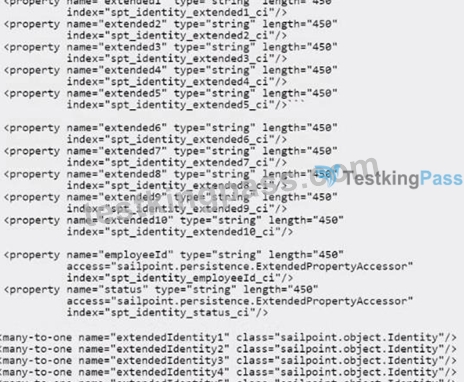
Is this a correct statement about the installation?
Solution: There is a limitation in this installation: When defining the identity mappings using Global Settings > Identity Attributes, only 12 additional searchable attributes can be defined. Additional identity attributes and mappings can be defined, but they cannot be searchable.
- A. No
- B. Yes
Answer: B
Explanation:
In SailPoint IdentityIQ, the configuration in IdentityExtended.hbm.xml file as shown in the image indeed outlines the use of extended identity attributes. These attributes (extended1, extended2, etc.) are custom attributes that are appended to the standard identity object model to store additional identity-related data.
According to the official SailPoint IdentityIQ documentation, when defining identity mappings under Global Settings > Identity Attributes, only up to 12 additional attributes can be made searchable within the IdentityIQ system. This limitation is crucial because it directly impacts the efficiency of search operations in large environments, where making too many attributes searchable can significantly slow down performance.
Once you define these 12 searchable attributes, any additional attributes can still be added, but they will not be indexed for search operations. This means that while the data in these attributes can be used in workflows, reports, and other operations, they cannot be used in search filters in the IdentityIQ user interface.
This limitation is particularly important when planning the design of the identity schema, as it affects both performance and usability. Therefore, the statement in question is correct and accurately reflects the constraints imposed by SailPoint IdentityIQ in terms of searchable identity attributes.
Reference:
This explanation is derived from the SailPoint IdentityIQ Configuration Guide and official documentation on identity attributes and their limitations. Specifically, this is covered in sections related to extended attributes and searchable properties within the system.
NEW QUESTION # 26
Can the following action be performed using Rapid Setup application onboarding?
Solution: Specify the account attribute and value filter that identifies a secondary account.
- A. No
- B. Yes
Answer: A
Explanation:
Rapid Setup application onboarding is designed to simplify the initial configuration and does not typically provide advanced configuration options like specifying an account attribute and value filter to identify secondary accounts. Such detailed configurations often require custom scripting or detailed adjustments within the standard application setup, outside of the Rapid Setup interface.
Reference:
SailPoint IdentityIQ Rapid Setup Guide
SailPoint IdentityIQ Administration Guide (Sections on Application Onboarding and Advanced Account Mapping)
NEW QUESTION # 27
Assuming that the policy violation owner has the necessary permissions, is this a valid option for the policy violation owner to use when acting on a policy violation of type 'Role SOD Policy?
Solution: Schedule Policy Composition Certification
- A. No
- B. Yes
Answer: A
Explanation:
In SailPoint IdentityIQ, when dealing with a policy violation of the type "Role Separation of Duties (SOD) Policy," there are specific actions that the policy violation owner can take. These options typically include:
Mitigate: Applying a mitigating control to the violation.
Remediate: Addressing the violation by removing or altering access.
Accept: Acknowledging the violation without making changes, which usually requires justification.
Forward: Assigning the violation to another individual or group for resolution.
The option "Schedule Policy Composition Certification" is not a valid action for addressing a Role SOD Policy violation directly. The concept of scheduling a certification is related to periodic review processes, not immediate policy violation handling. Certification campaigns are scheduled and executed to review roles, entitlements, or policies, but this is not an action taken in response to a specific policy violation.
Thus, "Schedule Policy Composition Certification" is not an appropriate or valid option in this context, and the correct answer is B. No.
Reference:
This explanation is corroborated by the SailPoint IdentityIQ Compliance Manager documentation, which outlines the various actions available to policy violation owners when responding to policy violations, including Role SOD policies. The documentation specifies the actions that can be taken, and scheduling a certification is not listed among them in this context.
NEW QUESTION # 28
Can an Escalation Rule be used to handle this scenario?
Solution: Automatically reassign parts of an access review to a different certifier.
- A. No
- B. Yes
Answer: B
Explanation:
Yes, an Escalation Rule can be used to handle the scenario of automatically reassigning parts of an access review to a different certifier. In SailPoint IdentityIQ, Escalation Rules are often employed within certification campaigns to manage situations where a primary certifier has not completed their review within a specified timeframe. The rule can trigger actions such as reassigning the review items to a different certifier, thus ensuring that the certification process continues smoothly without delays.
Therefore, the correct answer is A. Yes.
NEW QUESTION # 29
An engineer needs to first create a custom audit event and then set up an associated report. What are four steps to accomplish this goal?
Solution: Create a Data Export task.
- A. No
- B. Yes
Answer: A
Explanation:
Creating a custom audit event and setting up an associated report involves steps such as defining the audit event, modifying the audit configuration, and creating a custom report using the SailPoint IdentityIQ reporting framework. Simply creating a Data Export task does not fulfill these requirements. A Data Export task is used for exporting data from IdentityIQ and is unrelated to the creation of custom audit events or custom reports. Refer to the SailPoint IdentityIQ Reporting Guide and the IdentityIQ Audit Framework documentation for more information on correctly creating and configuring custom audit events and reports.
NEW QUESTION # 30
Which four steps are necessary for turning on Certifications logging at the severity log level of trace? Drag four options from the left into the answer area on the right, and place them in the correct order.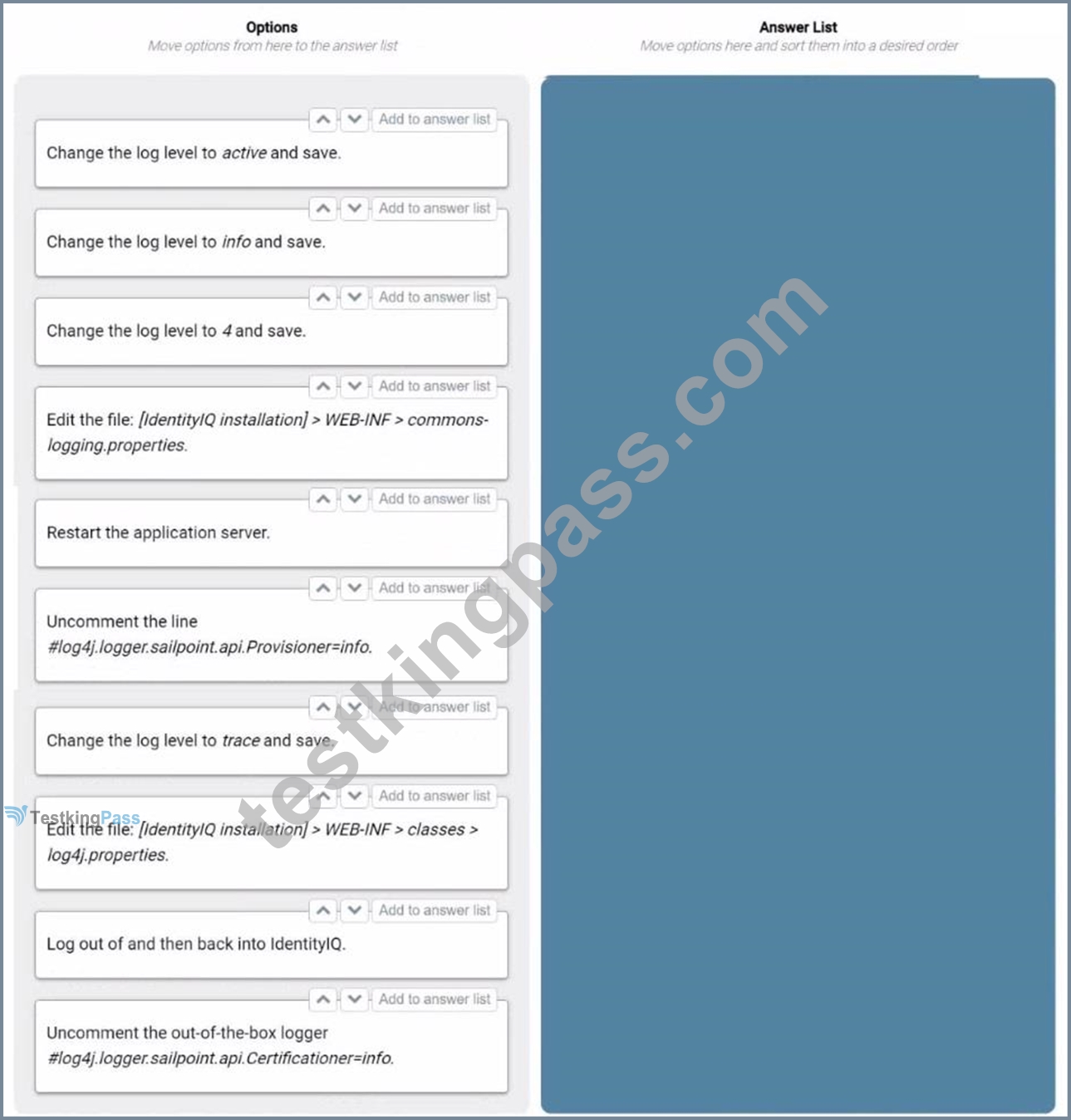
Answer:
Explanation: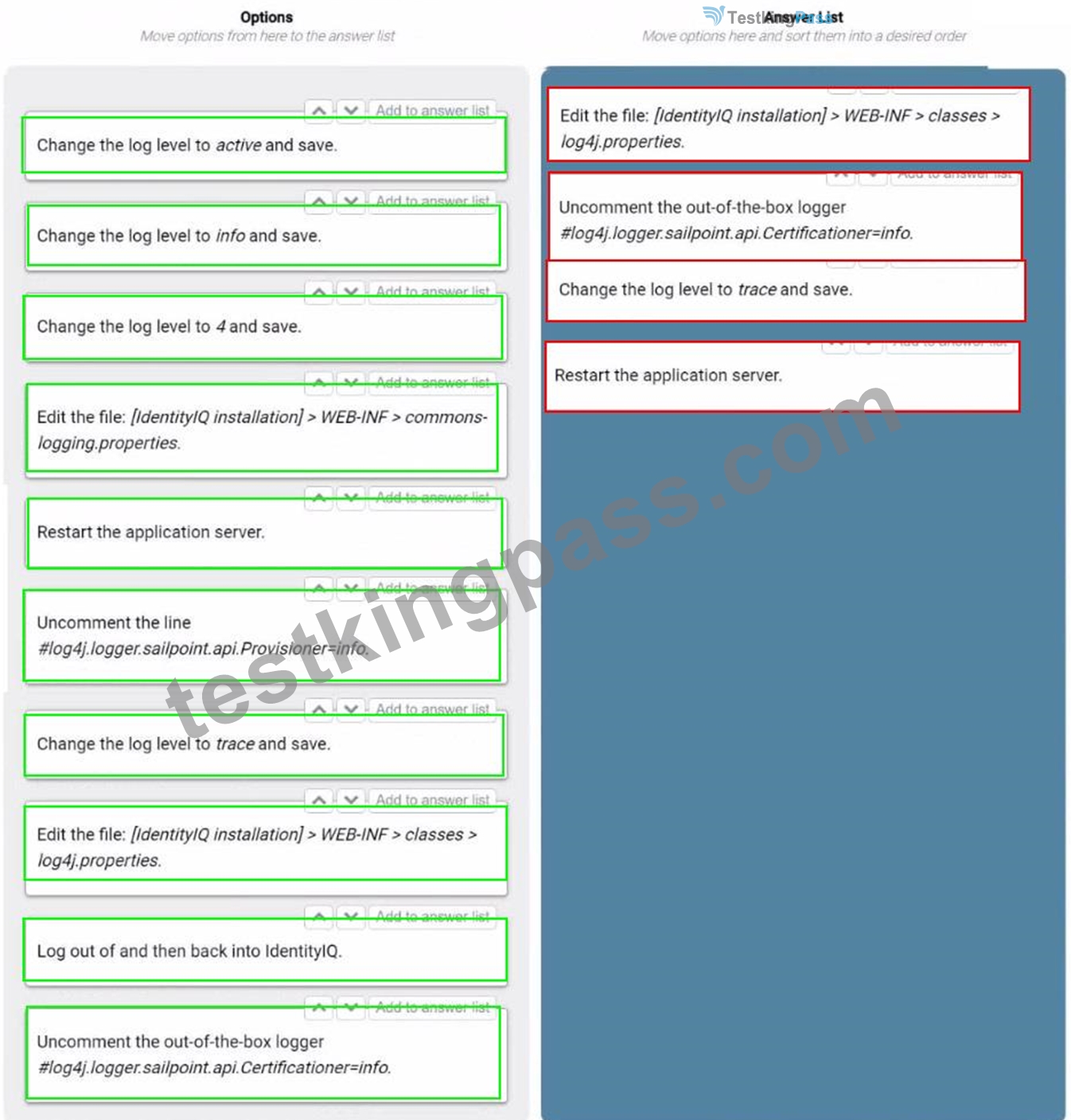
NEW QUESTION # 31
IdentitylQ is using emails to notify users about completion of steps within a process, or actions that need to be addressed.
To ensure this notification is working, a main configuration must be set up in IdentitylQ to provide mail server and mail server authentication details.
Is this a required setting that an engineer must set up in IdentitylQ in order to ensure successful communication with the SMTP server?
Solution: Email Protocol
- A. No
- B. Yes
Answer: A
Explanation:
No, the "Email Protocol" is not a setting that an engineer must set up to ensure successful communication with the SMTP server. Instead, the essential settings include the mail server address, port, authentication details (like username and password if required), and possibly the security settings (such as SSL/TLS). While the email protocol (e.g., SMTP) is implicitly involved, it is not a specific setting that needs to be configured separately within IdentityIQ. The critical setup revolves around configuring the mail server connection parameters.
Reference:
SailPoint IdentityIQ Configuration Guide (Email and Notification Settings) SailPoint IdentityIQ Administration Guide (SMTP Configuration for Email Notifications)
NEW QUESTION # 32
Is the following statement about workflows and sub-workflows (subprocesses) true?
Solution: Sub-workflows can be nested up to 3 levels only.
- A. No
- B. Yes
Answer: A
Explanation:
The statement is false. In SailPoint IdentityIQ, there is no strict limitation on nesting sub-workflows (subprocesses) up to 3 levels. You can nest sub-workflows as deeply as required by your business logic and system design. However, it is advisable to manage the complexity of nested workflows to ensure maintainability and performance, but there is no enforced limit of 3 levels for nesting.
Reference:
SailPoint IdentityIQ Workflow Guide
SailPoint IdentityIQ Administration Guide (Sections on Workflow Design Best Practices)
NEW QUESTION # 33
Can the Provisioning tab under "Administrator Console' be used to do the following task?
Solution: Manually retry the provisioning attempt for pending transactions.
- A. No
- B. Yes
Answer: B
Explanation:
Yes, the Provisioning tab under the "Administrator Console" can be used to manually retry provisioning attempts for pending transactions. This feature allows administrators to retry failed provisioning operations or manually trigger provisioning actions that are in a pending state, providing greater control over the provisioning process.
Reference:
SailPoint IdentityIQ Administration Guide (Provisioning Management and Manual Retry) SailPoint IdentityIQ Provisioning Guide
NEW QUESTION # 34
Can this action be performed as part of configuring an application definition in IdentitylQ?
Solution: Define account correlation via a rule.
- A. No
- B. Yes
Answer: B
Explanation:
Yes, defining account correlation via a rule is an action that can be performed as part of configuring an application definition in SailPoint IdentityIQ. Account correlation rules are often used to determine how accounts from different sources are linked to identities within IdentityIQ. These rules allow for complex logic to be applied when matching accounts to identities, beyond simple attribute matching.
Reference:
SailPoint IdentityIQ Administration Guide (Section on Account Correlation) SailPoint IdentityIQ Application Configuration Guide (Using Rules for Account Correlation)
NEW QUESTION # 35
Is this statement correct about writing and executing source mapping rules to populate identity attributes?
Solution: The rule type must be IdentityAttribute.
- A. No
- B. Yes
Answer: B
Explanation:
The statement "The rule type must be IdentityAttribute" is correct. In SailPoint IdentityIQ, when writing a rule that is intended to map or manipulate identity attributes during the aggregation process, the rule type should be set to "IdentityAttribute". This ensures that the rule is recognized and executed in the appropriate context for managing identity attributes.
Therefore, the correct answer is A. Yes.
NEW QUESTION # 36
Is this a correct procedure for testing generated emails in a non-production system?
Solution: Change the Email Notification Type to Redirect to file using FTP protocol under Global Settings > Configure IdentitylQ Settings > Mail Settings, run the test scenario, and verify that the email text saved to the redirected file.
- A. No
- B. Yes
Answer: A
Explanation:
The proposed solution suggests changing the Email Notification Type to "Redirect to file using FTP protocol" under Global Settings > Configure IdentityIQ Settings > Mail Settings. However, IdentityIQ does not provide an option to redirect emails to a file using the FTP protocol directly through the Global Settings in the application.
Typically, to test generated emails in a non-production environment, you would change the Email Notification Type to "Redirect to File" (if the option is available) or configure an SMTP server with a different setup that captures emails in a file or a specific mailbox designed for testing purposes. The specific steps for testing email generation may vary, but the solution as stated does not align with standard IdentityIQ practices.
Thus, the correct answer is B. No.
NEW QUESTION # 37
Is this a purpose of an IdentitylQ certification?
Solution: to attest lo a user's system access
- A. No
- B. Yes
Answer: B
Explanation:
Yes, this is indeed one of the primary purposes of an IdentityIQ certification. Certifications are conducted to attest to a user's system access, ensuring that each user has appropriate and justified access rights to applications, data, and systems within the organization. This is central to IdentityIQ's access governance and compliance processes.
Reference:
SailPoint IdentityIQ Certification Guide
SailPoint IdentityIQ Governance Overview
NEW QUESTION # 38
Is this statement correct about writing and executing source mapping rules to populate identity attributes?
Solution: The Identity object is passed to the rule.
- A. No
- B. Yes
Answer: B
Explanation:
The statement "The Identity object is passed to the rule" is correct. When writing source mapping rules to populate identity attributes, the Identity object is indeed passed to the rule. This allows the rule to access and modify attributes on the Identity object based on the logic defined within the rule.
Therefore, the correct answer is A. Yes.
NEW QUESTION # 39
Can the search type in Syslog be used to accomplish this result?
Solution: Launching a certification using the search results
- A. No
- B. Yes
Answer: B
Explanation:
Syslog cannot be used to launch a certification using the search results. Launching a certification in IdentityIQ is a process that involves interacting with the application's certification module, where you define parameters, select users or roles, and initiate the certification campaign. This process requires using the IdentityIQ user interface or APIs, not the Syslog, which is purely for logging purposes.
Reference:
SailPoint IdentityIQ Certification Guide
SailPoint IdentityIQ API and UI Guide
NEW QUESTION # 40
Select the best policy type for defining each access policy. Use the drop-down menus to select your answers.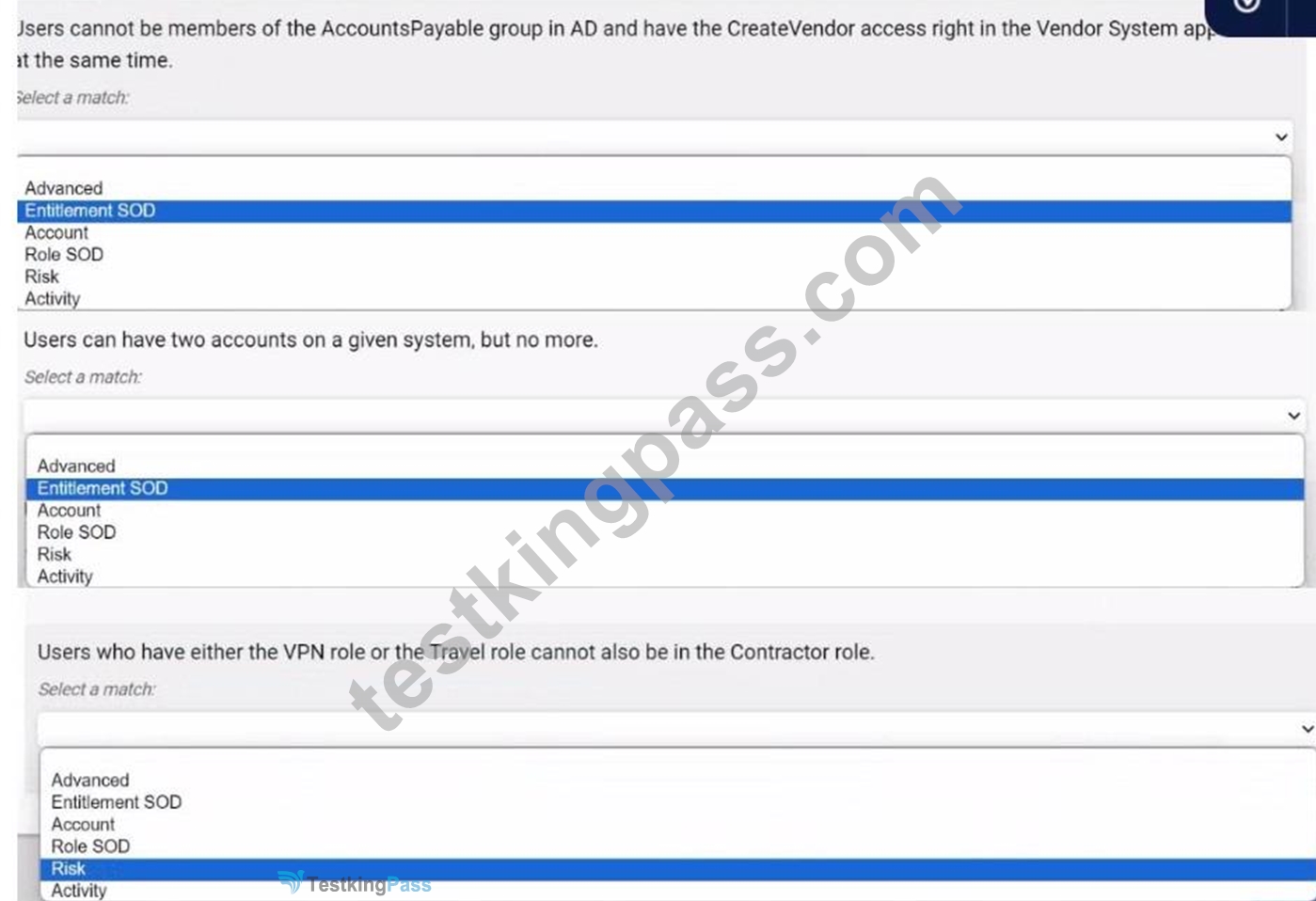
Answer:
Explanation: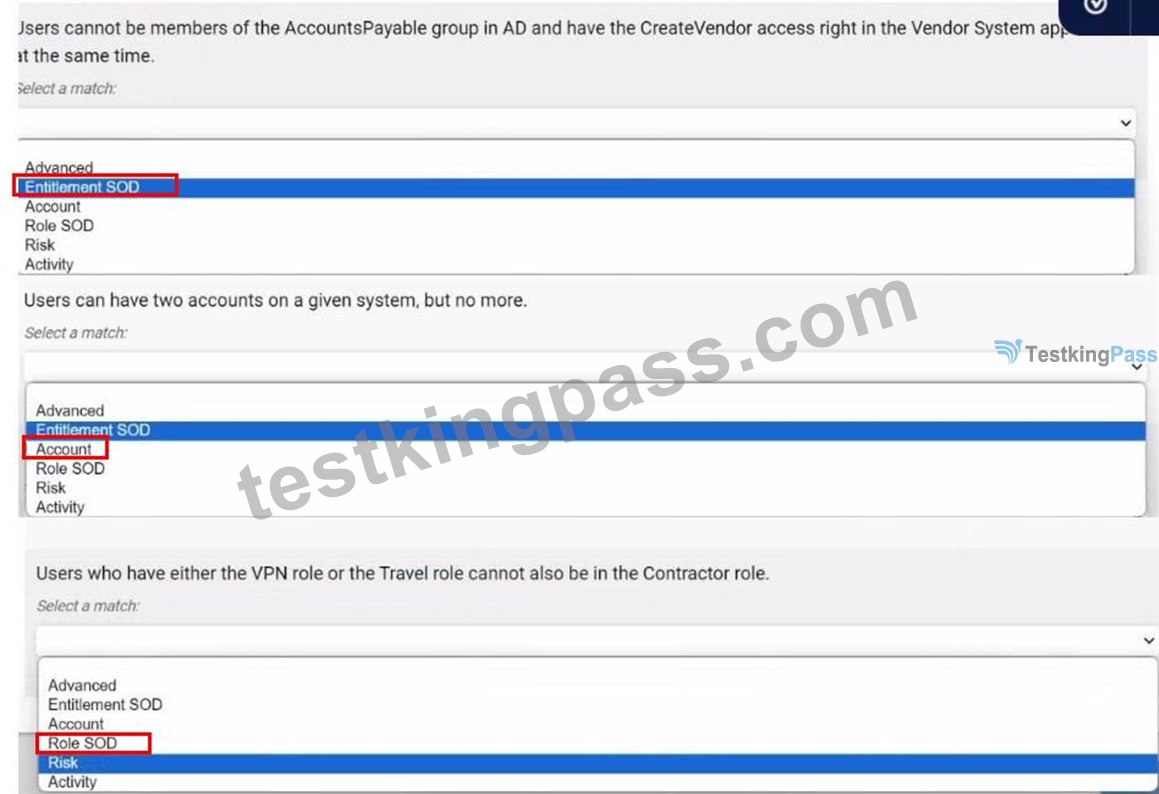
NEW QUESTION # 41
An engineer needs to first create a custom audit event and then set up an associated report. What are four steps to accomplish this goal?
Solution:
- A. No
- B. Yes
Answer: A
Explanation:
The solution provided is incomplete. To create a custom audit event and set up an associated report, the process involves several steps, including defining the custom audit event in the Audit Configuration object, updating or creating relevant audit triggers in the system, and defining the custom report using XML or the IdentityIQ report editor. The steps mentioned in the solution do not cover the necessary configuration and implementation details required for this task. For a complete process, consult the SailPoint IdentityIQ Reporting Guide and the Audit Framework documentation.
NEW QUESTION # 42
Is this statement true about identitylQ's syslog event storage?
Solution: To improve security, items logged through syslog are unable to be sent to Log4j.
- A. No
- B. Yes
Answer: A
Explanation:
The statement is false. In SailPoint IdentityIQ, syslog events can indeed be sent to Log4j. The system allows for flexible configuration where logging can be directed to multiple outputs, including both syslog and Log4j. This flexibility enables organizations to route logs according to their needs while maintaining security and compliance.
Reference:
SailPoint IdentityIQ Logging and Auditing Guide
SailPoint IdentityIQ Administration Guide (Syslog Configuration and Log4j Integration)
NEW QUESTION # 43
......
Get professional help from our IdentityIQ-Engineer Dumps PDF: https://evedumps.testkingpass.com/IdentityIQ-Engineer-testking-dumps.html