


Practice Examples and Dumps & Tips for 2024 Latest Scripting-and-Programming-Foundations Valid Tests Dumps
Latest [Jun 26, 2024] 100% Passing Guarantee - Brilliant Scripting-and-Programming-Foundations Exam Questions PDF
NEW QUESTION # 45
A software developer creates a list of all objects and functions that will be used in a board game application and then begins to write the code for each object.
- A. Design and implementation
- B. Analysis and implementation
- C. Analysis and design
- D. Design and testing
Answer: A
Explanation:
The process described involves two main phases: first, the developer is designing the application by creating a list of all objects and functions (the design phase), and then they are writing the code for each object (the implementation phase). This aligns with option C, Design and Implementation. Analysis would involve understanding the requirements or problems the software will address, which is not mentioned in the scenario.
Testing is a separate phase that typically occurs after implementation to ensure the code works as intended.
References: The information provided is based on standard practices in software development where design precedes implementation, and both are distinct from analysis and testing phases.
NEW QUESTION # 46
An algorithm to calculate the positive difference in two given values, x and y, uses the steps shown.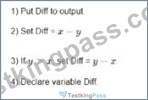
What are the two steps of the algorithm that need to be switched to result in success?
- A. 1 and 2
- B. 2 and 4
- C. 3 and 4
- D. 1 and 4
Answer: D
Explanation:
The algorithm's success depends on the correct sequence of steps. The steps should first declare the variable Diff before attempting to use it in calculations. If the declaration of Diff (step 4) is not done prior to its use (step 1), the algorithm will attempt to use an undeclared variable, which will result in an error.
Therefore, switching steps 1 and 4 ensures that Diff is declared before any operations are performed on it.
References: The importance of the correct sequence of steps in algorithm design is a fundamental concept in programming and can be found in introductory texts on algorithms and programming languages. It is also a standard practice in software development to declare variables before their use to avoid runtime errors.
NEW QUESTION # 47
A programmer receives requirements from customers and deciders 1o build a first version of a program.
Which phase of an agile approach is being carried out when trio programmer starts writing the program's first version?
- A. Analysis
- B. Design
- C. Implementation
- D. Testing
Answer: C
Explanation:
In the context of Agile software development, when a programmer begins writing the first version of a program after receiving requirements from customers, they are engaging in the Implementation phase. This phase is characterized by the actual coding or development of the software, where the focus is on turning the design and analysis work into a working product. It's a part of the iterative process where developers create, test, and refine the software in successive iterations.
The Agile approach emphasizes incremental development and frequent feedback, with each iteration resulting in a potentially shippable product increment. The Implementation phase is where these increments are built, and it typically follows the Design phase, where the system's architecture and components are planned out.
References: The information aligns with the key stages of the Agile Development Life Cycle, which includes the phases of Concept, Inception, Iteration (Implementation), Testing, Release, and Review12.
NEW QUESTION # 48
Which term refers to a function that represents the number of fixed-size memory units used for an input of a given size?
- A. Space complexity
- B. Computational complexity
- C. Linear search
- D. Runtime
Answer: A
Explanation:
Space complexity refers to the amount of memory space required by an algorithm in relation to the size of the input data. It is a function, often denoted as S(N), that represents the number of fixed-size memory units used by the algorithm for an input of size N. For example, if an algorithm needs to create a new array that is the same size as the input array, its space complexity would be linear, or O(N), where N is the size of the input array. This term is crucial in evaluating the efficiency of an algorithm, especially when working with large data sets or in systems with limited memory resources.
References: The definition and explanation of space complexity can be found in various educational resources and literature on data structures and algorithms, such as computer science textbooks and online educational platforms12.
NEW QUESTION # 49
A programmer has been hired to create an inventory system for the books in a library. What is the waterfall phase in which waterfall outlining all the functions that need to be written to support the inventory system?
- A. Analysis
- B. Implementation
- C. Design
- D. Testing
Answer: C
Explanation:
In the Waterfall model of software development, the phase where all functions that need to be written to support the inventory system would be outlined is the Design phase. This phase is critical as it translates the requirements gathered during the analysis phase into a blueprint for constructing the system. It involves two subphases: logical design and physical design. The logical design subphase is where possible solutions are brainstormed and theorized, while the physical design subphase is when those theoretical ideas and schemas are turned into concrete specifications12.
References:
* The explanation is based on the standard Waterfall model phases, which include Requirements, Design, Implementation, Verification, and Maintenance. More detailed information on these phases can be found in resources like "Waterfall Methodology: The Ultimate Guide to the Waterfall Model" by ProjectManager1 and other educational platforms2.
NEW QUESTION # 50
An algorithm should output ''OK'' if a number is between 98.3 and 98.9, else the output is ''Net OK'' Which test is a valid test of the algorithm?
- A. Input 98.6. Ensure output is "OK "
- B. Input 99.9. Ensure output is M98 9 "
- C. Input 98.6. Ensure output is "Not OK ''
- D. Input 99.9. Ensure output is "OK"
Answer: A
Explanation:
The algorithm is designed to output "OK" if the input number is within the range of 98.3 to 98.9. Therefore, the valid test would be one that checks if the algorithm correctly identifies a number within this range and outputs "OK". Option B provides an input of 98.6, which falls within the specified range, and expects the correct output of "OK", making it a valid test case for the algorithm.
References: The principles of testing algorithms involve checking for correct outputs given specific inputs, particularly testing normal, boundary, and invalid cases to ensure the algorithm behaves as expected12. In this scenario, the input 98.6 is a normal case within the specified range, and the expected output is "OK" as per the algorithm's design criteria3.
1: Stack Overflow - How to decide test cases for unit tests? 2: Analytics Vidhya - Writing Test Cases for Machine Learning systems 3: LinkedIn - How to Choose the Best Test Cases for Your Algorithm
NEW QUESTION # 51
What is the agile phase that results in a list of objects to be written?
- A. Analysis
- B. Implementation
- C. Design
- D. Testing
Answer: C
Explanation:
In Agile methodology, the phase that typically results in a list of objects to be written is the Design phase. This phase involves creating the architecture and design of the system to be developed. It's during this stage that developers and designers collaborate to identify the necessary objects and components that will make up the system, and how they will interact with each other. The output of this phase is often a set of design documents, diagrams, and a list of objects or components that need to be implemented in subsequent phases.
References: The Agile Development Lifecycle outlines various stages where different activities take place. The Design phase is crucial for setting a clear path for implementation and ensuring that the team has a shared understanding of the system's architecture12. Additionally, Agile methodologies like Scrum and Extreme Programming (XP) emphasize the importance of design and architecture in their practices3.
NEW QUESTION # 52
What would a string be used to store?
- A. The word "positive"
- B. A positive number between 2 and 3
- C. A true/false indication of whether a number is composite
- D. A positive whole number
Answer: A
Explanation:
In programming, a string is used to store sequences of characters, which can include letters, numbers, symbols, and spaces. Strings are typically utilized to store textual data, such as words and sentences12. For example, the word "positive" would be stored as a string. While strings can contain numbers, they are not used to store numbers in their numeric form but rather as text. Therefore, options A, C, and D, which involve numbers or boolean values, would not be stored as strings unless they are meant to be treated as text.
References: 1: Coderslang: Become a Software Engineer - What is a String in Programming. 2: Wikipedia - String (computer science).
NEW QUESTION # 53
Which two situations would be helped by using a programming library?
- A. A programmer needs to write several interacting objects for a student gradebook application, some of which need an inheritance structure.
- B. A programming student is writing code to iterate through the integers in a list and determine the maximum.
- C. A programmer is developing a database application that can house various types of data. The software cannot know ahead of time the data type, and so the programmer needs variables that do not require an initial declaration type.
- D. A programmer needs to perform a series of file compression tasks. These tasks are commonly performed by programmers, and the programmer does not want to have to code them all by hand
- E. A programmer is writing a piece of mathematical code that requires the heavy use of recursive functions.
- F. A video game programmer needs to perform several animation tasks, all of which are very common in the industry. The programmer does not want to have to code each task. And they are unsure if they a even know how lo code a few of them.
Answer: D,F
Explanation:
Programming libraries are collections of pre-written code that programmers can use to perform common tasks without having to write the code from scratch. They are particularly helpful in situations where:
* The tasks are common and standardized across the industry, such as animation tasks in video games (Option C). Using a library can save time and resources, and also ensure that the animations are up to industry standards.
* The tasks are well-known and frequently performed by many programmers, such as file compression (Option D). Libraries provide a reliable and tested set of functions that can handle these tasks efficiently.
For the other options:
* A: While a library could be used, writing interacting objects and implementing inheritance is a fundamental part of object-oriented programming and may not necessarily require a library.
* B: Iterating through a list to find the maximum value is a basic programming task that typically doesn't require a library.
* E: Dynamic typing or the use of variables without an initial declaration type is a feature of the programming language itself rather than a library.
* F: Recursive functions are a programming concept that can be implemented without the need for a library, unless the recursion is part of a specific algorithm that a library might provide.
References:
* Programming libraries documentation and standards.
* Industry best practices for video game development and file compression techniques.
NEW QUESTION # 54
Which value would require an integer as a data type?
- A. The number of students in a section
- B. An approximation of the number pi to five decimal places
- C. The cost of a dinner including tax and tip
- D. The weights of every patient involved in a pharmaceutical
Answer: A
Explanation:
An integer data type is used to represent whole numbers without any fractional or decimal component. In the given options:
* A. The number of students in a section is a countable quantity that does not require a fractional part, making it suitable for an integer data type.
* B. The cost of a dinner including tax and tip would typically involve a decimal to account for cents, thus requiring a floating-point data type.
* C. The weights of patients are usually measured with precision and can have decimal values, necessitating a floating-point data type.
* D. An approximation of the number pi to five decimal places is a decimal value and would require a floating-point data type.
References:
* The use of integer data types for countable quantities is a fundamental concept in programming and can be found in introductory programming textbooks such as "Starting Out with Programming Logic and Design" by Tony Gaddis and online resources like the Mozilla Developer Network's (MDN) Web Docs on JavaScript data types.
/**
NEW QUESTION # 55
Which three statements describe a characteristic of a programming library?
- A. A single library normally includes more than one function.
- B. Libraries improve a programmer's productivity.
- C. One library will contain one function but can have several variables.
- D. A single program can only include one library.
- E. A library typically must be included before any function in the library is used
- F. Using libraries will always make a program run less efficiently.
Answer: A,B,E
Explanation:
A programming library is a collection of pre-written code that developers can use to optimize tasks and improve productivity. Here's why the selected statements are correct:
* A: Libraries must be included or imported into your program before you can use the functions or objects they contain. This is because the program needs to know where to find the code it's executing12.
* B: A library typically includes multiple functions, objects, or classes that are related to a specific task or area of functionality. This allows developers to reuse code efficiently12.
* D: By providing pre-written code, libraries save developers time and effort, which in turn improves their productivity. Instead of writing code from scratch, developers can focus on the unique aspects of their project12.
The other options are incorrect because:
* C: While it's true that poorly designed libraries can affect performance, well-designed libraries can actually make programs more efficient by providing optimized code.
* E: A single program can include multiple libraries as needed. There's no limit to the number of libraries a program can use.
* F: Libraries often contain multiple functions and variables, not just one function.
References:
* CareerFoundry's guide on what a programming library is1.
* Codingem's complete guide on libraries in programming2.
NEW QUESTION # 56
A function should determine the average of x and y.
What should be the function's parameters and return value(s)?
- A. Parameters: averageReturn values: x, y
- B. Parameters: x, y. averageReturn value: none
- C. Parameters: nonsReturn values: x, y
- D. Parameters: x, yReturn value: average
Answer: D
Explanation:
In programming, a function that calculates the average of two numbers will require both numbers as input to perform the calculation. These inputs are known as parameters. Once the function has completed its calculation, it should return the result. In this case, the result is the average of the two numbers, which is the return value.
Here's a simple example in pseudocode:
function calculateAverage(x, y) {
average = (x + y) / 2
return average
}
In this function, x and y are the parameters, and the average is the calculated value that the function returns after execution.
References:
* Parameters and return values are fundamental concepts in programming that allow functions to receive inputs and return outputs12.
* The syntax and structure of function parameters and return values are consistent across many programming languages, ensuring that a function can perform operations using the provided inputs and then return a result2.
NEW QUESTION # 57
One requirement for the language of a protect is that it is based on a series of method calls.
When type of language is characterized in this way?
- A. Compiled
- B. Static
- C. Markup
- D. Functional
Answer: D
Explanation:
A language characterized by a series of method calls is typically referred to as a functional language. In functional programming, computation is treated as the evaluation of mathematical functions and avoids changing-state and mutable data. It is a declarative programming paradigm, which means programming is done with expressions or declarations instead of statements. In functional languages, functions are first-class citizens, meaning they can be passed as arguments to other functions, returned as values from other functions, and assigned to variables.
References: The information is based on the general characteristics of functional programming languages as they are known for treating functions as first-class citizens and focusing on the application of functions. This is in contrast to procedural programming, which involves a series of procedural method calls to form a hierarchy of operations1.
NEW QUESTION # 58
Which two statement describe advantages to using programming libraries? Choose 2 answers
- A. The programmer can improve productivity by using libraries.
- B. Libraries always make code run faster.
- C. Using a library prevents a programmer from having to code common tasks by hand
- D. Using libraries turns procedural code into object-oriented code.
- E. A program that uses libraries is more portable than one that does not
- F. Using a library minimizes copyright issues in coding.
Answer: A,C
Explanation:
Programming libraries offer a collection of pre-written code that developers can use to perform common tasks, which saves time and effort. This is because:
* B. Libraries provide pre-coded functions and procedures, which means programmers don't need to write code from scratch for tasks that are common across many programs. This reuse of code enhances efficiency and reduces the potential for errors in coding those tasks.
* E. By using libraries, programmers can significantly improve their productivity. Since they are not spending time writing and testing code for tasks that the library already provides, they can focus on the unique aspects of their own projects.
References:
* The benefits of using programming libraries are well-documented in software development literature.
For instance, "Code Complete" by Steve McConnell discusses how libraries can improve programmer productivity. Additionally, "The Pragmatic Programmer" by Andrew Hunt and David Thomas emphasizes the importance of reusing code to increase efficiency and reduce errors.
NEW QUESTION # 59
It is given that integer x=41 and integer y = 16. What is the value of the expression (x % 8) - y?
- A. 0
- B. 1
- C. 2
- D. 3
Answer: C
Explanation:
The expression ((x % 8) - y) involves the modulo operation and subtraction. The modulo operation finds the remainder when ( x ) is divided by ( 8 ). Given ( x = 41 ), we calculate ( 41 % 8 ) which equals ( 1 ) because (
41 ) divided by ( 8 ) equals ( 5 ) with a remainder of ( 1 ). Then, we subtract ( y ) (which is ( 16 )) from this remainder:
(41%8)16=116=15
However, there seems to be a discrepancy here as the calculation shows the answer should be (-15), but this is not an option provided in your question. Please double-check the options or the expression provided.
References:
* The concept of modulo operation is explained in various programming resources such as Python documentation and C++ reference guides.
* Basic arithmetic operations and their precedence are covered in introductory programming textbooks and online coding platforms like Codecademy and freeCodeCamp.
NEW QUESTION # 60
Which snippet represents the loop variable update statement in the given code?
- A. h < 30
- B. integer h = 2
- C. h = h + 2
- D. Put h to output
Answer: C
Explanation:
The loop variable update statement is the part of a loop that changes the loop variable's value at the end of each iteration. In the context of a for loop, it's typically the third component of the loop's header. Looking at the provided code snippet, option C, h = h + 2, is the statement that updates the loop variable h by incrementing it by 2 after each loop iteration. This is consistent with the standard behavior of a loop variable update statement in programming, where after executing the loop body, the loop control variable is updated based on the specified increment or decrement operation.
References:
* Stack Overflow discussion on loop variable updates1.
* GeeksforGeeks article on for loops in programming2.
* freeCodeCamp guide on for loops in C3.
* LaunchCode's breakdown of the for statement4.
NEW QUESTION # 61
Which snippet represents the loop condition expression in the given code?
- A. Put f to output
- B. Integer f = 1
- C. F = f + 2
- D. F < 27
Answer: D
Explanation:
The loop condition expression is the part of a loop that determines whether the loop will continue to execute or terminate. It is evaluated before each iteration of the loop, and if it evaluates to true, the loop body is executed; if it evaluates to false, the loop terminates. In the options provided, F < 27 is a Boolean expression that checks if f is less than 27, which is typical of a loop condition used to control the number of iterations of the loop.
References: The explanation is based on standard programming principles regarding loop structures, where the condition is a Boolean expression that controls the execution flow of the loop12. This concept is consistent across various programming languages and is a fundamental aspect of programming loops.
NEW QUESTION # 62
What is one characteristic of an object-oriented language that is not a characteristic of a procedural or functional language?
- A. The language supports decomposing a program into objects that interact with one another.
- B. The language is optimized for recursive programming.
- C. The language is based on the concept of modular programming and the calling of a subroutine.
- D. The language treats programs as evaluating mathematical functions.
Answer: A
Explanation:
One of the fundamental characteristics of object-oriented programming (OOP) is the concept of decomposing a program into objects that interact with one another1. This is distinct from procedural and functional programming paradigms, which do not inherently structure programs as a collection of objects. In OOP, objects are instances of classes and contain both data (attributes) and code (methods). These objects encapsulate data and operations and can interact with each other through methods, allowing for concepts such as inheritance, polymorphism, and encapsulation12.
In contrast, procedural programming is characterized by a focus on procedures or routines to perform tasks, and functional programming treats computation as the evaluation of mathematical functions without side effects or state changes2. Neither paradigm organizes code around objects with encapsulated data and methods, which is a defining feature of OOP1.
References: 1: Differences between Procedural and Object Oriented Programming - GeeksforGeeks 2:
Functional vs. Procedural vs. OOP | Scout APM
NEW QUESTION # 63
What is put to output by the following flowchart, if the input is 305?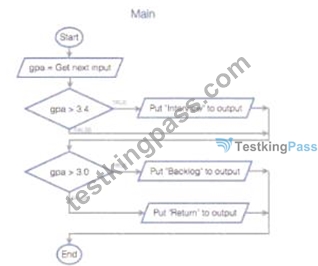
- A. Backlog
- B. Return
- C. interviewBacking
- D. Interview
Answer: D
Explanation:
The flowchart provided in the image represents a decision-making process based on the input value. Given the input of 305, we follow the flowchart's decision paths. The first decision checks if the input is less than 200, which 305 is not, so we move to the next decision point. The second decision asks if the input is greater than
300. Since 305 is greater than 300, we follow the path for 'yes' which leads us to the output "Interview".
Therefore, the correct output for the input 305 according to the flowchart is "Interview".
References:
* Understanding flowchart symbols and their usage in representing decision-making processes1.
* Analyzing flowcharts to determine the output based on given input values2.
* General principles of flowchart design and interpretation3.
NEW QUESTION # 64
What is an example of an algorithm?
- A. A webpage uses an HTML file type
- B. The list contains apples bananas, and oranges
- C. The sign of two integers determines the sign of the product
- D. Unplug the device, wait 30 seconds, and restart the device.
Answer: D
Explanation:
An algorithm is a set of instructions designed to perform a specific task or solve a problem. It is a sequence of steps that are followed to achieve a particular outcome. In the context of the given options, the correct example of an algorithm is option D. This option outlines a series of steps to troubleshoot a device, which is a common algorithmic procedure known as "power cycling" or "resetting." It involves turning off a device, waiting for a short period, and then turning it back on. This process can resolve temporary issues by clearing the device's memory and resetting its state.
Option A is incorrect because it is simply a list of items, not a sequence of steps with a specific goal. Option B is also incorrect as it describes a file type used in web development, not a set of instructions. Option C is a statement about a mathematical property, not an algorithm.
References: The definition and examples of algorithms can be found in various educational resources and programming literature. For instance, Scribbr provides a clear explanation of what an algorithm is and how it functions in both daily life and computer science1. Additionally, GeeksforGeeks offers insights into the definition, types, complexity, and examples of algorithms2. These sources corroborate the explanation provided here and offer further reading on the subject.
NEW QUESTION # 65
A particular sorting takes integer list 10,8 and incorrectly sorts the list to 6, 10, 8.
What is true about the algorithm's correctness for sorting an arbitrary list of three integers?
- A. The algorithm is correct
- B. The algorithm only works for 10,6, 8
- C. The algorithm's correctness is unknown
- D. The algorithm is incorrect
Answer: D
Explanation:
The correctness of a sorting algorithm is determined by its ability to sort a list of elements into a specified order, typically non-decreasing or non-increasing order. For an algorithm to be considered correct, it must consistently produce the correct output for all possible inputs. In the case of the given algorithm, it takes the input list [10, 8] and produces the output [6, 10, 8], which is not sorted in non-decreasing order. This indicates that the algorithm does not correctly sort the list, as the output is neither sorted nor does it maintain the integrity of the original list (the number 6 was not in the original list).
Furthermore, the fact that the output contains an integer (6) that was not present in the input list suggests that the algorithm is not preserving the elements of the input list, which is a fundamental requirement for a sorting algorithm. This violation confirms that the algorithm is incorrect for sorting an arbitrary list of three integers, as it cannot be relied upon to sort correctly or maintain the original list elements.
References: The principles of algorithm correctness can be found in various computer science literature and online resources. They often involve ensuring that the algorithm adheres to its preconditions and postconditions, and that it produces a valid output for all valid inputs1234.
NEW QUESTION # 66
......
Scripting-and-Programming-Foundations are Available for Instant Access: https://evedumps.testkingpass.com/Scripting-and-Programming-Foundations-testking-dumps.html