


Authentic MCPA-Level-1 Dumps - Free PDF Questions to Pass
Guaranteed Accomplishment with Newest Dec-2021 FREE MCPA-Level-1
NEW QUESTION 13
Refer to the exhibit. An organization is running a Mule standalone runtime and has configured Active Directory as the Anypoint Platform external Identity Provider. The organization does not have budget for other system components.
What policy should be applied to all instances of APIs in the organization to most effecuvelyKestrict access to a specific group of internal users?
- A. Apply an OAuth 2.0 access token enforcement policy; the internal Active Directory will be configured as the OAuth server
- B. Apply a basic authentication - LDAP policy; the internal Active Directory will be configured as the LDAP source for authenticating users
- C. Apply a client ID enforcement policy; the specific group of users will configure their client applications to use their specific client credentials
- D. Apply an IP whitelist policy; only the specific users' workstations will be in the whitelist
Answer: B
NEW QUESTION 14
Refer to the exhibit.
A developer is building a client application to invoke an API deployed to the STAGING environment that is governed by a client ID enforcement policy.
What is required to successfully invoke the API?
- A. The client ID and secret for the Anypoint Platform account's STAGING environment
- B. The client ID and secret obtained from Anypoint Exchange for the API instance in the STAGING environment
- C. The client ID and secret for the Anypoint Platform account owning the API in the STAGING environment
- D. A valid OAuth token obtained from Anypoint Platform and its associated client ID and secret
Answer: D
Explanation:
Explanation
https://docs.mulesoft.com/api-manager/2.x/policy-mule3-client-id-based-policies
NEW QUESTION 15
An organization is deploying their new implementation of the OrderStatus System API to multiple workers in CloudHub. This API fronts the organization's on-premises Order Management System, which is accessed by the API implementation over an IPsec tunnel.
What type of error typically does NOT result in a service outage of the OrderStatus System API?
- A. API Manager has an extended outage during the initial deployment of the API implementation
- B. The Order Management System is Inaccessible due to a network outage in the organization's on-premises data center
- C. A CloudHub worker fails with an out-of-memory exception
- D. The AWS region goes offline with a major network failure to the relevant AWS data centers
Answer: B
NEW QUESTION 16
A Mule application exposes an HTTPS endpoint and is deployed to the CloudHub Shared Worker Cloud. All traffic to that Mule application must stay inside the AWS VPC.
To what TCP port do API invocations to that Mule application need to be sent?
- A. 0
- B. 1
- C. 2
- D. 3
Answer: D
Explanation:
Explanation
https://help.mulesoft.com/s/question/0D52T00004mXXULSA4/multiple-http-listerners-on-cloudhub-one-with-p
NEW QUESTION 17
An API implementation is deployed to CloudHub.
What conditions can be alerted on using the default Anypoint Platform functionality, where the alert conditions depend on the end-to-end request processing of the API implementation?
- A. When the API is invoked by an unrecognized API client
- B. When a particular API client invokes the API too often within a given time period
- C. When the API receives a very high number of API invocations
- D. When the response time of API invocations exceeds a threshold
Answer: D
Explanation:
Correct answer: When the response time of API invocations exceeds a threshold
*****************************************
>> Alerts can be setup for all the given options using the default Anypoint Platform functionality
>> However, the question insists on an alert whose conditions depend on the end-to-end request processing of the API implementation.
>> Alert w.r.t "Response Times" is the only one which requires end-to-end request processing of API implementation in order to determine if the threshold is exceeded or not.
NEW QUESTION 18
Refer to the exhibit.
What is the best way to decompose one end-to-end business process into a collaboration of Experience, Process, and System APIs?
A) Handle customizations for the end-user application at the Process API level rather than the Experience API level
B) Allow System APIs to return data that is NOT currently required by the identified Process or Experience APIs
C) Always use a tiered approach by creating exactly one API for each of the 3 layers (Experience, Process and System APIs)
D) Use a Process API to orchestrate calls to multiple System APIs, but NOT to other Process APIs
- A. Option C
- B. Option B
- C. Option D
- D. Option A
Answer: A
NEW QUESTION 19
What is a best practice when building System APIs?
- A. Build an Enterprise Data Model (Canonical Data Model) for each backend system and apply it to System APIs
- B. Document the API using an easily consumable asset like a RAML definition
- C. Model all API resources and methods to closely mimic the operations of the backend system
- D. Expose to API clients all technical details of the API implementation's interaction wifch the backend system
Answer: C
Explanation:
Correct answer: Model all API resources and methods to closely mimic the operations of the backend system.
*****************************************
>> There are NO fixed and straight best practices while opting data models for APIs. They are completly contextual and depends on number of factors. Based upon those factors, an enterprise can choose if they have to go with Enterprise Canonical Data Model or Bounded Context Model etc.
>> One should NEVER expose the technical details of API implementation to their API clients. Only the API interface/ RAML is exposed to API clients.
>> It is true that the RAML definitions of APIs should be as detailed as possible and should reflect most of the documentation. However, just that is NOT enough to call your API as best documented API. There should be even more documentation on Anypoint Exchange with API Notebooks etc. to make and create a developer friendly API and repository..
>> The best practice always when creating System APIs is to create their API interfaces by modeling their resources and methods to closely reflect the operations and functionalities of that backend system.
NEW QUESTION 20
What is true about where an API policy is defined in Anypoint Platform and how it is then applied to API instances?
- A. The API policy is defined in API Manager, and then applied to ALL API instances in the specified environment
- B. The API policy Is defined In API Manager for a specific API Instance, and then ONLY applied to the specific API instance
- C. The API policy Is defined In Runtime Manager as part of the API deployment to a Mule runtime, and then ONLY applied to the specific API Instance
- D. The API policy Is defined in API Manager and then automatically applied to ALL API instances
Answer: B
Explanation:
Correct answer: The API policy is defined in API Manager for a specific API instance, and then ONLY applied to the specific API instance.
*****************************************
>> Once our API specifications are ready and published to Exchange, we need to visit API Manager and register an API instance for each API.
>> API Manager is the place where management of API aspects takes place like addressing NFRs by enforcing policies on them.
>> We can create multiple instances for a same API and manage them differently for different purposes.
>> One instance can have a set of API policies applied and another instance of same API can have different set of policies applied for some other purpose.
>> These APIs and their instances are defined PER environment basis. So, one need to manage them seperately in each environment.
>> We can ensure that same configuration of API instances (SLAs, Policies etc..) gets promoted when promoting to higher environments using platform feature. But this is optional only. Still one can change them per environment basis if they have to.
>> Runtime Manager is the place to manage API Implementations and their Mule Runtimes but NOT APIs itself. Though API policies gets executed in Mule Runtimes, We CANNOT enforce API policies in Runtime Manager. We would need to do that via API Manager only for a cherry picked instance in an environment.
So, based on these facts, right statement in the given choices is - "The API policy is defined in API Manager for a specific API instance, and then ONLY applied to the specific API instance".
NEW QUESTION 21
Refer to the exhibit.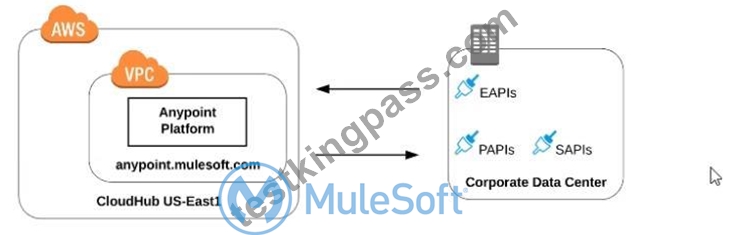
what is true when using customer-hosted Mule runtimes with the MuleSoft-hosted Anypoint Platform control plane (hybrid deployment)?
- A. Anypoint Runtime Manager initiates a network connection to a Mule runtime in order to deploy Mule applications
- B. Anypoint Runtime Manager automatically ensures HA in the control plane by creating a new Mule runtime instance in case of a node failure
- C. API implementations can run successfully in customer-hosted Mule runtimes, even when they are unable to communicate with the control plane
- D. The MuleSoft-hosted Shared Load Balancer can be used to load balance API invocations to the Mule runtimes
Answer: B
NEW QUESTION 22
An organization is deploying their new implementation of the OrderStatus System API to multiple workers in CloudHub. This API fronts the organization's on-premises Order Management System, which is accessed by the API implementation over an IPsec tunnel.
What type of error typically does NOT result in a service outage of the OrderStatus System API?
- A. API Manager has an extended outage during the initial deployment of the API implementation
- B. A CloudHub worker fails with an out-of-memory exception
- C. The AWS region goes offline with a major network failure to the relevant AWS data centers
- D. The Order Management System is Inaccessible due to a network outage in the organization's on-premises data center
Answer: B
Explanation:
Correct answer: A CloudHub worker fails with an out-of-memory exception.
*****************************************
>> An AWS Region itself going down will definitely result in an outage as it does not matter how many workers are assigned to the Mule App as all of those in that region will go down. This is a complete downtime and outage.
>> Extended outage of API manager during initial deployment of API implementation will of course cause issues in proper application startup itself as the API Autodiscovery might fail or API policy templates and polices may not be downloaded to embed at the time of applicaiton startup etc... there are many reasons that could cause issues.
>> A network outage onpremises would of course cause the Order Management System not accessible and it does not matter how many workers are assigned to the app they all will fail and cause outage for sure.
The only option that does NOT result in a service outage is if a cloudhub worker fails with an out-of-memory exception. Even if a worker fails and goes down, there are still other workers to handle the requests and keep the API UP and Running. So, this is the right answer.
NEW QUESTION 23
An API experiences a high rate of client requests (TPS) vwth small message paytoads. How can usage limits be imposed on the API based on the type of client application?
- A. Use a spike control policy that limits the number of requests for each client application type
- B. Use a rate limiting policy and a client ID enforcement policy, each configured by the client application type
- C. Use an SLA-based rate limiting policy and assign a client application to a matching SLA tier based on its type
- D. Use a cross-origin resource sharing (CORS) policy to limit resource sharing between client applications, configured by the client application type
Answer: C
NEW QUESTION 24
How are an API implementation, API client, and API consumer combined to invoke and process an API?
- A. The ApI consumer creates an API client, which sends API invocations to an API such that they are processed by an API implementation
- B. The API client creates an API consumer, which receives API invocations from an API such that they are processed for an API implementation
- C. The ApI client creates an API consumer, which sends API invocations to an API such that they are processed by an API implementation
- D. The API consumer creates an API implementation, which receives API invocations from an API such that they are processed for an API client
Answer: D
NEW QUESTION 25
Refer to the exhibit.
What is the best way to decompose one end-to-end business process into a collaboration of Experience, Process, and of System APIs?
- A. Use a Process API to orchestrate calls to multiple System APIs, but NOT to other Process APIs.

- B. Always use a tiered approach by creating exactly one API for each of the 3 layers (Experience, Process and System APIs).

- C. Handle customizations for the end-user application at the Process API level rather than the Experience API level.

- D. Allow System APIs to return data that is NOT currently required by the identified Process or Experience APIs.

Answer: B
NEW QUESTION 26
What Mule application can have API policies applied by Anypoint Platform to the endpoint exposed by that Mule application?
- A. A Mule application that accepts JSON requests over TCP but is NOT required to provide a response.

- B. A Mule application that accepts requests over HTTP/1x.

- C. A Mule application that accepts gRPC requests over HTTP/2

- D. A Mule application that accepts JSON requests over WebSocket.

Answer: C
Explanation:
Explanation/Reference:
NEW QUESTION 27
What is true about automating interactions with Anypoint Platform using tools such as Anypoint Platform REST APIs, Anypoint CU, or the Mule Maven plugin?
- A. By default, the Anypoint CLI and Mule Maven plugin are NOT included in the Mule runtime, so are NOT available to be used by deployed Mule applications
- B. Anypoint Platform APIs can ONLY automate interactions with CloudHub, while the Mule Maven plugin is required for deployment to customer-hosted Mule runtimes
- C. Access to Anypoint Platform APIs and Anypoint CU can be controlled separately through the roles and permissions in Anypoint Platform, so that specific users can get access to Anypoint CLI white others get access to the platform APIs
- D. API policies can be applied to the Anypoint Platform APIs so that ONLY certain LOBs have access to specific functions
Answer: A
NEW QUESTION 28
Traffic is routed through an API proxy to an API implementation. The API proxy is managed by API Manager and the API implementation is deployed to a CloudHub VPC using Runtime Manager. API policies have been applied to this API. In this deployment scenario, at what point are the API policies enforced on incoming API client requests?
- A. At both the API proxy and the API implementation
- B. At the API implementation
- C. At a MuleSoft-hosted load balancer
- D. At the API proxy
Answer: D
Explanation:
Correct answer: At the API proxy
*****************************************
>> API Policies can be enforced at two places in Mule platform.
>> One - As an Embedded Policy enforcement in the same Mule Runtime where API implementation is running.
>> Two - On an API Proxy sitting in front of the Mule Runtime where API implementation is running.
>> As the deployment scenario in the question has API Proxy involved, the policies will be enforced at the API Proxy.
NEW QUESTION 29
A System API is designed to retrieve data from a backend system that has scalability challenges. What API policy can best safeguard the backend system?
- A. SLA-based rate limiting
- B. Client ID enforcement
- C. Auth 2 token enforcement
- D. IPwhitelist
Answer: C
NEW QUESTION 30
......
MCPA-Level-1 Braindumps PDF, MuleSoft MCPA-Level-1 Exam Cram: https://evedumps.testkingpass.com/MCPA-Level-1-testking-dumps.html