


PECB New 2026 ISO-IEC-27005-Risk-Manager Test Tutorial (Updated 62 Questions)
ISO-IEC-27005-Risk-Manager Exam Questions Dumps, Selling PECB Products
NEW QUESTION # 12
Scenario 4: In 2017, seeing that millions of people turned to online shopping, Ed and James Cordon founded the online marketplace for footwear called Poshoe. In the past, purchasing pre-owned designer shoes online was not a pleasant experience because of unattractive pictures and an inability to ascertain the products' authenticity. However, after Poshoe's establishment, each product was well advertised and certified as authentic before being offered to clients. This increased the customers' confidence and trust in Poshoe's products and services. Poshoe has approximately four million users and its mission is to dominate the second-hand sneaker market and become a multi-billion dollar company.
Due to the significant increase of daily online buyers, Poshoe's top management decided to adopt a big data analytics tool that could help the company effectively handle, store, and analyze dat a. Before initiating the implementation process, they decided to conduct a risk assessment. Initially, the company identified its assets, threats, and vulnerabilities associated with its information systems. In terms of assets, the company identified the information that was vital to the achievement of the organization's mission and objectives. During this phase, the company also detected a rootkit in their software, through which an attacker could remotely access Poshoe's systems and acquire sensitive data.
The company discovered that the rootkit had been installed by an attacker who had gained administrator access. As a result, the attacker was able to obtain the customers' personal data after they purchased a product from Poshoe. Luckily, the company was able to execute some scans from the target device and gain greater visibility into their software's settings in order to identify the vulnerability of the system.
The company initially used the qualitative risk analysis technique to assess the consequences and the likelihood and to determine the level of risk. The company defined the likelihood of risk as "a few times in two years with the probability of 1 to 3 times per year." Later, it was decided that they would use a quantitative risk analysis methodology since it would provide additional information on this major risk. Lastly, the top management decided to treat the risk immediately as it could expose the company to other issues. In addition, it was communicated to their employees that they should update, secure, and back up Poshoe's software in order to protect customers' personal information and prevent unauthorized access from attackers.
Based on the scenario above, answer the following question:
Poshoe detected a rootkit installed in their software. In which category of threats does this threat belong?
- A. Human actions
- B. Organizational threats
- C. Technical failures
Answer: A
Explanation:
A rootkit installed in software due to an attacker gaining administrator access is considered a threat resulting from human actions. In this scenario, the attacker deliberately exploited a vulnerability to install the rootkit and gain unauthorized access to sensitive data. ISO/IEC 27005 categorizes threats into three main types: technical failures, human actions, and environmental events. Since this threat is a result of intentional malicious activity by an individual (human), it falls under the category of human actions. Option A (Technical failures) would refer to failures in hardware or software that are not caused by deliberate actions, while Option C (Organizational threats) would relate to internal organizational issues, neither of which apply to this case.
NEW QUESTION # 13
Scenario 2: Travivve is a travel agency that operates in more than 100 countries. Headquartered in San Francisco, the US, the agency is known for its personalized vacation packages and travel services. Travivve aims to deliver reliable services that meet its clients' needs. Considering the impact of information security in its reputation, Travivve decided to implement an information security management system (ISMS) based on ISO/IEC 27001. In addition, they decided to establish and implement an information security risk management program. Based on the priority of specific departments in Travivve, the top management decided to initially apply the risk management process only in the Sales Management Department. The process would be applicable for other departments only when introducing new technology.
Travivve's top management wanted to make sure that the risk management program is established based on the industry best practices. Therefore, they created a team of three members that would be responsible for establishing and implementing it. One of the team members was Travivve's risk manager who was responsible for supervising the team and planning all risk management activities. In addition, the risk manager was responsible for monitoring the program and reporting the monitoring results to the top management.
Initially, the team decided to analyze the internal and external context of Travivve. As part of the process of understanding the organization and its context, the team identified key processes and activities. Then, the team identified the interested parties and their basic requirements and determined the status of compliance with these requirements. In addition, the team identified all the reference documents that applied to the defined scope of the risk management process, which mainly included the Annex A of ISO/IEC 27001 and the internal security rules established by Travivve. Lastly, the team analyzed both reference documents and justified a few noncompliances with those requirements.
The risk manager selected the information security risk management method which was aligned with other approaches used by the company to manage other risks. The team also communicated the risk management process to all interested parties through previously established communication mechanisms. In addition, they made sure to inform all interested parties about their roles and responsibilities regarding risk management. Travivve also decided to involve interested parties in its risk management activities since, according to the top management, this process required their active participation.
Lastly, Travivve's risk management team decided to conduct the initial information security risk assessment process. As such, the team established the criteria for performing the information security risk assessment which included the consequence criteria and likelihood criteria.
Based on the scenario above, answer the following question:
Travivve decided to initially apply the risk management process only in the Sales Management Department. Is this acceptable?
- A. Yes, the risk management process must be applied to only those departments that handle customers' personal information in an organization
- B. Yes, the risk management process may be applied to only a subset of departments in an organization
- C. No, the risk management process must be applied in all organizational levels
Answer: B
Explanation:
ISO/IEC 27005 provides guidance on risk management for information security, and it allows flexibility in applying the risk management process to different parts of an organization. The decision to initially apply the risk management process only to the Sales Management Department is acceptable under ISO/IEC 27005, as the standard supports the selective application of risk management activities based on the specific needs and priorities of the organization. This is in line with risk management best practices, where organizations may focus on critical areas first (such as high-risk departments or those that handle sensitive information) and later expand the process as needed. Therefore, applying the risk management process to a subset of departments is appropriate, making option B the correct answer.
Reference:
ISO/IEC 27005:2018, Clause 7, "Context Establishment," which allows defining the scope and boundaries of risk management as relevant to the organization's needs.
ISO/IEC 27001:2013, Clause 4.3, "Determining the scope of the information security management system," which also permits defining a scope based on priorities and relevance.
NEW QUESTION # 14
Which of the following statements best defines information security risk?
- A. The potential that threats will exploit vulnerabilities of an information asset and cause harm to an organization
- B. Weakness of an asset or control that can be exploited by one or a group of threats
- C. Potential cause of an unwanted incident related to information security that can cause harm to an organization
Answer: A
Explanation:
Information security risk, as defined by ISO/IEC 27005, is "the potential that a threat will exploit a vulnerability of an asset or group of assets and thereby cause harm to the organization." This definition emphasizes the interplay between threats (e.g., cyber attackers, natural disasters), vulnerabilities (e.g., weaknesses in software, inadequate security controls), and the potential impact or harm that could result from this exploitation. Therefore, option A is the most comprehensive and accurate description of information security risk. In contrast, option B describes a vulnerability, and option C focuses on the cause of an incident rather than defining risk itself. Option A aligns directly with the risk definition in ISO/IEC 27005.
NEW QUESTION # 15
According to CRAMM methodology, how is risk assessment initiated?
- A. By gathering information on the system and identifying assets within the scope
- B. By identifying the security risks
- C. By determining methods and procedures for managing risks
Answer: A
Explanation:
According to the CRAMM (CCTA Risk Analysis and Management Method) methodology, risk assessment begins by collecting detailed information on the system and identifying all assets that fall within the defined scope. This foundational step ensures that the assessment is comprehensive and includes all relevant assets, which could be potential targets for risk. This makes option A the correct answer.
NEW QUESTION # 16
Scenario 7: Adstry is a business growth agency that specializes in digital marketing strategies. Adstry helps organizations redefine the relationships with their customers through innovative solutions. Adstry is headquartered in San Francisco and recently opened two new offices in New York. The structure of the company is organized into teams which are led by project managers. The project manager has the full power in any decision related to projects. The team members, on the other hand, report the project's progress to project managers.
Considering that data breaches and ad fraud are common threats in the current business environment, managing risks is essential for Adstry. When planning new projects, each project manager is responsible for ensuring that risks related to a particular project have been identified, assessed, and mitigated. This means that project managers have also the role of the risk manager in Adstry. Taking into account that Adstry heavily relies on technology to complete their projects, their risk assessment certainly involves identification of risks associated with the use of information technology. At the earliest stages of each project, the project manager communicates the risk assessment results to its team members.
Adstry uses a risk management software which helps the project team to detect new potential risks during each phase of the project. This way, team members are informed in a timely manner for the new potential risks and are able to respond to them accordingly. The project managers are responsible for ensuring that the information provided to the team members is communicated using an appropriate language so it can be understood by all of them.
In addition, the project manager may include external interested parties affected by the project in the risk communication. If the project manager decides to include interested parties, the risk communication is thoroughly prepared. The project manager firstly identifies the interested parties that should be informed and takes into account their concerns and possible conflicts that may arise due to risk communication. The risks are communicated to the identified interested parties while taking into consideration the confidentiality of Adstry's information and determining the level of detail that should be included in the risk communication. The project managers use the same risk management software for risk communication with external interested parties since it provides a consistent view of risks. For each project, the project manager arranges regular meetings with relevant interested parties of the project, they discuss the detected risks, their prioritization, and determine appropriate treatment solutions. The information taken from the risk management software and the results of these meetings are documented and are used for decision-making processes. In addition, the company uses a computerized documented information management system for the acquisition, classification, storage, and archiving of its documents.
Based on scenario 7, Adstry's project managers hold regular meetings with interested parties to discuss risks and risk treatment solutions. According to the guidelines of ISO/IEC 27005, is this in compliance with best practices?
- A. Yes, risks can be communicated to and discussed with relevant interested parties only if the project manager decides that it is appropriate to do so
- B. No, risk owners should not communicate or discuss risk treatment options with external interested parties
- C. Yes, the coordination between project managers and relevant interested parties can be achieved by discussions upon risks and appropriate treatment solutions
Answer: C
NEW QUESTION # 17
Scenario 4: In 2017, seeing that millions of people turned to online shopping, Ed and James Cordon founded the online marketplace for footwear called Poshoe. In the past, purchasing pre-owned designer shoes online was not a pleasant experience because of unattractive pictures and an inability to ascertain the products' authenticity. However, after Poshoe's establishment, each product was well advertised and certified as authentic before being offered to clients. This increased the customers' confidence and trust in Poshoe's products and services. Poshoe has approximately four million users and its mission is to dominate the second-hand sneaker market and become a multi-billion dollar company.
Due to the significant increase of daily online buyers, Poshoe's top management decided to adopt a big data analytics tool that could help the company effectively handle, store, and analyze dat a. Before initiating the implementation process, they decided to conduct a risk assessment. Initially, the company identified its assets, threats, and vulnerabilities associated with its information systems. In terms of assets, the company identified the information that was vital to the achievement of the organization's mission and objectives. During this phase, the company also detected a rootkit in their software, through which an attacker could remotely access Poshoe's systems and acquire sensitive data.
The company discovered that the rootkit had been installed by an attacker who had gained administrator access. As a result, the attacker was able to obtain the customers' personal data after they purchased a product from Poshoe. Luckily, the company was able to execute some scans from the target device and gain greater visibility into their software's settings in order to identify the vulnerability of the system.
The company initially used the qualitative risk analysis technique to assess the consequences and the likelihood and to determine the level of risk. The company defined the likelihood of risk as "a few times in two years with the probability of 1 to 3 times per year." Later, it was decided that they would use a quantitative risk analysis methodology since it would provide additional information on this major risk. Lastly, the top management decided to treat the risk immediately as it could expose the company to other issues. In addition, it was communicated to their employees that they should update, secure, and back up Poshoe's software in order to protect customers' personal information and prevent unauthorized access from attackers.
According to scenario 4, Poshoe has identified its assets, vulnerabilities, and threats associated with its information systems. What does the company need in order to start identifying its existing controls?
- A. A list of incident scenarios with their consequences
- B. The risk treatment implementation plan and documentation of controls
- C. A list of all existing and planned controls
Answer: C
Explanation:
To start identifying its existing controls, Poshoe needs a list of all existing and planned controls. This list will provide the necessary baseline to understand what security measures are already in place and what measures are planned to mitigate risks. This helps in determining gaps, evaluating the effectiveness of current controls, and identifying areas requiring improvement. Option A (The risk treatment implementation plan and documentation of controls) is incorrect because it is too specific and assumes a level of completion not indicated in the scenario. Option C (A list of incident scenarios with their consequences) is incorrect as it pertains to the analysis phase of risk management, not the identification of existing controls.
NEW QUESTION # 18
Scenario 3: Printary is an American company that offers digital printing services. Creating cost-effective and creative products, the company has been part of the printing industry for more than 30 years. Three years ago, the company started to operate online, providing greater flexibility for its clients. Through the website, clients could find information about all services offered by Printary and order personalized products. However, operating online increased the risk of cyber threats, consequently, impacting the business functions of the company. Thus, along with the decision of creating an online business, the company focused on managing information security risks. Their risk management program was established based on ISO/IEC 27005 guidelines and industry best practices.
Last year, the company considered the integration of an online payment system on its website in order to provide more flexibility and transparency to customers. Printary analyzed various available solutions and selected Pay0, a payment processing solution that allows any company to easily collect payments on their website. Before making the decision, Printary conducted a risk assessment to identify and analyze information security risks associated with the software. The risk assessment process involved three phases: identification, analysis, and evaluation. During risk identification, the company inspected assets, threats, and vulnerabilities. In addition, to identify the information security risks, Printary used a list of the identified events that could negatively affect the achievement of information security objectives. The risk identification phase highlighted two main threats associated with the online payment system: error in use and data corruption After conducting a gap analysis, the company concluded that the existing security controls were sufficient to mitigate the threat of data corruption. However, the user interface of the payment solution was complicated, which could increase the risk associated with user errors, and, as a result, impact data integrity and confidentiality.
Subsequently, the risk identification results were analyzed. The company conducted risk analysis in order to understand the nature of the identified risks. They decided to use a quantitative risk analysis methodology because it would provide more detailed information. The selected risk analysis methodology was consistent with the risk evaluation criteri a. Firstly, they used a list of potential incident scenarios to assess their potential impact. In addition, the likelihood of incident scenarios was defined and assessed. Finally, the level of risk was defined as low.
In the end, the level of risk was compared to the risk evaluation and acceptance criteria and was prioritized accordingly.
Based on scenario 3, what does the complicated user interface of the software which could lead to error present?
- A. A vulnerability
- B. A threat
- C. An asset
Answer: A
Explanation:
ISO/IEC 27005 defines a vulnerability as a weakness in an asset or control that could potentially be exploited by one or more threats. In the scenario, the complicated user interface of the payment software represents a weakness that could lead to user errors, potentially impacting data integrity and confidentiality. This aligns with the definition of a vulnerability, as it is a weakness that could be exploited by threats (e.g., errors in use). Therefore, the complicated user interface is correctly identified as a vulnerability, making option A the correct answer.
Reference:
ISO/IEC 27005:2018, Clause 8.3, "Risk Identification," where vulnerabilities are identified as weaknesses that can be exploited by threats.
NEW QUESTION # 19
Scenario 8: Biotide is a pharmaceutical company that produces medication for treating different kinds of diseases. The company was founded in 1997, and since then it has contributed in solving some of the most challenging healthcare issues.
As a pharmaceutical company, Biotide operates in an environment associated with complex risks. As such, the company focuses on risk management strategies that ensure the effective management of risks to develop high-quality medication. With the large amount of sensitive information generated from the company, managing information security risks is certainly an important part of the overall risk management process. Biotide utilizes a publicly available methodology for conducting risk assessment related to information assets. This methodology helps Biotide to perform risk assessment by taking into account its objectives and mission. Following this method, the risk management process is organized into four activity areas, each of them involving a set of activities, as provided below.
1. Activity area 1: The organization determines the criteria against which the effects of a risk occurring can be evaluated. In addition, the impacts of risks are also defined.
2. Activity area 2: The purpose of the second activity area is to create information asset profiles. The organization identifies critical information assets, their owners, as well as the security requirements for those assets. After determining the security requirements, the organization prioritizes them. In addition, the organization identifies the systems that store, transmit, or process information.
3. Activity area 3: The organization identifies the areas of concern which initiates the risk identification process. In addition, the organization analyzes and determines the probability of the occurrence of possible threat scenarios.
4. Activity area 4: The organization identifies and evaluates the risks. In addition, the criteria specified in activity area 1 is reviewed and the consequences of the areas of concerns are evaluated. Lastly, the level of identified risks is determined.
The table below provides an example of how Biotide assesses the risks related to its information assets following this methodology:
Based on the scenario above, answer the following question: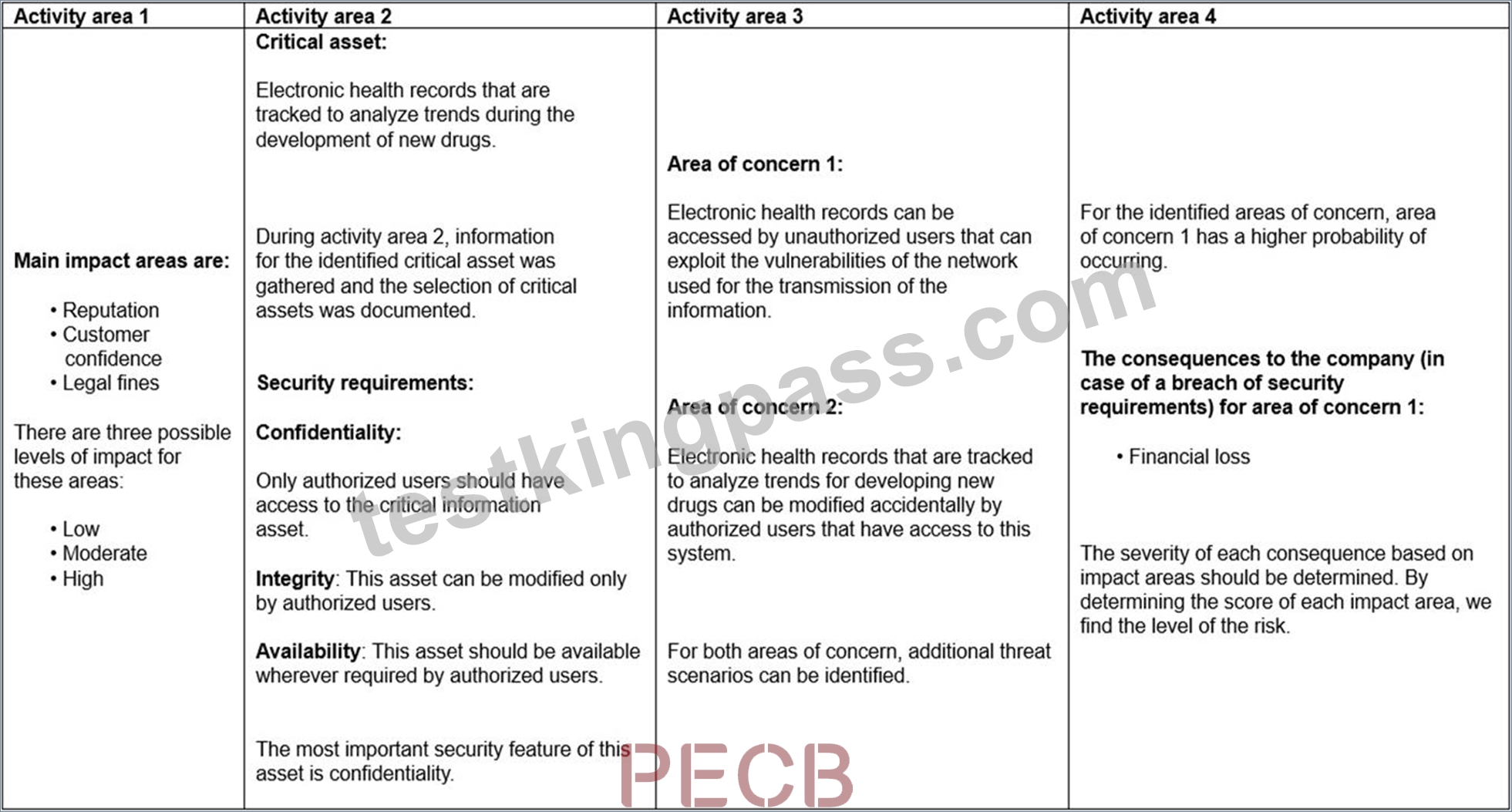
Which risk assessment methodology does Biotide use?
- A. OCTAVE Allegro
- B. MEHARI
- C. OCTAVE-S
Answer: A
Explanation:
Biotide uses the OCTAVE Allegro methodology for risk assessment. This is determined based on the description of the activities mentioned in the scenario. OCTAVE Allegro is a streamlined approach specifically designed to help organizations perform risk assessments that are efficient and effective, particularly when handling information assets. The methodology focuses on a thorough examination of information assets, the threats they face, and the impact of those threats.
Activity Area 1: OCTAVE Allegro defines the criteria for evaluating the impact of risks, which is consistent with determining the risk effects' evaluation criteria in the scenario.
Activity Area 2: In OCTAVE Allegro, a critical step is creating profiles for information assets, identifying their owners, and determining security requirements. This aligns with the activity in which Biotide identifies critical assets, their owners, and their security needs.
Activity Area 3: Identifying areas of concern that initiate risk identification and analyzing threat scenarios is central to OCTAVE Allegro. This is reflected in the activity of identifying areas of concern and determining the likelihood of threats.
Activity Area 4: Evaluating the risks, reviewing criteria, and determining risk levels corresponds to the latter stages of OCTAVE Allegro, where risks are prioritized based on the likelihood and impact, and risk management strategies are formulated accordingly.
The steps outlined align with the OCTAVE Allegro approach, which focuses on understanding and addressing information security risks comprehensively and in line with organizational objectives. Hence, option A, OCTAVE Allegro, is the correct answer.
ISO/IEC 27005:2018 emphasizes the importance of using structured methodologies for information security risk management, like OCTAVE Allegro, to ensure that risks are consistently identified, assessed, and managed in accordance with organizational risk tolerance and objectives.
NEW QUESTION # 20
Scenario 5: Detika is a private cardiology clinic in Pennsylvania, the US. Detika has one of the most advanced healthcare systems for treating heart diseases. The clinic uses sophisticated apparatus that detects heart diseases in early stages. Since 2010, medical information of Detika's patients is stored on the organization's digital systems. Electronic health records (EHR), among others, include patients' diagnosis, treatment plan, and laboratory results.
Storing and accessing patient and other medical data digitally was a huge and a risky step for Detik a. Considering the sensitivity of information stored in their systems, Detika conducts regular risk assessments to ensure that all information security risks are identified and managed. Last month, Detika conducted a risk assessment which was focused on the EHR system. During risk identification, the IT team found out that some employees were not updating the operating systems regularly. This could cause major problems such as a data breach or loss of software compatibility. In addition, the IT team tested the software and detected a flaw in one of the software modules used. Both issues were reported to the top management and they decided to implement appropriate controls for treating the identified risks. They decided to organize training sessions for all employees in order to make them aware of the importance of the system updates. In addition, the manager of the IT Department was appointed as the person responsible for ensuring that the software is regularly tested.
Another risk identified during the risk assessment was the risk of a potential ransomware attack. This risk was defined as low because all their data was backed up daily. The IT team decided to accept the actual risk of ransomware attacks and concluded that additional measures were not required. This decision was documented in the risk treatment plan and communicated to the risk owner. The risk owner approved the risk treatment plan and documented the risk assessment results.
Following that, Detika initiated the implementation of new controls. In addition, one of the employees of the IT Department was assigned the responsibility for monitoring the implementation process and ensure the effectiveness of the security controls. The IT team, on the other hand, was responsible for allocating the resources needed to effectively implement the new controls.
How should Detika define which of the identified risks should be treated first? Refer to scenario 5.
- A. Based on their priority in the risk treatment plan
- B. Based on the resources required for ensuring effective implementation
- C. Based on who is accountable and responsible for approving the risk treatment plan
Answer: A
Explanation:
Detika should prioritize the treatment of identified risks based on their priority in the risk treatment plan. According to ISO/IEC 27005, the risk treatment plan specifies the order in which risks should be treated based on their severity, likelihood, and impact on the organization. Risks that pose the greatest threat to the organization or have the highest priority should be treated first. Options B and C are incorrect because allocating resources or determining accountability do not inherently establish the priority of risk treatment; the risk treatment plan does.
NEW QUESTION # 21
Scenario 2: Travivve is a travel agency that operates in more than 100 countries. Headquartered in San Francisco, the US, the agency is known for its personalized vacation packages and travel services. Travivve aims to deliver reliable services that meet its clients' needs. Considering the impact of information security in its reputation, Travivve decided to implement an information security management system (ISMS) based on ISO/IEC 27001. In addition, they decided to establish and implement an information security risk management program. Based on the priority of specific departments in Travivve, the top management decided to initially apply the risk management process only in the Sales Management Department. The process would be applicable for other departments only when introducing new technology.
Travivve's top management wanted to make sure that the risk management program is established based on the industry best practices. Therefore, they created a team of three members that would be responsible for establishing and implementing it. One of the team members was Travivve's risk manager who was responsible for supervising the team and planning all risk management activities. In addition, the risk manager was responsible for monitoring the program and reporting the monitoring results to the top management.
Initially, the team decided to analyze the internal and external context of Travivve. As part of the process of understanding the organization and its context, the team identified key processes and activities. Then, the team identified the interested parties and their basic requirements and determined the status of compliance with these requirements. In addition, the team identified all the reference documents that applied to the defined scope of the risk management process, which mainly included the Annex A of ISO/IEC 27001 and the internal security rules established by Travivve. Lastly, the team analyzed both reference documents and justified a few noncompliances with those requirements.
The risk manager selected the information security risk management method which was aligned with other approaches used by the company to manage other risks. The team also communicated the risk management process to all interested parties through previously established communication mechanisms. In addition, they made sure to inform all interested parties about their roles and responsibilities regarding risk management. Travivve also decided to involve interested parties in its risk management activities since, according to the top management, this process required their active participation.
Lastly, Travivve's risk management team decided to conduct the initial information security risk assessment process. As such, the team established the criteria for performing the information security risk assessment which included the consequence criteria and likelihood criteria.
Based on scenario 2, has Travivve defined the responsibilities of the risk manager appropriately?
- A. No, the risk manager should not be responsible for planning all risk management activities
- B. Yes, the risk manager should be responsible for all actions defined bv Traviwe
- C. No, the risk manager should not be responsible for reporting the monitoring results of the risk management program to the top management
Answer: B
Explanation:
ISO/IEC 27005 recommends that the risk manager or a designated authority should oversee the entire risk management process, including planning, monitoring, and reporting. In the scenario, the risk manager is responsible for supervising the team, planning all risk management activities, monitoring the program, and reporting the results to top management. This allocation of responsibilities is aligned with the guidelines of ISO/IEC 27005, which emphasizes that a risk manager should coordinate and manage all aspects of the risk management process to ensure its effectiveness and alignment with the organization's objectives. Therefore, assigning these responsibilities to the risk manager is appropriate, making option A the correct answer.
Reference:
ISO/IEC 27005:2018, Clause 5.3, "Roles and responsibilities," which specifies that those managing risk should have defined roles and should coordinate all activities in the risk management process.
NEW QUESTION # 22
Scenario 1
The risk assessment process was led by Henry, Bontton's risk manager. The first step that Henry took was identifying the company's assets. Afterward, Henry created various potential incident scenarios. One of the main concerns regarding the use of the application was the possibility of being targeted by cyber attackers, as a great number of organizations were experiencing cyberattacks during that time. After analyzing the identified risks, Henry evaluated them and concluded that new controls must be implemented if the company wants to use the application. Among others, he stated that training should be provided to personnel regarding the use of the application and that awareness sessions should be conducted regarding the importance of protecting customers' personal data.
Lastly, Henry communicated the risk assessment results to the top management. They decided that the application will be used only after treating the identified risks.
Henry concluded that one of the main concerns regarding the use of the application for online ordering was cyberattacks. What did Henry identify in this case? Refer to scenario 1.\
- A. A threat
- B. The vulnerabilities of an asset
- C. The consequences of a potential security incident
Answer: A
Explanation:
In this scenario, Henry identifies "cyberattacks" as one of the main concerns related to the use of the application for online ordering. According to ISO/IEC 27005, a "threat" is any potential cause of an unwanted incident that may result in harm to a system or organization. In this context, cyberattacks are considered a threat because they represent a potential cause that could compromise the security of the application. Henry's identification of cyberattacks as a primary concern aligns with recognizing a specific threat that could exploit vulnerabilities within the system.
Reference:
ISO/IEC 27005:2018, Clause 8.3, "Threat identification," which provides guidance on identifying threats that could affect the organization's information assets.
ISO/IEC 27001:2013, Clause 6.1.2, "Information Security Risk Assessment," where identifying threats is part of the risk assessment process.
These answers are verified based on the standards' definitions and guidelines, providing a comprehensive understanding of how ISO/IEC 27005 is used within the context of ISO/IEC 27001.
NEW QUESTION # 23
Which statement regarding risks and opportunities is correct?
- A. Risks always have a positive outcome whereas opportunities have an unpredicted outcome
- B. There is no difference between opportunities and risks; these terms can be used interchangeably
- C. Opportunities might have a positive impact, whereas risks might have a negative impact
Answer: C
Explanation:
ISO standards, including ISO/IEC 27005, make a distinction between risks and opportunities. Risks are defined as the effect of uncertainty on objectives, which can result in negative consequences (such as financial loss, reputational damage, or operational disruption). Opportunities, on the other hand, are situations or conditions that have the potential to provide a positive impact on achieving objectives. Therefore, option B is correct, as it accurately reflects that risks are generally associated with negative impacts, while opportunities can lead to positive outcomes. Option A is incorrect because risks can have negative outcomes, not positive ones. Option C is incorrect because risks and opportunities have different meanings and implications and are not interchangeable.
NEW QUESTION # 24
Scenario 7: Adstry is a business growth agency that specializes in digital marketing strategies. Adstry helps organizations redefine the relationships with their customers through innovative solutions. Adstry is headquartered in San Francisco and recently opened two new offices in New York. The structure of the company is organized into teams which are led by project managers. The project manager has the full power in any decision related to projects. The team members, on the other hand, report the project's progress to project managers.
Considering that data breaches and ad fraud are common threats in the current business environment, managing risks is essential for Adstry. When planning new projects, each project manager is responsible for ensuring that risks related to a particular project have been identified, assessed, and mitigated. This means that project managers have also the role of the risk manager in Adstry. Taking into account that Adstry heavily relies on technology to complete their projects, their risk assessment certainly involves identification of risks associated with the use of information technology. At the earliest stages of each project, the project manager communicates the risk assessment results to its team members.
Adstry uses a risk management software which helps the project team to detect new potential risks during each phase of the project. This way, team members are informed in a timely manner for the new potential risks and are able to respond to them accordingly. The project managers are responsible for ensuring that the information provided to the team members is communicated using an appropriate language so it can be understood by all of them.
In addition, the project manager may include external interested parties affected by the project in the risk communication. If the project manager decides to include interested parties, the risk communication is thoroughly prepared. The project manager firstly identifies the interested parties that should be informed and takes into account their concerns and possible conflicts that may arise due to risk communication. The risks are communicated to the identified interested parties while taking into consideration the confidentiality of Adstry's information and determining the level of detail that should be included in the risk communication. The project managers use the same risk management software for risk communication with external interested parties since it provides a consistent view of risks. For each project, the project manager arranges regular meetings with relevant interested parties of the project, they discuss the detected risks, their prioritization, and determine appropriate treatment solutions. The information taken from the risk management software and the results of these meetings are documented and are used for decision-making processes. In addition, the company uses a computerized documented information management system for the acquisition, classification, storage, and archiving of its documents.
Based on the scenario above, answer the following question:
Which of the following documented information management systems does Adstry use?
- A. Content management system
- B. Electronic documented management system
- C. Cloud-based documented management system
Answer: B
Explanation:
Adstry uses a computerized documented information management system for the acquisition, classification, storage, and archiving of documents. This type of system is typically referred to as an Electronic Document Management System (EDMS). An EDMS is designed to handle digital documents and support the management of information, ensuring that documents are stored, retrieved, and maintained efficiently. Option B (Content management system) is incorrect because it primarily manages web content rather than organizational documents. Option C (Cloud-based documented management system) could be partially correct if the EDMS is hosted in the cloud, but the scenario does not specify this.
NEW QUESTION # 25
Scenario 7: Adstry is a business growth agency that specializes in digital marketing strategies. Adstry helps organizations redefine the relationships with their customers through innovative solutions. Adstry is headquartered in San Francisco and recently opened two new offices in New York. The structure of the company is organized into teams which are led by project managers. The project manager has the full power in any decision related to projects. The team members, on the other hand, report the project's progress to project managers.
Considering that data breaches and ad fraud are common threats in the current business environment, managing risks is essential for Adstry. When planning new projects, each project manager is responsible for ensuring that risks related to a particular project have been identified, assessed, and mitigated. This means that project managers have also the role of the risk manager in Adstry. Taking into account that Adstry heavily relies on technology to complete their projects, their risk assessment certainly involves identification of risks associated with the use of information technology. At the earliest stages of each project, the project manager communicates the risk assessment results to its team members.
Adstry uses a risk management software which helps the project team to detect new potential risks during each phase of the project. This way, team members are informed in a timely manner for the new potential risks and are able to respond to them accordingly. The project managers are responsible for ensuring that the information provided to the team members is communicated using an appropriate language so it can be understood by all of them.
In addition, the project manager may include external interested parties affected by the project in the risk communication. If the project manager decides to include interested parties, the risk communication is thoroughly prepared. The project manager firstly identifies the interested parties that should be informed and takes into account their concerns and possible conflicts that may arise due to risk communication. The risks are communicated to the identified interested parties while taking into consideration the confidentiality of Adstry's information and determining the level of detail that should be included in the risk communication. The project managers use the same risk management software for risk communication with external interested parties since it provides a consistent view of risks. For each project, the project manager arranges regular meetings with relevant interested parties of the project, they discuss the detected risks, their prioritization, and determine appropriate treatment solutions. The information taken from the risk management software and the results of these meetings are documented and are used for decision-making processes. In addition, the company uses a computerized documented information management system for the acquisition, classification, storage, and archiving of its documents.
Based on scenario 7, Adstry's project managers hold regular meetings with interested parties to discuss risks and risk treatment solutions. According to the guidelines of ISO/IEC 27005, is this in compliance with best practices?
- A. Yes, risks can be communicated to and discussed with relevant interested parties only if the project manager decides that it is appropriate to do so
- B. No, risk owners should not communicate or discuss risk treatment options with external interested parties
- C. Yes, the coordination between project managers and relevant interested parties can be achieved by discussions upon risks and appropriate treatment solutions
Answer: C
Explanation:
According to ISO/IEC 27005, effective risk management includes communication and consultation with relevant interested parties. Holding regular meetings to discuss risks, their prioritization, and appropriate treatment solutions is a good practice for ensuring that all parties are aware of the risks and involved in the decision-making process for risk treatment. This approach fosters coordination and collaboration, which is essential for managing risks effectively. Therefore, the practice of discussing risks and treatment options with relevant interested parties aligns with best practices, making option A the correct answer.
Reference:
ISO/IEC 27005:2018, Clause 7, "Communication and Consultation," which emphasizes the importance of communicating risks and consulting with relevant interested parties.
NEW QUESTION # 26
According to ISO/IEC 27005, what is the input when selecting information security risk treatment options?
- A. A list of prioritized risks with event or risk scenarios that lead to those risks
- B. A risk treatment plan and residual risks subject to the acceptance decision
- C. A list of risks with level values assigned
Answer: A
Explanation:
According to ISO/IEC 27005, the input for selecting information security risk treatment options should include a list of prioritized risks along with the specific event or risk scenarios that led to those risks. This information helps decision-makers understand the context and potential impact of each risk, allowing them to choose the most appropriate treatment options. Option A is incorrect because the risk treatment plan and residual risks are outputs, not inputs, of the risk treatment process. Option C is incorrect because a list of risks with level values assigned provides limited context for selecting appropriate treatment options.
NEW QUESTION # 27
Scenario 7: Adstry is a business growth agency that specializes in digital marketing strategies. Adstry helps organizations redefine the relationships with their customers through innovative solutions. Adstry is headquartered in San Francisco and recently opened two new offices in New York. The structure of the company is organized into teams which are led by project managers. The project manager has the full power in any decision related to projects. The team members, on the other hand, report the project's progress to project managers.
Considering that data breaches and ad fraud are common threats in the current business environment, managing risks is essential for Adstry. When planning new projects, each project manager is responsible for ensuring that risks related to a particular project have been identified, assessed, and mitigated. This means that project managers have also the role of the risk manager in Adstry. Taking into account that Adstry heavily relies on technology to complete their projects, their risk assessment certainly involves identification of risks associated with the use of information technology. At the earliest stages of each project, the project manager communicates the risk assessment results to its team members.
Adstry uses a risk management software which helps the project team to detect new potential risks during each phase of the project. This way, team members are informed in a timely manner for the new potential risks and are able to respond to them accordingly. The project managers are responsible for ensuring that the information provided to the team members is communicated using an appropriate language so it can be understood by all of them.
In addition, the project manager may include external interested parties affected by the project in the risk communication. If the project manager decides to include interested parties, the risk communication is thoroughly prepared. The project manager firstly identifies the interested parties that should be informed and takes into account their concerns and possible conflicts that may arise due to risk communication. The risks are communicated to the identified interested parties while taking into consideration the confidentiality of Adstry's information and determining the level of detail that should be included in the risk communication. The project managers use the same risk management software for risk communication with external interested parties since it provides a consistent view of risks. For each project, the project manager arranges regular meetings with relevant interested parties of the project, they discuss the detected risks, their prioritization, and determine appropriate treatment solutions. The information taken from the risk management software and the results of these meetings are documented and are used for decision-making processes. In addition, the company uses a computerized documented information management system for the acquisition, classification, storage, and archiving of its documents.
Based on scenario 7, which principle of efficient communication strategy Adstry's project managers follow when communicating risks to team members?
- A. Credibility
- B. Clarity
- C. Responsiveness
Answer: B
Explanation:
Adstry's project managers focus on ensuring that the information provided to team members is communicated using an appropriate language that can be understood by all. This approach reflects the principle of clarity, which is a key element of an effective communication strategy. Clear communication helps to ensure that all parties understand the risks, their implications, and the necessary actions to mitigate them. Option B (Credibility) relates to trustworthiness, which is not the primary focus here, and Option C (Responsiveness) involves timely reactions, which is also not the main point of emphasis in this context.
NEW QUESTION # 28
Scenario 4: In 2017, seeing that millions of people turned to online shopping, Ed and James Cordon founded the online marketplace for footwear called Poshoe. In the past, purchasing pre-owned designer shoes online was not a pleasant experience because of unattractive pictures and an inability to ascertain the products' authenticity. However, after Poshoe's establishment, each product was well advertised and certified as authentic before being offered to clients. This increased the customers' confidence and trust in Poshoe's products and services. Poshoe has approximately four million users and its mission is to dominate the second-hand sneaker market and become a multi-billion dollar company.
Due to the significant increase of daily online buyers, Poshoe's top management decided to adopt a big data analytics tool that could help the company effectively handle, store, and analyze dat a. Before initiating the implementation process, they decided to conduct a risk assessment. Initially, the company identified its assets, threats, and vulnerabilities associated with its information systems. In terms of assets, the company identified the information that was vital to the achievement of the organization's mission and objectives. During this phase, the company also detected a rootkit in their software, through which an attacker could remotely access Poshoe's systems and acquire sensitive data.
The company discovered that the rootkit had been installed by an attacker who had gained administrator access. As a result, the attacker was able to obtain the customers' personal data after they purchased a product from Poshoe. Luckily, the company was able to execute some scans from the target device and gain greater visibility into their software's settings in order to identify the vulnerability of the system.
The company initially used the qualitative risk analysis technique to assess the consequences and the likelihood and to determine the level of risk. The company defined the likelihood of risk as "a few times in two years with the probability of 1 to 3 times per year." Later, it was decided that they would use a quantitative risk analysis methodology since it would provide additional information on this major risk. Lastly, the top management decided to treat the risk immediately as it could expose the company to other issues. In addition, it was communicated to their employees that they should update, secure, and back up Poshoe's software in order to protect customers' personal information and prevent unauthorized access from attackers.
Based on scenario 4, which scanning tool did Poshoe use to detect the vulnerability in their software?
- A. Host-based scanning tool
- B. Network-based scanning tool
- C. Penetration testing tool
Answer: A
Explanation:
Poshoe used scans from the target device to gain greater visibility into their software's settings and identify vulnerabilities, which indicates the use of a host-based scanning tool. Host-based scanning tools are used to examine the internal state of a system, such as installed software, configurations, and files, to detect vulnerabilities or malicious software like rootkits. Option A (Network-based scanning tool) would be used to scan network traffic and identify vulnerabilities in network devices, which does not match the context. Option C (Penetration testing tool) involves simulating an attack to test system defenses, which is more intrusive than the scanning described in the scenario.
NEW QUESTION # 29
According to ISO/IEC 27000, what is the definition of information security?
- A. Protection of privacy during the processing of personally identifiable information
- B. Preservation of authenticity, accountability, and reliability in the cyberspace
- C. Preservation of confidentiality, integrity, and availability of information
Answer: C
Explanation:
According to ISO/IEC 27000, information security is defined as the "preservation of confidentiality, integrity, and availability of information." This definition highlights the three core principles of information security:
Confidentiality ensures that information is not disclosed to unauthorized individuals or systems.
Integrity ensures the accuracy and completeness of information and its processing methods.
Availability ensures that authorized users have access to information and associated assets when required.
This definition encompasses the protection of information in all forms and aligns with ISO/IEC 27005's guidelines on managing information security risks. Therefore, option A is the correct answer. Options B and C are incorrect as they refer to more specific aspects or other areas of information management.
NEW QUESTION # 30
Scenario 8: Biotide is a pharmaceutical company that produces medication for treating different kinds of diseases. The company was founded in 1997, and since then it has contributed in solving some of the most challenging healthcare issues.
As a pharmaceutical company, Biotide operates in an environment associated with complex risks. As such, the company focuses on risk management strategies that ensure the effective management of risks to develop high-quality medication. With the large amount of sensitive information generated from the company, managing information security risks is certainly an important part of the overall risk management process. Biotide utilizes a publicly available methodology for conducting risk assessment related to information assets. This methodology helps Biotide to perform risk assessment by taking into account its objectives and mission. Following this method, the risk management process is organized into four activity areas, each of them involving a set of activities, as provided below.
1. Activity area 1: The organization determines the criteria against which the effects of a risk occurring can be evaluated. In addition, the impacts of risks are also defined.
2. Activity area 2: The purpose of the second activity area is to create information asset profiles. The organization identifies critical information assets, their owners, as well as the security requirements for those assets. After determining the security requirements, the organization prioritizes them. In addition, the organization identifies the systems that store, transmit, or process information.
3. Activity area 3: The organization identifies the areas of concern which initiates the risk identification process. In addition, the organization analyzes and determines the probability of the occurrence of possible threat scenarios.
4. Activity area 4: The organization identifies and evaluates the risks. In addition, the criteria specified in activity area 1 is reviewed and the consequences of the areas of concerns are evaluated. Lastly, the level of identified risks is determined.
The table below provides an example of how Biotide assesses the risks related to its information assets following this methodology:
According to the risk assessment methodology used by Biotide, what else should be performed during activity area 4? Refer to scenario 8.
- A. Select a mitigation strategy for the identified risk profiles
- B. Create a strategic and operational plan
- C. Monitor security controls for ensuring they are appropriate for new threats
Answer: A
Explanation:
In Activity Area 4 of the risk assessment methodology used by Biotide, the focus is on identifying and evaluating risks, reviewing the criteria defined in Activity Area 1, and evaluating the consequences of identified areas of concern to determine the level of risk. However, an essential part of completing a risk assessment process also includes determining appropriate mitigation strategies for the identified risks.
ISO/IEC 27005 provides guidance on selecting and implementing security measures to manage the risk to an acceptable level. Therefore, selecting a mitigation strategy for the identified risk profiles is a crucial next step. This involves deciding on controls or measures that will reduce either the likelihood of the threat exploiting the vulnerability or the impact of the risk should it occur. Thus, the correct answer is B.
Reference:
ISO/IEC 27005:2018, Section 8.3.5 "Risk treatment" outlines the process of selecting appropriate risk treatment options (mitigation strategies) once risks have been identified and evaluated.
NEW QUESTION # 31
Scenario 6: Productscape is a market research company headquartered in Brussels, Belgium. It helps organizations understand the needs and expectations of their customers and identify new business opportunities. Productscape's teams have extensive experience in marketing and business strategy and work with some of the best-known organizations in Europe. The industry in which Productscape operates requires effective risk management. Considering that Productscape has access to clients' confidential information, it is responsible for ensuring its security. As such, the company conducts regular risk assessments. The top management appointed Alex as the risk manager, who is responsible for monitoring the risk management process and treating information security risks.
The last risk assessment conducted was focused on information assets. The purpose of this risk assessment was to identify information security risks, understand their level, and take appropriate action to treat them in order to ensure the security of their systems. Alex established a team of three members to perform the risk assessment activities. Each team member was responsible for specific departments included in the risk assessment scope. The risk assessment provided valuable information to identify, understand, and mitigate the risks that Productscape faces.
Initially, the team identified potential risks based on the risk identification results. Prior to analyzing the identified risks, the risk acceptance criteria were established. The criteria for accepting the risks were determined based on Productscape's objectives, operations, and technology. The team created various risk scenarios and determined the likelihood of occurrence as "low," "medium," or "high." They decided that if the likelihood of occurrence for a risk scenario is determined as "low," no further action would be taken. On the other hand, if the likelihood of occurrence for a risk scenario is determined as "high" or "medium," additional controls will be implemented. Some information security risk scenarios defined by Productscape's team were as follows:
1. A cyber attacker exploits a security misconfiguration vulnerability of Productscape's website to launch an attack, which, in turn, could make the website unavailable to users.
2. A cyber attacker gains access to confidential information of clients and may threaten to make the information publicly available unless a ransom is paid.
3. An internal employee clicks on a link embedded in an email that redirects them to an unsecured website, installing a malware on the device.
The likelihood of occurrence for the first risk scenario was determined as "medium." One of the main reasons that such a risk could occur was the usage of default accounts and password. Attackers could exploit this vulnerability and launch a brute-force attack. Therefore, Productscape decided to start using an automated "build and deploy" process which would test the software on deploy and minimize the likelihood of such an incident from happening. However, the team made it clear that the implementation of this process would not eliminate the risk completely and that there was still a low possibility for this risk to occur. Productscape documented the remaining risk and decided to monitor it for changes.
The likelihood of occurrence for the second risk scenario was determined as "medium." Productscape decided to contract an IT company that would provide technical assistance and monitor the company's systems and networks in order to prevent such incidents from happening.
The likelihood of occurrence for the third risk scenario was determined as "high." Thus, Productscape decided to include phishing as a topic on their information security training sessions. In addition, Alex reviewed the controls of Annex A of ISO/IEC 27001 in order to determine the necessary controls for treating this risk. Alex decided to implement control A.8.23 Web filtering which would help the company to reduce the risk of accessing unsecure websites. Although security controls were implemented to treat the risk, the level of the residual risk still did not meet the risk acceptance criteria defined in the beginning of the risk assessment process. Since the cost of implementing additional controls was too high for the company, Productscape decided to accept the residual risk. Therefore, risk owners were assigned the responsibility of managing the residual risk.
Based on scenario 6, Productscape decided to monitor the remaining risk after risk treatment. Is this necessary?
- A. No, there is no need to monitor risks that meet the risk acceptance criteria
- B. Yes, the remaining risk after risk treatment should be monitored and reviewed
- C. No, unless the risk has a severe impact if it occurs, there is no need to monitor the risk
Answer: B
Explanation:
ISO/IEC 27005 advises that even after risks have been treated, any residual risks should be continuously monitored and reviewed. This is necessary to ensure that they remain within acceptable levels and that any changes in the internal or external environment do not escalate the risk beyond acceptable thresholds. Monitoring also ensures that the effectiveness of the controls remains adequate over time. Option A is incorrect because all risks, including those meeting the risk acceptance criteria, should be monitored. Option B is incorrect because monitoring is necessary regardless of the perceived severity if it occurs, to detect changes early.
NEW QUESTION # 32
Scenario 3: Printary is an American company that offers digital printing services. Creating cost-effective and creative products, the company has been part of the printing industry for more than 30 years. Three years ago, the company started to operate online, providing greater flexibility for its clients. Through the website, clients could find information about all services offered by Printary and order personalized products. However, operating online increased the risk of cyber threats, consequently, impacting the business functions of the company. Thus, along with the decision of creating an online business, the company focused on managing information security risks. Their risk management program was established based on ISO/IEC 27005 guidelines and industry best practices.
Last year, the company considered the integration of an online payment system on its website in order to provide more flexibility and transparency to customers. Printary analyzed various available solutions and selected Pay0, a payment processing solution that allows any company to easily collect payments on their website. Before making the decision, Printary conducted a risk assessment to identify and analyze information security risks associated with the software. The risk assessment process involved three phases: identification, analysis, and evaluation. During risk identification, the company inspected assets, threats, and vulnerabilities. In addition, to identify the information security risks, Printary used a list of the identified events that could negatively affect the achievement of information security objectives. The risk identification phase highlighted two main threats associated with the online payment system: error in use and data corruption After conducting a gap analysis, the company concluded that the existing security controls were sufficient to mitigate the threat of data corruption. However, the user interface of the payment solution was complicated, which could increase the risk associated with user errors, and, as a result, impact data integrity and confidentiality.
Subsequently, the risk identification results were analyzed. The company conducted risk analysis in order to understand the nature of the identified risks. They decided to use a quantitative risk analysis methodology because it would provide more detailed information. The selected risk analysis methodology was consistent with the risk evaluation criteri a. Firstly, they used a list of potential incident scenarios to assess their potential impact. In addition, the likelihood of incident scenarios was defined and assessed. Finally, the level of risk was defined as low.
In the end, the level of risk was compared to the risk evaluation and acceptance criteria and was prioritized accordingly.
Based on scenario 3, Printary used a list of identified events that could negatively influence the achievement of its information security objectives to identify information security risks. Is this in compliance with the guidelines of ISO/IEC 27005?
- A. No. a list of risk sources, business processes. and business objectives should be used to identify information security risks
- B. No, a list of risk scenarios with their consequences related to assets or events and their likelihood should be used to identity information security risks
- C. Yes, a list of events that can negatively influence the achievement of information security objectives in the company should be used to identity information security risks
Answer: C
Explanation:
According to ISO/IEC 27005, identifying risks to information security involves recognizing events that could adversely affect the achievement of information security objectives. Using a list of events that could negatively impact these objectives is consistent with the risk identification process as outlined in ISO/IEC 27005. This approach focuses on identifying specific incidents or events that could result in security breaches or compromises, providing a clear understanding of the potential risks to the organization. Thus, Printary's use of a list of such events to identify information security risks complies with the standard's guidelines, making option B the correct answer.
Reference:
ISO/IEC 27005:2018, Clause 8.2, "Risk Identification," which states that the organization should identify the events that could compromise information security objectives.
NEW QUESTION # 33
Scenario 8: Biotide is a pharmaceutical company that produces medication for treating different kinds of diseases. The company was founded in 1997, and since then it has contributed in solving some of the most challenging healthcare issues.
As a pharmaceutical company, Biotide operates in an environment associated with complex risks. As such, the company focuses on risk management strategies that ensure the effective management of risks to develop high-quality medication. With the large amount of sensitive information generated from the company, managing information security risks is certainly an important part of the overall risk management process. Biotide utilizes a publicly available methodology for conducting risk assessment related to information assets. This methodology helps Biotide to perform risk assessment by taking into account its objectives and mission. Following this method, the risk management process is organized into four activity areas, each of them involving a set of activities, as provided below.
1. Activity area 1: The organization determines the criteria against which the effects of a risk occurring can be evaluated. In addition, the impacts of risks are also defined.
2. Activity area 2: The purpose of the second activity area is to create information asset profiles. The organization identifies critical information assets, their owners, as well as the security requirements for those assets. After determining the security requirements, the organization prioritizes them. In addition, the organization identifies the systems that store, transmit, or process information.
3. Activity area 3: The organization identifies the areas of concern which initiates the risk identification process. In addition, the organization analyzes and determines the probability of the occurrence of possible threat scenarios.
4. Activity area 4: The organization identifies and evaluates the risks. In addition, the criteria specified in activity area 1 is reviewed and the consequences of the areas of concerns are evaluated. Lastly, the level of identified risks is determined.
The table below provides an example of how Biotide assesses the risks related to its information assets following this methodology:
Based on scenario 8, how should Biotide use the criteria defined in the activity area 1?
- A. To identify the assets on which information is stored
- B. To evaluate the potential impact of the risk on Biotide's objectives
- C. To determine the probability of threat scenarios
Answer: B
Explanation:
According to ISO/IEC 27005, which provides guidelines for information security risk management, the criteria defined in Activity Area 1 are used to establish the foundation for evaluating the effects of a risk event on an organization's objectives. This is the first step in the risk management process, where the organization must identify its risk evaluation criteria, including the impact levels and their corresponding definitions.
In the context of Biotide, Activity Area 1 involves determining the criteria against which the effects of a risk occurring can be evaluated and defining the impacts of those risks. This directly aligns with ISO/IEC 27005 guidance, where the purpose of setting criteria is to ensure that the potential impact of any risk on the organization's objectives, such as reputation, customer confidence, and legal implications, is comprehensively understood and appropriately managed.
Option A, "To evaluate the potential impact of the risk on Biotide's objectives," is correct because it accurately describes the purpose of defining such criteria: to provide a consistent basis for assessing how various risk scenarios might affect the organization's ability to meet its strategic and operational goals.
Options B and C, which focus on identifying assets or determining the probability of threats, are related to later stages in the risk management process (specifically, Activities 2 and 3), where information assets are profiled and potential threat scenarios are analyzed. Therefore, these do not correspond to the initial criteria definition purpose outlined in Activity Area 1.
NEW QUESTION # 34
Scenario 2: Travivve is a travel agency that operates in more than 100 countries. Headquartered in San Francisco, the US, the agency is known for its personalized vacation packages and travel services. Travivve aims to deliver reliable services that meet its clients' needs. Considering the impact of information security in its reputation, Travivve decided to implement an information security management system (ISMS) based on ISO/IEC 27001. In addition, they decided to establish and implement an information security risk management program. Based on the priority of specific departments in Travivve, the top management decided to initially apply the risk management process only in the Sales Management Department. The process would be applicable for other departments only when introducing new technology.
Travivve's top management wanted to make sure that the risk management program is established based on the industry best practices. Therefore, they created a team of three members that would be responsible for establishing and implementing it. One of the team members was Travivve's risk manager who was responsible for supervising the team and planning all risk management activities. In addition, the risk manager was responsible for monitoring the program and reporting the monitoring results to the top management.
Initially, the team decided to analyze the internal and external context of Travivve. As part of the process of understanding the organization and its context, the team identified key processes and activities. Then, the team identified the interested parties and their basic requirements and determined the status of compliance with these requirements. In addition, the team identified all the reference documents that applied to the defined scope of the risk management process, which mainly included the Annex A of ISO/IEC 27001 and the internal security rules established by Travivve. Lastly, the team analyzed both reference documents and justified a few noncompliances with those requirements.
The risk manager selected the information security risk management method which was aligned with other approaches used by the company to manage other risks. The team also communicated the risk management process to all interested parties through previously established communication mechanisms. In addition, they made sure to inform all interested parties about their roles and responsibilities regarding risk management. Travivve also decided to involve interested parties in its risk management activities since, according to the top management, this process required their active participation.
Lastly, Travivve's risk management team decided to conduct the initial information security risk assessment process. As such, the team established the criteria for performing the information security risk assessment which included the consequence criteria and likelihood criteria.
Did the risk management team establish all the criteria required to perform the information security risk assessment? Refer to scenario 2.
- A. Yes. the risk management team established all the criteria that are necessary to perform an information security risk assessment
- B. No, the risk management team should also establish the criteria for determining the level of risk
- C. No, the risk management team should also establish the criteria for treating the identified risks
Answer: B
Explanation:
While Travivve's risk management team established criteria for consequence and likelihood, ISO/IEC 27005 requires that additional criteria should be defined to complete a risk assessment. Specifically, the team should also establish criteria for determining the level of risk, which involves combining the likelihood and consequence to evaluate risk magnitude. This step is crucial for prioritizing risks and determining which risks require treatment. The absence of criteria for determining the level of risk means that the team did not fully meet the requirements of ISO/IEC 27005 for performing an information security risk assessment. Therefore, the correct answer is A.
Reference:
ISO/IEC 27005:2018, Clause 8.4, "Risk Assessment," which outlines the need to establish criteria for risk acceptance, which includes determining the level of risk.
NEW QUESTION # 35
......
PECB ISO-IEC-27005-Risk-Manager Exam Syllabus Topics:
| Topic | Details |
|---|---|
| Topic 1 |
|
| Topic 2 |
|
| Topic 3 |
|
| Topic 4 |
|
ISO-IEC-27005-Risk-Manager Cert Guide PDF 100% Cover Real Exam Questions: https://evedumps.testkingpass.com/ISO-IEC-27005-Risk-Manager-testking-dumps.html