


Latest Adobe AD0-E605 Free Certification Exam Material with 71 Q&As
UPDATED AD0-E605 Exam Questions Certification Test Engine to PDF
Adobe AD0-E605 Exam Syllabus Topics:
| Topic | Details |
|---|---|
| Topic 1 |
|
| Topic 2 |
|
| Topic 3 |
|
NEW QUESTION # 31
What features support data governance in Adobe RT-CDP? (Select two.)
- A. Identity Graph integration.
- B. Role-based access control (RBAC).
- C. Probabilistic identity stitching.
- D. Data retention policy management.
Answer: B,D
NEW QUESTION # 32
What is the core function of alerts in the Adobe Real-Time CDP?
- A. To support data routing and orchestration
- B. To notify users of system or operation predefined conditions
- C. To track customer behavior patterns
- D. To monitor privacy regulations
Answer: B
Explanation:
The core function of theAdobe Experience Platform Alerting Serviceis to provide proactive notifications to users regarding specific system behaviors or operational milestones. Alerts are essential for maintaining the health of the data ecosystem by surfacing issues before they impact downstream marketing activities.
Administrators can subscribe to various types of alerts, which typically fall into categories such asData Ingestion(e.g., notification when a batch fails to ingest),Dataflows(e.g., when a destination export fails), and System Health. These alerts can be delivered via the in-product notification center or through external channels like email. By setting up predefined conditions-such as an alert for any data ingestion failure-a data engineer can react immediately to rectify issues, ensuring that theReal-Time Customer Profileremains accurate and up to date.
Option B is incorrect because routing and orchestration are handled by theEdge NetworkandActivation services, not by the alerting mechanism. Option C describes aGovernanceorPrivacy Servicefunction. Option D refers toSegmentationandAnalyticsuse cases. Alerts are strictly an administrative and operational monitoring tool designed to keep teams informed of the status and integrity of their platform workflows.
NEW QUESTION # 33
A data analyst is trying to apply a series of complex conditions to filter audiences in Adobe Real-Time CDP for a client's online sale event. What would be the two recommended courses of action in terms of segment creation in this situation? (Choose two.)
- A. Use Rule-Based Segments for complex conditions
- B. Use Computed Attributes for streaming use-cases
- C. Use Audience Export Segments for real-time personalization
- D. Use Batch Evaluation Segments for complex expressions and longer look back windows
Answer: A,D
Explanation:
In Adobe Real-Time Customer Data Platform, selecting the right segmentation method depends on the complexity of the logic and the required lookback duration.
Rule-Based Segments (Option A)are the standard way to build audiences in theSegment Builder. They allow data analysts to drag and drop various attributes and events, using boolean logic (AND/OR/NOT) to create highly specific filters. This is the primary method for handling "complex conditions" involving multiple profile traits and behavioral events.
Batch Evaluation Segments (Option D)are specifically recommended when those complex expressions involvelong lookback windows(e.g., "purchased in the last 18 months") or require processing massive historical datasets that exceed the limits of the streaming engine. Batch segmentation runs on a scheduled basis (usually once every 24 hours) and performs a full scan of the Real-Time Customer Profile store, making it the most robust choice for high-complexity calculations that do not require millisecond-level updates.
Option B is incorrect as "Audience Export" is an activation step, not a creation method. Option C,Computed Attributes, are useful for simplifying segments (e.g., calculating a "Total Lifetime Value"), but they are a data preparation tool rather than a segmentation method itself. Using a combination of Rule-Based logic evaluated via the Batch engine provides the analyst with the most powerful toolkit for complex filtering.
NEW QUESTION # 34
What are benefits of using Adobe RT-CDP's NoSQL data model for customer data? (Select two.)
- A. Real-time querying and processing capabilities.
- B. Automatic normalization of data into relational structures.
- C. Efficient handling of unstructured data.
- D. Predefined relationships between all datasets.
Answer: A,C
NEW QUESTION # 35
A customer has noticed incorrect data was loaded into the Real-Time Customer Profile for only two profiles. The data came from a single XDM Individual Profile class-based dataset. What actions can the customer take to correct the problem?
- A. Look up each profile in the UI and update the incorrect attributes manually
- B. Delete the entire dataset containing the incorrect profiles
- C. Delete the batch that created the problem from the dataset in the data lake and let the profile roll- back to its previous state
- D. Re-load all the affected profiles with the correct data and have the profile update and/or replace the existing records in the dataset
Answer: D
NEW QUESTION # 36
What is an example of on-site personalization using Adobe RT-CDP?
- A. Running a batch activation workflow for ad platforms.
- B. Exporting a customer profile report to an external system.
- C. Sending an email campaign to a segment of customers.
- D. Displaying a personalized homepage banner based on recent browsing behavior.
Answer: D
NEW QUESTION # 37
A marketer needs to quickly validate that data ingested into a dataset processed to Profile successfully. Using the AEP, in which two ways can the marketer perform this task? (Choose two.)
- A. Identities > Browse
- B. Monitoring > Batch
- C. Sources > Data Flow
- D. Query service
- E. Dataset > Activity
Answer: B,E
NEW QUESTION # 38
Which features optimize ingestion workflows in Adobe RT-CDP? (Select two.)
- A. Real-time error tracking during ingestion.
- B. Automated batch processing configurations.
- C. Data governance policy enforcement.
- D. Pre-defined campaign activation logic.
Answer: A,C
NEW QUESTION # 39
A marketer wants to create an Audience of all individuals who have clicked on a specific link on the company website in the last 7 days and have bought a product from the website in the last 30 days. What is the best way to create this Audience within Adobe Experience Platform?
- A. Import the audience list from an external source that tracks link clicks and product purchases, and then apply the corresponding attributes
- B. Create an audience using the Audience Builder and apply the condition for link click, then export the audience list and apply the condition for product purchase within a separate tool
- C. Create two separate audiences, one for link click and another for product purchase, and then combine them using an advanced feature in the Audience Builder
- D. Create an audience using the Audience Builder and apply both conditions for link click and product purchase in the rule builder
Answer: D
Explanation:
Adobe Experience Platform'sSegment Builder(also known as Audience Builder) is a powerful, centralized tool designed specifically to handle complex, multi-event logic within a single interface. The most efficient and standard approach to this requirement is to build a single rule-based audience that incorporates both behavioral conditions.
In the Rule Builder, the marketer would drag the "Web Link Click" event and the "Commerce Purchase" event onto the canvas. They would then apply specific time-based constraints to each: a 7-day lookback for the link click and a 30-day lookback for the purchase. The platform'sSegmentation Serviceevaluates these conditions against theReal-Time Customer Profilein a single pass.
Option A and B are inefficient legacy approaches that introduce data silos and external dependencies, defeating the purpose of a unified CDP. Option D, while technically possible via "Audience Composition," is unnecessarily complex for a straightforward boolean "AND" condition between two events. By building the logic directly in the Segment Builder (Option C), the marketer ensures that the audience is dynamic and automatically refreshes as new events are ingested, allowing for real-time activation across all connected channels.
NEW QUESTION # 40
A financial institution needs to ingest sensitive customer data, including credit card transactions, while ensuring real-time updates to customer profiles.
What considerations should they prioritize?
- A. Disable real-time updates to ensure data consistency.
- B. Avoid using streaming connectors for sensitive data.
- C. Enable Edge ingestion with encryption for sensitive data.
- D. Rely solely on batch ingestion workflows.
Answer: C
NEW QUESTION # 41
File-based destinations in Real-Time CDP allow customers to export data to files in various formats (such as CSV or JSON), which can then be used for marketing activation purposes.
Which three types of schedules are available for exporting profiles to file-based destinations in the Adobe Real-Time CDP? (Choose three.)
- A. Scheduled
- B. After segment evaluation
- C. On-demand (scheduled)
- D. On-demand
- E. Incremental
Answer: A,B,D
NEW QUESTION # 42
A financial institution is migrating its customer transaction data from a relational database (RDBMS) to Adobe Real-Time CDP. The institution's transaction records include data points like customer ID, account type, transaction type, transaction amount, and transaction date. The data architect must ensure the transaction data can be linked to individual customer profiles in Adobe Real-Time CDP while also ensuring the data model maintains performance for real-time analysis and personalization use cases. What is the best approach to model this data in Adobe Real-Time CDP's NoSQL data model?
- A. Create an XDM Experience Event schema for transactions and link it to the individual customer profile via the customer ID
- B. Create a custom entity schema for each transaction type
- C. Create an XDM Experience Event schema for each transaction type
- D. Create an Experience Data Model (XDM) Individual Profile schema for each customer and link transactions via relationships
Answer: A
Explanation:
In Adobe Real-Time CDP, transaction data is inherently behavioral and time-bound. TheXDM ExperienceEventclass is the optimized choice for this data type because it is designed to capture immutable, point-in-time actions. Each transaction (containing amount, type, and date) should be treated as an event. By including thecustomer IDwithin this schema and marking it as anIdentity, the platform's Identity Service automatically associates these events with the correspondingXDM Individual Profile.
This approach is superior to Option C because the Individual Profile schema is intended for stateful attributes (like "current balance" or "account level"), not a growing list of transactions. Storing transactions in the profile would lead to extremely large profile fragments, degrading performance. Option A is inefficient as it creates schema sprawl; instead, a single ExperienceEvent schema should use a "transaction type" field to differentiate between deposits, withdrawals, or transfers.
By leveraging the NoSQL architecture of the Real-Time Customer Profile, these events are stored in a way that allows theSegmentation Serviceto evaluate them in milliseconds. For example, a segment could instantly identify "customers who made a transaction over $1,000 in the last hour." Linking via the customer ID ensures that as soon as a transaction is ingested, it is immediately visible on the unified profile for real-time personalization.
NEW QUESTION # 43
A company wants to analyze the audience they have created before they activate it to an upcoming Email campaign.
What is the recommended approach to extract this audience?
- A. Extract the audience using a custom HTTP API
- B. Create a query via data distiller and extract the resulting audience
- C. Create a segment and configure a destination to extract the audience
- D. Create a segment, run the segment export job, and share the audience through dataset export
Answer: C
NEW QUESTION # 44
What is the key difference between RDBMS and Adobe RT-CDP's NoSQL data model?
- A. RT-CDP's NoSQL model is designed to store hierarchical and unstructured data efficiently.
- B. RT-CDP's NoSQL model uses schema-on-write instead of schema-on-read.
- C. RT-CDP's NoSQL model requires predefined relationships between tables.
- D. RT-CDP's NoSQL model supports only structured data.
Answer: A
NEW QUESTION # 45
What actions are critical for maintaining governance in Adobe RT-CDP? (Select two.)
- A. Assigning usage labels to all datasets.
- B. Running data ingestion workflows without governance policies.
- C. Automating segment updates based on governance rules.
- D. Monitoring compliance through governance dashboards.
Answer: A,D
NEW QUESTION # 46
A data engineer is concerned about a sudden increase in ingestion errors during data acquisition from a streaming source to Adobe Experience Platform (AEP). Which monitoring capability should the engineer enable in AEP to understand the cause of each ingestion failure?
- A. Enable partial ingestion with Async Validation
- B. Enable Adobe I/O Events to receive real-time notifications about ingestion errors
- C. Enable System Events to receive real-time notifications about system failures
- D. Enable Alert Rules for Ingestion Failures and Flow Run Failures
Answer: D
Explanation:
To effectively monitor and diagnose a sudden increase in ingestion errors, a data engineer must utilize the Alerting Servicein Adobe Experience Platform. By enablingAlert Rules for Ingestion Failures and Flow Run Failures (Option A), the engineer can receive proactive notifications whenever a dataflow encounters an issue.
Alerts provide the necessary operational visibility by linking directly to theMonitoringdashboard, where the engineer can inspect specific flow runs. This allows for the investigation of error codes, such as schema validation mismatches or identity resolution failures, which are common in streaming sources. WhilePartial Ingestion (Option B)can help a process continue by skipping faulty records, it is a data handling strategy rather than a monitoring capability to "understand the cause" of failures.
Options C and D refer toAdobe I/O Eventsor general system events, which are primarily used for building external, custom webhook integrations rather than using the native, built-in monitoring and alerting UI specifically designed for dataflow oversight. By subscribing to native alerts, the data engineer ensures they are notified of failures as they happen, allowing for immediate remediation to maintain the integrity of the Real-Time Customer Profile.
NEW QUESTION # 47
What is a common use case for batch data ingestion in Adobe RT-CDP?
- A. Periodic uploads of customer transaction history.
- B. Low-latency personalization for email campaigns.
- C. Identity stitching for cross-device activities.
- D. Real-time website interaction tracking.
Answer: A
NEW QUESTION # 48
A retail company uses Adobe RT-CDP to ingest transactional data from its POS system daily and web browsing behavior in real time.
What is the best data ingestion strategy?
- A. Use batch ingestion for POS data and Edge ingestion for web browsing behavior.
- B. Export web browsing data to an external identity graph.
- C. Batch process both POS data and web behavior for consistency.
- D. Stream both POS data and web behavior to reduce latency.
Answer: A
NEW QUESTION # 49
A segment has a total audience size of 12 million profiles. The segment is activated to an Amazon S3 destination.
How many files would land in the Amazon S3 destination?
- A. One file (filename.csv)
filename.csv (12 million profiles) - B. Four files (filename.csv, filename_1.csv, filename_2.csv, filename_3.csv)
- C. Two files (filename.csv, filename_1.csv)
filename.csv (6 million Profiles)
filename_1.csv (6 million Profiles) - D. Three files (filename.csv, filename_1.csv, filename_2.csv)
filename.csv (5 million profiles)
filename_1.csv (5 million profiles)
filename_2.csv (2 million profiles)
Answer: D
NEW QUESTION # 50
A customer is bringing their brand data using Mobile and Web SDK into AEP to use for brand marketing using Adobe Real-Time CDP. The client has a license limited to 5 million Addressable Audience. What strategy should be adopted by the Data Architect to keep profile count in check and within license limits?
- A. Experience Event TTL
- B. Pseudonymous TTL
- C. Privacy API Deletes
- D. Datalake Storage TTL
Answer: B
Explanation:
In Adobe Experience Platform, managing theAddressable Audiencecount is critical for license compliance, especially when ingesting high volumes of top-of-funnel data via Web and Mobile SDKs.Pseudonymous TTL (Time-to-Live)is the primary architectural strategy used to automatically manage the lifecycle of profiles that lack a durable identity.
When users browse a website or app anonymously, the system creates profiles keyed off apseudonymous identifier(like an ECID). Without a management strategy, these transient profiles persist indefinitely, quickly exhausting the 5 million profile license limit. By configuring aPseudonymous TTLat the sandbox or identity level, the architect can instruct theReal-Time Customer Profileservice to automatically delete profiles that have not seen any activity within a specific timeframe (e.g., 14 or 30 days) and do not possess a "durable" identity (such as an Email or CRM ID).
Option A (Experience Event TTL) removes individual events but does not delete the profile record itself.
Option B (Privacy API) is intended for one-off GDPR/CCPA requests, not automated capacity management.
Option D (Datalake Storage TTL) only affects the long-term storage and not theActive Profilecount used for licensing. By implementing Option C, the architect ensures that only active or known customers occupy the 5 million slots, while stale, anonymous fragments are purged to make room for new prospects.
NEW QUESTION # 51
A customer has an ongoing scheduled batch dataflow (S3 source connector) that runs in every 8 hours starting
2 PM UTC. The customer requested for a schedule update to change the start time to 3 PM UTC and to run in every 6 hours. Which is the best possible solution to achieve that?
- A. Disable the existing dataflow and create a new dataflow with requested schedule (backfill disabled)
- B. From dataflow UI update the scheduler (start time & frequency) of the existing dataflow
- C. Disable the existing dataflow and create a new dataflow with requested schedule (backfill enabled)
- D. Use Flow Service API to patch update the scheduler (start time & frequency) of the existing dataflow
Answer: D
Explanation:
In Adobe Experience Platform, theDataflow User Interface (UI)currently has limitations regarding the modification of an active dataflow's schedule once it has been established. To update the "start time" and
"frequency" of an existing batch dataflow without deleting it and losing historical context, theFlow Service APImust be used.
By performing aPATCH requestto the /flows endpoint, a developer can update the schedule object within the dataflow's JSON definition. This approach is superior to Options A and C because it maintains the existing dataflow ID and configuration, avoiding the "double ingestion" or "gaps" that can occur when creating new dataflows. Option B is incorrect as the current UI allows for very limited schedule edits (often only frequency, but not the base start time for certain connectors). Using the Flow Service API is the most efficient and
"clean" solution, ensuring that the S3 source connector continues to function with the updated requirements of
6-hour intervals starting at 3 PM UTC while preserving all lineage and monitoring history.
======
Would you like me to move on to the next set of questions from your list?
NEW QUESTION # 52
Given the following segment definition:
Email address is not null
and City = Chicago
and State = Illinois
There is a profile that meets the criteria for the segment.
Given the following segment job runs:
T1: segment job run
T2: segment job run (city changes to Oakbrook)
T3: segment job run (Email address value changes)
What is the segment membership status at each time period?
- A. Exited, Realized, Realized
- B. Realized, Exited, Realized
- C. Exited, Realized, Exited,
- D. Realized, Exited, Exited
Answer: D
NEW QUESTION # 53
A financial services customer wishes to suppress people from active credit card campaigns as soon as they submit an application for the associated credit card name. The business's goal is to optimize ad spend by suppressing people quickly who convert and use the savings to help funnel more money back into their acquisition strategies.
The current data model that IT has provided from their data warehouse looks like the following: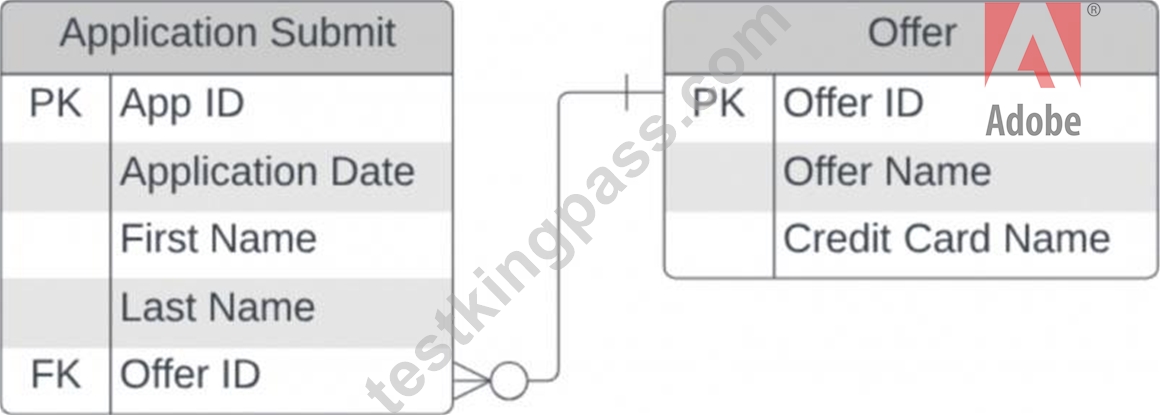
It is assumed that each application submit contains an offer that is always associated to a credit card name.
Assuming all applications are streamed into the Real-Time Customer Profile, in which two ways could a developer model the application submit event to ensure the real-time suppression requirement is supported? (Choose two.)
- A. Application Submit is modeled as an XDM Individual Profile class-based schema
- B. Application Submit is modeled as an XDM Experience Event class-based schema
- C. Offer is modeled as an object within the Application Submit schema
- D. Offer is de-normalized back into the Application Submit schema
Answer: B,D
NEW QUESTION # 54
......
Get The Important Preparation Guide With AD0-E605 Dumps: https://evedumps.testkingpass.com/AD0-E605-testking-dumps.html