


Free 2025 NCP-US-6.5 Dumps 100 Pass Guarantee With Latest Demo
Prepare NCP-US-6.5 Question Answers Free Update With 100% Exam Passing Guarantee [2025]
NEW QUESTION # 61
Which error logs should the administrator be reviewing to determine why the relates service is down?
- A. Arithmos.ERROR
- B. Solver.log
- C. Tcpkill.log
- D. Cerebro.ERROR
Answer: D
Explanation:
The error log that the administrator should review to determine why the relay service is down is Cerebro.
ERROR. Cerebro is a service that runs on each FSVM and provides relay functionality for Data Lens. Relay service is responsible for collecting metadata and statistics from FSVMs and sending them to Data Lens via HTTPS. If Cerebro.ERROR log shows any errors or exceptions related to relay service, it can indicate that relay service is down or not functioning properly. References: Nutanix Files Administration Guide, page 23; Nutanix Data Lens User Guide
NEW QUESTION # 62
How can an administrator deploy a new instance of Files?
- A. From LCM in Prism Central.
- B. From LCM in Prism Element.
- C. From the Storage view in Prism Element.
- D. From the Files Console view in Prism Central.
Answer: D
Explanation:
The Files Console view in Prism Central is the primary interface for deploying and managing Files clusters.
Administrators can use the Files Console to create a new instance of Files by providing the required information, such as cluster name, network configuration, storage capacity, and license key. References:
Nutanix Files Administration Guide
Deploying a new instance of Nutanix Files is done through the Files Console view in Prism Central, where the administrator can create a new File Server, specify the number of FSVMs, configure networks (Client and Storage), and allocate storage. This is the standard and supported method for Files deployment, providing a centralized interface for managing Files instances.
Exact Extract from Nutanix Documentation:
From the Nutanix Files Deployment Guide (available on the Nutanix Portal):
"To deploy a new instance of Nutanix Files, use the Files Console view in Prism Central. Navigate to the Files Console, select the option to create a new File Server, and configure the settings, including the number of FSVMs, network configuration, and storage allocation."
:
Nutanix Files Deployment Guide, Version 4.0, Section: "Deploying a New Files Instance" (Nutanix Portal).
Nutanix Certified Professional - Unified Storage (NCP-US) Study Guide, Section: "Nutanix Files Deployment".
NEW QUESTION # 63
An administrator has been directed to configure Volumes to Nutanix's best practices for security.
What should the administrate! do to be compliant?
- A. Configure Volume Groups to use CHAP.
- B. Use data services IP for external host connectivity.
- C. Segment iSCSI traffic to a physically separate network.
- D. Enable at-rest encryption on Volume Groups.
Answer: A
Explanation:
Nutanix Volumes is a feature that allows users to create and manage block storage devices (volume groups) on a Nutanix cluster. Volume groups can be accessed by external hosts using the iSCSI protocol. To secure volume groups from unauthorized access, Nutanix recommends configuring CHAP (Challenge-Handshake Authentication Protocol) for each volume group in Prism Element. CHAP is a security feature that authenticates iSCSI initiators and targets before allowing access to a volume group. CHAP requires both the initiator and the target to have a shared secret (a password) that is used to generate a challenge and a response during the authentication process. CHAP can prevent unauthorized access to volume groups and protect data from malicious attacks. References: Nutanix Volumes Administration Guide, page 25; Nutanix Volumes Security Guide Nutanix's best practices for Volumes security emphasize securing iSCSI connections through authentication.
Configuring Volume Groups to use CHAP ensures that only authorized initiators can access the storage, preventing unauthorized access and aligning with security compliance requirements. This is a direct and mandatory step for securing Volumes, making it the best choice among the options.
Exact Extract from Nutanix Documentation:
From the Nutanix Volumes Administration Guide (available on the Nutanix Portal):
"To align with Nutanix best practices for security, configure Volume Groups to use CHAP (Challenge- Handshake Authentication Protocol) for iSCSI authentication. This ensures that only authorized initiators can access the Volume Group, protecting against unauthorized access and enhancing security."
:
Nutanix Volumes Administration Guide, Version 6.0, Section: "Security Best Practices for Nutanix Volumes" (Nutanix Portal).
Nutanix Certified Professional - Unified Storage (NCP-US) Study Guide, Section: "Nutanix Volumes Security Configuration".
NEW QUESTION # 64
An administrator has received an alert A130357 - VolumeGroupProtectionFailedOnPC with the following details:
* Block Serial Number: 16Suxxxxxxxx
* Alert Time: Thu Jan 19 2023 20:31:10 GMT-0800 (PST)
* Alert Type: VolumeGroupProtectionFailedOnPC
* Alert Message: A130357:VolumeGroupProtectionFailedOnPC
* Cluster ID: xxxxx
* Alert Body: Volume Group protection failed on PCWhich two conditions need to be addressed to allow successful protection of the Volume Group? (Choose two.)
- A. Volume Group is protected in a legacy protection domain.
- B. The Protection Policy applied on Volume Group has an Async snapshot schedule applied.
- C. Volume Group is not protected in a legacy protection domain.
- D. The Protection Policy applied on Volume Group has a NearSync snapshot schedule applied.
Answer: A,D
Explanation:
The alert A130357 - VolumeGroupProtectionFailedOnPC in a Nutanix environment indicates a failure to protect a Volume Group (VG) in a Protection Domain (PD) managed through Prism Central (PC). Nutanix Volumes, part of Nutanix Unified Storage (NUS), provides block storage via iSCSI, and Volume Groups can be protected using Protection Domains for snapshots and replication. The alert suggests that the protection process failed, likely due to incompatible configurations.
Understanding the Issue:
* Volume Group Protection: A Volume Group in Nutanix Volumes can be added to a Protection Domain in Prism Central for data protection (e.g., snapshots, replication).
* Protection Failed on PC: The failure occurred during the protection process, managed through Prism Central, indicating an issue with the Protection Domain or policy settings.
* Conditions to Address: The failure is likely due to configuration mismatches or unsupported settings in the Protection Domain or policy.
Analysis of Conditions:
* Option A (Volume Group is protected in a legacy protection domain): Correct. A "legacy protection domain" refers to an older protection mechanism in Nutanix (e.g., from earlier AOS versions) that may not be fully compatible with newer Prism Central features or Volume Group protection workflows. If the Volume Group is part of a legacy PD, the protection process may fail due to deprecated features or APIs. Addressing this involves migrating the Volume Group to a modern Protection Domain in Prism Central, ensuring compatibility.
* Option B (The Protection Policy applied on Volume Group has an Async snapshot schedule applied): Incorrect. An Async (asynchronous) snapshot schedule is a standard and supported configuration for Volume Group protection in a Protection Domain. Async schedules take snapshots at intervals (e.g., hourly, daily) and replicate them to a remote site, and this does not cause protection failures-it's a valid setup.
* Option C (The Protection Policy applied on Volume Group has a NearSync snapshot schedule applied): Correct. NearSync is a near-synchronous replication schedule (e.g., 1-minute RPO, as in Question 24) that is supported for VMs and some Nutanix Files configurations, but it is not supported for Volume Groups in a Protection Domain. If a NearSync schedule is applied to a Volume Group's Protection Policy, the protection will fail because Volume Groups only support Async schedules.
Addressing this involves changing the schedule to an Async policy, which is compatible with Volume Groups.
* Option D (Volume Group is not protected in a legacy protection domain): Incorrect. This option suggests that the Volume Group is already in a modern (non-legacy) Protection Domain, which would not cause the failure. The issue lies in specific conditions (e.g., legacy PD or incompatible schedule), so this option does not identify a condition that needs addressing.
Selected Conditions:
* A: A legacy Protection Domain can cause compatibility issues, leading to protection failures. Migrating to a modern PD in Prism Central resolves this.
* C: A NearSync schedule is not supported for Volume Groups, causing the protection to fail. Switching to an Async schedule ensures compatibility.
Why These Conditions?
* Legacy Protection Domain (A): Legacy PDs may use outdated mechanisms that are incompatible with Prism Central's modern protection workflows for Volume Groups, causing failures.
* NearSync Schedule (C): Volume Groups in a Protection Domain only support Async snapshot schedules. A NearSync schedule, designed for low-RPO replication, is not supported and will cause the protection process to fail.
Exact Extract from Nutanix Documentation:
From the Nutanix Prism Alerts Reference Guide (available on the Nutanix Portal):
"Alert A130357 - VolumeGroupProtectionFailedOnPC: This alert is triggered when Volume Group protection fails in a Protection Domain managed through Prism Central. Common causes include:
* The Volume Group is protected in a legacy protection domain, which is not fully compatible with modern Prism Central workflows. Migrate the Volume Group to a modern Protection Domain.
* The Protection Policy applied to the Volume Group has a NearSync snapshot schedule, which is not supported for Volume Groups. Change the schedule to an Async policy to allow successful protection."
:
Nutanix Prism Alerts Reference Guide, Version 6.0, Section: "Alert A130357 - VolumeGroupProtectionFailedOnPC" (Nutanix Portal).
Nutanix Volumes Administration Guide, Version 6.0, Section: "Protecting Volume Groups with Protection Domains" (Nutanix Portal).
Nutanix Certified Professional - Unified Storage (NCP-US) Study Guide, Section: "Nutanix Volumes Data Protection".
NEW QUESTION # 65
An administrator has been requested to set up a Files instance in a Nutanix environment. After testing data in the environment, it was determined an estimated 4,000 connections on average will be needed per node. What is the proper memory sizing that the administrator should use to configure this environment?
- A. 32 GiB RAM per node
- B. 96 GiB RAM per node
- C. 40 GiB RAM per node
- D. 128 GiB RAM per node
Answer: B
Explanation:
Nutanix Files, part of Nutanix Unified Storage (NUS), uses File Server Virtual Machines (FSVMs) to manage file services (e.g., SMB, NFS). Each FSVM runs on a node in the Nutanix cluster, and the number of connections per node impacts the resource requirements, particularly memory (RAM), for the FSVMs. The administrator needs to size the memory for a Files instance where each node will handle an average of 4,000 connections.
Sizing Guidelines:
Nutanix provides sizing guidelines for Files deployments based on the number of connections per FSVM (and thus per node, assuming one FSVM per node, which is the default configuration). The memory requirements scale with the number of connections to ensure performance and stability:
* The minimum memory per FSVM is 12 GiB (as noted in Question 2), which supports up to 1,000 connections.
* For higher connection counts, Nutanix recommends increasing the memory proportionally.
According to Nutanix documentation:
* Up to 1,000 connections: 12 GiB RAM per FSVM.
* 1,000 to 2,000 connections: 24 GiB RAM per FSVM.
* 2,000 to 4,000 connections: 48 GiB RAM per FSVM.
* 4,000 to 8,000 connections: 96 GiB RAM per FSVM.
Since the question specifies 4,000 connections per node, and assuming one FSVM per node (standard deployment), the FSVM on each node needs to handle 4,000 connections. Based on the sizing guidelines:
* 4,000 connections fall into the 4,000 to 8,000 range, requiring 96 GiB RAM per FSVM.
* Since each node hosts one FSVM, this translates to 96 GiB RAM per node dedicated to the FSVM.
Analysis of Options:
* Option A (32 GiB RAM per node): Incorrect. 32 GiB RAM per node is sufficient for up to 2,000 connections (24 GiB for the FSVM, plus some overhead), but it is insufficient for 4,000 connections, which require 96 GiB.
* Option B (40 GiB RAM per node): Incorrect. 40 GiB RAM per node is still too low for 4,000 connections, as it falls short of the 96 GiB recommended for this connection range.
* Option C (96 GiB RAM per node): Correct. 96 GiB RAM per node aligns with Nutanix's sizing guidelines for an FSVM handling 4,000 to 8,000 connections, ensuring the Files instance can manage the expected load efficiently.
* Option D (128 GiB RAM per node): Incorrect. While 128 GiB RAM per node would work, it exceeds the recommended sizing for 4,000 connections. Nutanix recommends 96 GiB for up to 8,000 connections, and 128 GiB is typically reserved for even higher connection counts (e.g., >8,000) or additional workloads on the node. The question asks for the "proper" sizing, which is the minimum recommended for the given load, making 96 GiB the correct choice.
Why Option C?
For 4,000 connections per node, Nutanix recommends 96 GiB RAM per FSVM (one FSVM per node), which translates to 96 GiB RAM per node dedicated to the FSVM. This ensures the Files instance can handle the connection load without performance degradation, aligning with Nutanix's sizing guidelines.
Exact Extract from Nutanix Documentation:
From the Nutanix Files Sizing Guide (available on the Nutanix Portal):
"For Nutanix Files deployments, memory sizing depends on the number of connections per FSVM. For 4,000 to 8,000 connections, allocate 96 GiB of RAM per FSVM. Assuming one FSVM per node, this translates to
96 GiB RAM per node dedicated to the FSVM to ensure optimal performance." Additional Notes:
* The question assumes one FSVM per node, which is the default configuration for Nutanix Files unless otherwise specified. If multiple FSVMs were on a single node, the total RAM would need to be adjusted, but the question's phrasing ("per node") aligns with the standard one-FSVM-per-node deployment.
* The 96 GiB RAM is for the FSVM itself; the node may require additional RAM for other workloads (e.
g., CVM, VMs), but the question focuses on the Files instance's memory sizing, making 96 GiB the correct answer.
:
Nutanix Files Sizing Guide, Version 4.0, Section: "Memory Sizing for Nutanix Files" (Nutanix Portal).
Nutanix Certified Professional - Unified Storage (NCP-US) Study Guide, Section: "Nutanix Files Sizing and Performance".
NEW QUESTION # 66
Within the Prism Central Entity > Services > Objects menu option, what is the correct task order for creating an object storage?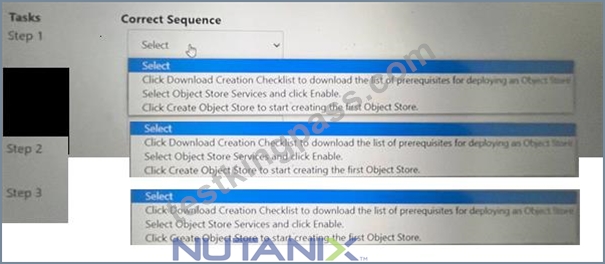
Answer:
Explanation: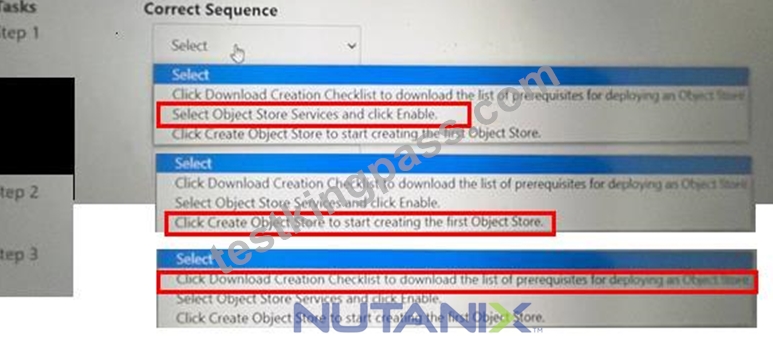
NEW QUESTION # 67
An administrator has been asked to confirm the ability of a physical windows Server 2019 host to boot from storage on a Nutanix AOS cluster.
Which statement is true regarding this confirmation by the administrator?
- A. Physical servers may boot from an object bucket from the data services IP address and MPIO is not required.
- B. Physical servers may boot from a volume group from the data services IP and MPIO is not required.
- C. Physical servers may boot from a volume group from the data services IP and MPIO is
- D. Physical servers may boot from an object bucket from the data services IP and MPIO is required.
Answer: C
Explanation:
Nutanix Volumes allows physical servers to boot from a volume group that is exposed as an iSCSI target from the data services IP. To ensure high availability and load balancing, multipath I/O (MPIO) is required on the physical server. Object buckets cannot be used for booting physical servers1. Reference: Nutanix Volumes Administration Guide1
NEW QUESTION # 68
An organization currently has two Objects instances deployed between two sites. Both instances are managed via manage the same Prism Central to simplify management.
The organization has a critical application with all data in a bucket that needs to be replicated to the secondary site for DR purposes. The replication needs to be asynchronous, including al delete the marker versions.
- A. Leverage the Objects Baseline Replication Tool from a Linus VM
- B. Use a protection Domain to replicate the objects Volume Group.
- C. Create a Bucket replication rule, set the destination Objects instances.
- D. With Object Browser, upload the data at the destination site.
Answer: C
Explanation:
The administrator can achieve this requirement by creating a bucket replication rule and setting the destination Objects instance. Bucket replication is a feature that allows administrators to replicate data from one bucket to another bucket on a different Objects instance for disaster recovery or data migration purposes.
Bucket replication can be configured with various parameters, such as replication mode, replication frequency, replication status, etc. Bucket replication can also replicate all versions of objects, including delete markers, which are special versions that indicate that an object has been deleted. By creating a bucket replication rule and setting the destination Objects instance, the administrator can replicate data from one Objects instance to another asynchronously, including all delete markers and versions. References: Nutanix Objects User Guide, page 19; Nutanix Objects Solution Guide, page 9 Nutanix Objects, part of Nutanix Unified Storage (NUS), supports replication of buckets between Object Store instances for disaster recovery (DR). The organization has two Objects instances across two sites, managed by the same Prism Central, and needs to replicate a bucket's data asynchronously, including delete marker versions, to the secondary site.
Analysis of Options:
* Option A (With Object Browser, upload the data at the destination site): Incorrect. The Object Browser is a UI tool in Nutanix Objects for managing buckets and objects, but it is not designed for replication. Manually uploading data to the destination site does not satisfy the requirement for asynchronous replication, nor does it handle delete marker versions automatically.
* Option B (Leverage the Objects Baseline Replication Tool from a Linux VM): Incorrect. The Objects Baseline Replication Tool is not a standard feature in Nutanix Objects documentation. While third-party tools or scripts might be used for manual replication, Nutanix provides a native solution for bucket replication, making this option unnecessary and incorrect for satisfying the requirement.
* Option C (Use a Protection Domain to replicate the Objects Volume Group): Incorrect. Protection Domains are used in Nutanix for protecting VMs and Volume Groups (block storage) via replication, but they do not apply to Nutanix Objects. Objects uses bucket replication rules for DR, not Protection Domains.
* Option D (Create a Bucket replication rule, set the destination Objects instance): Correct. Nutanix Objects supports bucket replication rules to replicate data between Object Store instances asynchronously. This feature allows the organization to replicate the bucket to the secondary site, including all versions (such as delete marker versions), as required. The replication rule can be configured in Prism Central, specifying the destination Object Store instance, and it supports asynchronous replication for DR purposes.
Why Option D?
Bucket replication in Nutanix Objects is the native mechanism for asynchronous replication between Object Store instances. It supports replicating all versions of objects, including delete marker versions (which indicate deleted objects in a versioned bucket), ensuring that the secondary site has a complete replica of the bucket for DR. Since both Object Store instances are managed by the same Prism Central, the administrator can easily create a replication rule to meet the requirement.
Exact Extract from Nutanix Documentation:
From the Nutanix Objects Administration Guide (available on the Nutanix Portal):
"Nutanix Objects supports asynchronous bucket replication for disaster recovery. To replicate a bucket to a secondary site, create a bucket replication rule in Prism Central, specifying the destination Object Store instance. The replication rule can be configured to include all versions, including delete marker versions, ensuring that the secondary site maintains a complete replica of the bucket for DR purposes."
:
Nutanix Objects Administration Guide, Version 4.0, Section: "Bucket Replication for Disaster Recovery" (Nutanix Portal).
Nutanix Certified Professional - Unified Storage (NCP-US) Study Guide, Section: "Nutanix Objects Replication Features".
NEW QUESTION # 69
An administrator has received an alert AI303551 - VolumeGroupProtectionFailed details of alerts as follows:
Which error logs should the administrator be reviewing to determine why the relative service is down:
- A. arithmos.ERROR
- B. solver.log
Answer: A
Explanation:
The error log that the administrator should review to determine why the relative service is down is arithmos.
ERROR. Arithmos is a service that runs on each CVM and provides volume group protection functionality for Volumes. Volume group protection is a feature that allows administrators to create protection policies for volume groups, which define how often snapshots are taken, how long they are retained, and where they are replicated. If arithmos.ERROR log shows any errors or exceptions related to volume group protection, it can indicate that the relative service is down or not functioning properly. References: Nutanix Volumes Administration Guide, page 29; Nutanix Volumes Troubleshooting Guide
NEW QUESTION # 70
An administrator is required to place all iSCSI traffic on an isolated network. How can the administrator meet this requirement?
- A. Configure the Data Services IP on an isolated network.
- B. Create a Volumes network in Prism Central.
- C. Configure network segmentation for Volumes.
- D. Create a new network interface on the CVMs via ncli.
Answer: A
NEW QUESTION # 71
An administrator needs to protect a Files cluster unique policies for different shares.
How should the administrator meet this requirement?
- A. Create a protection domain in the Data Protection view in Prism Central.
- B. Configure data protection polices in the Files view in Prism Central.
- C. Create a protection domain in the Data Protection view in Prism Element.
- D. Configure data protection polices in File Server view in Prism Element
Answer: B
Explanation:
The administrator can meet this requirement by configuring data protection policies in the Files view in Prism Central. Data protection policies are policies that define how file data is protected by taking snapshots, replicating them to another site, or tiering them to cloud storage. Data protection policies can be configured for each share or export in a file server in the Files view in Prism Central. The administrator can create different data protection policies for different shares or exports based on their protection needs and requirements. Reference: Nutanix Files Administration Guide, page 79; Nutanix Files Solution Guide, page 9
NEW QUESTION # 72
Workload optimization on Files is configured on which entity?
- A. Share
- B. File Server
- C. Container
- D. Volume
Answer: B
Explanation:
Workload optimization in Nutanix Files, part of Nutanix Unified Storage (NUS), involves tuning the Files deployment to handle specific workloads efficiently. This was previously discussed in Question 13, where workload optimization was based on FSVM quantity. The question now asks which entity workload optimization is configured on.
Analysis of Options:
* Option A (Volume): Incorrect. Volumes in Nutanix refer to block storage provided by Nutanix Volumes, not Nutanix Files. Workload optimization for Files does not involve Volumes, which are a separate entity for iSCSI-based storage.
* Option B (Share): Incorrect. Shares in Nutanix Files are the individual file shares (e.g., SMB, NFS) accessed by clients. While shares can be tuned (e.g., quotas, permissions), workload optimization in Files is not configured at the share level-it applies to the broader file server infrastructure.
* Option C (Container): Incorrect. Containers in Nutanix are logical storage pools managed by AOS, used to store data for VMs, Files, and other services. While Files data resides in a container, workload optimization is not configured at the container level-it is specific to the Files deployment.
* Option D (File Server): Correct. Workload optimization in Nutanix Files is configured at the File Server level, which consists of multiple FSVMs (as established in Question 13). The File Server is the entity that manages all FSVMs, shares, and resources, and optimization tasks (e.g., scaling FSVMs, adjusting resources) are applied at this level to handle workloads efficiently.
Why Option D?
Workload optimization in Nutanix Files involves adjusting resources and configurations at the File Server level, such as scaling the number of FSVMs (as in Question 13) or tuning memory and CPU for the File Server. The File Server encompasses all FSVMs and shares, making it the entity where optimization is configured to ensure the entire deployment can handle the workload effectively.
Exact Extract from Nutanix Documentation:
From the Nutanix Files Administration Guide (available on the Nutanix Portal):
"Workload optimization in Nutanix Files is configured at the File Server level. This involves adjusting the number of FSVMs, allocating resources (e.g., CPU, memory), and tuning configurations to optimize the File Server for specific workloads."
:
Nutanix Files Administration Guide, Version 4.0, Section: "Optimizing Nutanix Files for Workloads" (Nutanix Portal).
Nutanix Certified Professional - Unified Storage (NCP-US) Study Guide, Section: "Nutanix Files Performance Optimization".
NEW QUESTION # 73
Which two steps are required for enabling Data Lens? (Choose two.)
- A. Add File Services VM admin credentials to a MyNutanix account.
- B. In Prism, enable Pulse health monitoring.
- C. Configure the Data Services IP in Prism Central.
- D. Configure a MyNutanix account to access the Data Lens console-
Answer: C
Explanation:
The two steps that are required for enabling Data Lens are:
In Prism, enable Pulse health monitoring: Pulse is a feature that collects diagnostic and usage information from Nutanix clusters and services and sends it to Nutanix for analysis and support purposes. Pulse health monitoring is a feature that monitors the health status of Nutanix clusters and services and sends alerts to Nutanix if any issues are detected. To enable Data Lens, Pulse health monitoring must be enabled in Prism Element or Prism Central.
Configure the Data Services IP in Prism Central: Data Services IP is an IP address that is used for communication between Prism Central and Data Lens. Data Services IP must be configured in Prism Central before enabling Data Lens for any file server. Data Services IP must be routable from both Prism Central and Data Lens. Reference: Nutanix Files Administration Guide, page 93; Nutanix Data Lens Deployment Guide
NEW QUESTION # 74
Users are complaining about having to reconnecting to share when there are networking issues.
Which files feature should the administrator enable to ensure the sessions will auto-reconnect in such events?
- A. Workload Optimization
- B. Multi-Protocol Shares
- C. Connected Shares
- D. Durable File Handles
Answer: D
Explanation:
The Files feature that the administrator should enable to ensure the sessions will auto-reconnect in such events is Durable File Handles. Durable File Handles is a feature that allows SMB clients to reconnect to a file server after a temporary network disruption or a client sleep state without losing the handle to the open file. Durable File Handles can improve the user experience and reduce the risk of data loss or corruption. Durable File Handles can be enabled for each share in the Files Console. Reference: Nutanix Files Administration Guide, page 76; Nutanix Files Solution Guide, page 10
NEW QUESTION # 75
Which prerequisite is required to deploy Objects on AHV or ESXi?
- A. Prism Central version is 5.17.1 or later
- B. Port 9440 is accessible on both PE and PC
- C. Valid SSL Certificate
- D. Nutanix STARTER License
Answer: B
Explanation:
Nutanix Objects, part of Nutanix Unified Storage (NUS), is an S3-compatible object storage solution that can be deployed on AHV or ESXi hypervisors. Deploying Objects has specific prerequisites to ensure successful installation and operation.
Analysis of Options:
* Option A (Prism Central version is 5.17.1 or later): Incorrect. While Nutanix Objects requires Prism Central for deployment and management, the minimum version for Objects deployment is typically lower (e.g., Prism Central 5.15 or later, depending on the Objects version). Version 5.17.1 is not a specific requirement for Objects deployment on AHV or ESXi.
* Option B (Port 9440 is accessible on both PE and PC): Correct. Port 9440 is used for communication between Prism Element (PE) and Prism Central (PC), as well as for internal Nutanix services. When deploying Objects, Prism Central communicates with the cluster (via Prism Element) to deploy Object Store Service VMs. This communication requires port 9440 to be open between PE and PC, making it a key prerequisite.
* Option C (Valid SSL Certificate): Incorrect. While a valid SSL certificate is recommended for secure communication (e.g., for S3 API access), it is not a strict prerequisite for deploying Objects. Objects can be deployed with self-signed certificates, though Nutanix recommends replacing them with valid certificates for production use.
* Option D (Nutanix STARTER License): Incorrect. The Nutanix STARTER license is an entry-level license for basic cluster functionality (e.g., VMs, storage). However, Nutanix Objects requires a separate license (e.g., Objects license or a higher-tier AOS license like Pro or Ultimate). The STARTER license alone does not support Objects deployment.
Why Option B?
Port 9440 is critical for communication between Prism Element and Prism Central during the deployment of Objects. If this port is blocked, the deployment will fail, as Prism Central cannot communicate with the cluster to deploy the Object Store Service VMs.
Exact Extract from Nutanix Documentation:
From the Nutanix Objects Deployment Guide (available on the Nutanix Portal):
"Before deploying Nutanix Objects on AHV or ESXi, ensure that port 9440 is accessible between Prism Element (PE) and Prism Central (PC). This port is required for communication during the deployment process, as Prism Central manages the deployment of Object Store Service VMs on the cluster."
:
Nutanix Objects Deployment Guide, Version 4.0, Section: "Prerequisites for Deploying Objects" (Nutanix Portal).
Nutanix Certified Professional - Unified Storage (NCP-US) Study Guide, Section: "Nutanix Objects Deployment Requirements".
NEW QUESTION # 76
Which scenario is causing the alert and need to be addressed to allow the entities to be protected?
- A. One or more VMs or Volume Groups belonging to the Consistency Group is part of multiple Recovery Plans configured with a Witness.
- B. The logical timestamp for one or more of the Volume Groups is not consistent between clusters
- C. One or more VMs or Volume Groups belonging to the Consistency Group may have been deleted
- D. One or more VMs or Volume Groups belonging to the Consistency Group contains state metadata
Answer: C
Explanation:
The scenario that is causing the alert and needs to be addressed to allow the entities to be protected is that one or more VMs or Volume Groups belonging to the Consistency Group may have been deleted. A Consistency Group is a logical grouping of VMs or Volume Groups that are protected together by a Protection Policy. A Protection Policy is a set of rules that defines how often snapshots are taken, how long they are retained, and where they are replicated for disaster recovery purposes. If one or more VMs or Volume Groups belonging to the Consistency Group are deleted, the Protection Policy will fail to protect them and generate an alert with the code AI303551 - VolumeGroupProtectionFailed. References: Nutanix Volumes Administration Guide, page 29; Nutanix Volumes Troubleshooting Guide
NEW QUESTION # 77
......
Nutanix NCP-US-6.5 Exam Syllabus Topics:
| Topic | Details |
|---|---|
| Topic 1 |
|
| Topic 2 |
|
| Topic 3 |
|
| Topic 4 |
|
| Topic 5 |
|
| Topic 6 |
|
| Topic 7 |
|
| Topic 8 |
|
| Topic 9 |
|
Dumps Real Nutanix NCP-US-6.5 Exam Questions [Updated 2025]: https://evedumps.testkingpass.com/NCP-US-6.5-testking-dumps.html