


2026 Valid 1z1-076 test answers & Oracle Exam PDF
Free Oracle 1z1-076 Exam Questions and Answer from Training Expert TestkingPass
NEW QUESTION # 22
Which FOUR database parameters might be affected by or influence the creation of standby databases?
- A. ARCHIVE_LAG_TARGET
- B. FALSERVER
- C. STANDBY_ARCHIVE_DEST
- D. COMPATIBLE
- E. db_file_name_convert
- F. DB_NAME
Answer: C,D,E,F
Explanation:
* DB_NAME (A): The name of the database, which should remain consistent across the primary and standby databases.
* db_file_name_convert (C): This parameter helps define the mapping of data file names from the primary to the standby database, which is crucial during the creation and operation of a standby database.
* COMPATIBLE (D): The compatibility level can influence the features that can be used on the standby database and must be consistent with or higher than that of the primary database, especially after upgrades.
* STANDBY_ARCHIVE_DEST (F): This parameter specifies the destination of archived redo log files on the standby database, which is important for log transport and apply services.
References:
* Oracle Data Guard Concepts and Administration Guide
* Oracle Database Reference
NEW QUESTION # 23
Examine the Data Guard configuration: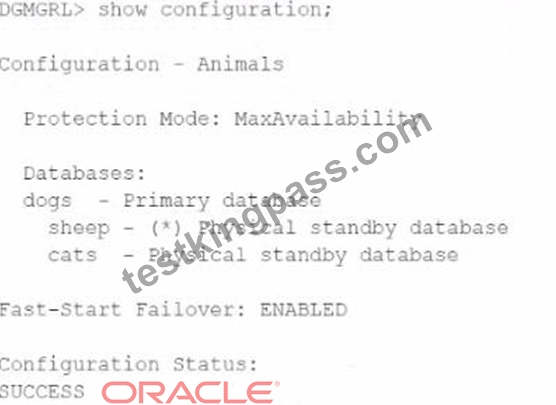
What happens if you issue "switchover to sheep;" at the DGMGRL prompt?
- A. It results in an error indicating that a switchover is not allowed.
- B. The switchover succeeds and Fast-Start Failover is suspended.
- C. The switchover succeeds and Dogs becomes the new failover target.
- D. The switchover succeeds but Dogs needs to be reinstated.
- E. The switchover succeeds and Cats becomes the new failover target.
Answer: C
Explanation:
When issuing a "switchover to sheep;" command in a Data Guard configuration, the primary database (Dogs) transitions to a standby role, and the target standby database (Sheep) becomes the new primary database. Fast-Start Failover (FSFO) remains enabled, but its target changes according to the new roles of the databases. Since Cats is also a physical standby database, it does not become the failover target by default unless it is specified in the broker configuration. After the switchover, the original primary (Dogs) becomes the new standby database and thus the new failover target for FSFO.
Reference:
Oracle Data Guard Broker documentation provides detailed procedures and explanations of switchover operations, including how FSFO targets are affected post-switchover. This behavior is consistent across different Oracle Database versions that support Data Guard and FSFO.
NEW QUESTION # 24
You notice that the SQL apply lag on your logical standby database has increased but the redo transport lag has not.
Which four could be reasons for the increase in SQL apply lag?
- A. Many SQL apply operations do full table scans
- B. An undersized undo tablespace on the logical standby
- C. The standby redo log files are undersized on the primary database
- D. An increased number of bulk inserts on the primary
- E. An increased number of bulk updates on the primary
- F. An undersized shared pool
Answer: A,B,E,F
Explanation:
The SQL apply lag on a logical standby database can be caused by several factors:
A: An undersized undo tablespace can lead to delays in SQL apply operations as it may not be able to handle the volume of undo records generated by the SQL apply process.
B: SQL apply operations that do full table scans can consume significant system resources, potentially leading to higher apply lag.
C: An increased number of bulk updates on the primary database may generate a large volume of redo data, which can cause apply lag if the logical standby cannot apply the changes quickly enough.
F: An undersized shared pool may affect the parsing and execution of SQL statements by SQL apply, which can contribute to the apply lag.
Option D is less likely to be a direct cause of SQL apply lag compared to bulk updates, as inserts generate new data rather than modifying existing data, which SQL apply can typically handle more efficiently.
Option E is incorrect because the size of the standby redo log files on the primary database impacts redo transport lag, not SQL apply lag.
NEW QUESTION # 25
You must configure flashback database for your Oracle 19c databases that will be part of a Data Guard Broker configuration.
The databases are all in ARCHIVELOG mode.
You will execute the SQL statement:
ALTER DATABASE FLASHBACK ON;
Which three are true concerning this command?
- A. It will execute successfully while an Oracle 19c primary database is open.
- B. It will execute successfully on an Oracle 19c physical standby database while Real Time Query is active.
- C. If executed successfully on an Oracle 19c primary database, flashback will also be enabled on all physical standby databases that are part of the configuration.
- D. It will execute successfully on an Oracle 19c logical standby database while SQL apply is active.
- E. It will execute successfully while an Oracle 19c primary database is mounted.
- F. If executed successfully on an Oracle 19c primary database, flashback will also be enabled on all logical standby databases that are part of the configuration.
Answer: A,D,E
Explanation:
The command ALTER DATABASE FLASHBACK ON; enables the Flashback Database feature, which provides a way to quickly revert an entire Oracle database back to a previous point in time. This command can be executed while an Oracle 19c primary database is either open (option A) or mounted (option B). It is also applicable to an Oracle 19c logical standby database while SQL Apply is active (option E). However, it's important to note that enabling Flashback Database on the primary does not automatically enable it on all associated standby databases, whether they are physical or logical. Each database in a Data Guard configuration must have Flashback Database explicitly enabled if desired. Real Time Query being active on a physical standby does not directly relate to the ability to execute this command on the standby. Reference: The explanation is based on Oracle's concepts for Flashback Technology and Data Guard configurations as detailed in the Oracle Database Backup and Recovery User's Guide and the Oracle Data Guard Concepts and Administration guide.
NEW QUESTION # 26
A Data Guard environment has this configuration and these attributes:
The primary database prima is in the local region.
A physical standby database physt1 is in the local region.
A physical standby database physt2 is in a remote region.
The primary ships redo to physt1.
physt1 ships redo to physt2.
physt1 and physt2 have Real-Time Query enabled.
A sequence has been created with this SQL statement in the primary database:
CREATE SEQUENCE a NOCACHE SESSION;
Which TWO statements are TRUE?
- A. The sequence is usable on physt1 and physt2.
- B. physt2 will no longer receive redo if physt1 becomes unavailable, unless LOG_ARCHIVE_DEST_n has the ALTERNATE attribute specified on the primary database.
- C. The sequence is usable on physt1 but not usable on physt2.
- D. The sequence is usable on physt2 if physt1 becomes unavailable, but only if an alternate redo destination has been configured on the primary database.
- E. physt2 will no longer receive redo if physt1 becomes unavailable, unless LOG_ARCHIVE_DEST_n has the ALTERNATE attribute specified on physt1.
Answer: A,B
NEW QUESTION # 27
Which three are prerequisites for enabling Fast-Start Failover?
- A. You can specify only one standby database as the fast-start failover target.
- B. Flashback Database must be enabled only on the Fast-Start Failover target standby database.
- C. The configuration must be operating in either Maximum Performance or Maximum Protection mode.
- D. The maximum protection mode can be used, but with two or more standby databases.
- E. Flashback Database must be enabled on both the primary database and the Fast-Start Failover target standby database.
- F. The Data Guard environment must be managed by the Data Guard Broker.
Answer: A,E,F
Explanation:
To enable Fast-Start Failover in a Data Guard environment, the following conditions must be in place:
* The Data Guard environment must be managed by the Data Guard Broker (A): The Broker simplifies management tasks and is required to enable fast-start failover, which is an automatic failover mechanism provided by Data Guard.
* You can specify only one standby database as the fast-start failover target (C): Fast-start failover is designed to fail over to a single, predetermined standby database, known as the target standby.
* Flashback Database must be enabled on both the primary database and the Fast-Start Failover target standby database (F): Flashback Database provides a quick way to revert a database to a point
* in time before a logical or physical corruption or error occurred. It must be enabled on both the primary and target standby databases to allow for the possibility of reinstating the old primary as a standby after a failover.References:
* Oracle Data Guard Concepts and Administration Guide
* Oracle Database High Availability Overview
NEW QUESTION # 28
Which TWO statements are true about Real-Time Query?
- A. Setting standby_max_data_delay=0 requires synchronous redo transport.
- B. Disabling Real-Time Query prevents the automatic start of redo apply when a physical standby databases opened read only.
- C. A standby database enabled for Real-Time Query cannot be the Fast-Start Failover target of the Data Guard configuration.
- D. Real-Time Query has no limitations regarding the protection level of the Data Guard environment.
- E. Real-Time Query sessions can be connected to a Far Sync instance.
Answer: A,B
Explanation:
Real-Time Query is a feature that allows queries to be run on a physical standby database while it is applying redo data. The relevant truths about it are:
* Setting standby_max_data_delay=0 requires synchronous redo transport (A): For the real-time apply feature to function with no data delay (zero delay), synchronous redo transport must be used. This setting ensures that the data on the standby database is as current as possible before queries are executed against it.
* Disabling Real-Time Query prevents the automatic start of redo apply when a physical standby database is opened read-only (C): If Real-Time Query is disabled, opening the standby database in read-only mode will not start the redo apply process automatically. Redo apply needs to be manually started to synchronize the standby database with the primary.References:
* Oracle Data Guard Concepts and Administration Guide
NEW QUESTION # 29
Which three statements are true about snapshot standby databases?
- A. A resize command to reduce the size of an empty datafile in the snapshot standby database, which was created in the physical standby database, will succeed.
- B. A resize command to reduce the size of an empty datafile in the snapshot standby database, which was created in the snapshot standby database, will succeed.
- C. A resize command to extend the size of a datafile in the snapshot standby database, which was created in the primary database, will succeed.
- D. A resize command to reduce the size of an empty datafile in the snapshot standby database, which was created in the primary database, will succeed.
- E. A resize command to extend the size of a datafile in the snapshot standby database, which was created in the snapshot standby database, will succeed.
Answer: B,C,E
NEW QUESTION # 30
You are using Data Guard in conjunction with Global Database Services.
You have a Data Guard Broker configuration called Sales and a GDS pool called Prod.
Which three are true concerning the management of the broker configuration when using GDS?
- A. Adding a database to the Sales configuration with DGMGRL requires that the Sales configuration be disabled first. It must then be enabled after the new database is added to the configuration.
- B. DGMGRL may be used to add a single database to the Sales configuration even if Sales is a member of the Prod pool.
- C. Performing a role change with DGMGRL automatically notifies GDS which in turn activates the appropriate services.
- D. DGMGRL may be used to add the Sales configuration to the Prod pool in gds.
- E. Adding a database to the Sales configuration with DGMGRL automatically adds the database to the Prod Pool.
Answer: B,C,D
Explanation:
In the context of Oracle Data Guard and Global Database Services (GDS):
* DGMGRL may be used to add the Sales configuration to the Prod pool in gds (A): Data Guard Broker's command-line interface DGMGRL can be utilized to manage configurations with GDS, allowing the addition of Data Guard Broker configurations to GDS pools.
* Performing a role change with DGMGRL automatically notifies GDS which in turn activates the appropriate services (B): When a role change is executed using DGMGRL, GDS is automatically notified, and it then activates the services that are appropriate for the new database roles.
* DGMGRL may be used to add a single database to the Sales configuration even if Sales is a member of the Prod pool (C): DGMGRL provides the capability to manage individual databases within a broker configuration, including adding databases to a configuration that is already part of a GDS pool.References:
* Oracle Data Guard Broker documentation
* Oracle Global Data Services documentation
NEW QUESTION # 31
Which THREE are true about using flashback database in a Data Guard environment?
- A. It may not be used to flash back a primary database after a failover to a physical standby.
- B. You can use it when real-time apply is enabled in case the physical standby suffers from logical corruption.
- C. When a flashback database operation is performed on a primary database, a logical standby database is also flashed back automatically.
- D. You can use it when real-time apply is enabled in case the phylt may not be used to flash back a primary database after a failover to a logical standby.
- E. It may be used to flash back a physical standby that receives redo from a far sync instance.
- F. When a flashback database operation is performed on a primary database, a physical standby database is also flashed back automatically.
Answer: A,B,E
NEW QUESTION # 32
Examine this validate command:
DGMGRL> VALIDATE DATABASE VERBOSE "<database name>";
Which THREE statements are TRUE?
- A. The command uses information available in various Oracle Data Guard views as well as the Automatic Diagnostic Repository.
- B. The command performs a comprehensive set of database checks prior to a role change.
- C. The command performs network connectivity checks between members of a broker configuration.
- D. The command performs a comparison of SPFILE entries between the primary database and a specified standby database.
- E. The command can be used for a logical standby database.
Answer: B,C,E
Explanation:
* The command performs a comprehensive set of database checks prior to a role change (A): The VALIDATE DATABASE command in Data Guard Manager (DGMGRL) is designed to perform an exhaustive check of a specified database's readiness for a role change, such as a switchover or failover.
* The command performs network connectivity checks between members of a broker configuration (C): One of the checks includes verifying that the necessary network connectivity exists between the databases in a Data Guard Broker configuration.
* The command can be used for a logical standby database (D): The VALIDATE DATABASE command is versatile and can be used for both physical and logical standby databases to ensure their readiness for role changes.
References:
* Oracle Data Guard Broker documentation
* Oracle Data Guard Concepts and Administration Guide
NEW QUESTION # 33
You are licensed to use Oracle Active Data Guard.
Which TWO statements are true after enabling block change tracking on a physical standby database?
- A. It starts the CTWR process on the physical standby database instance.
- B. It allows fast incremental backups to be offloaded to the physical standby database.
- C. It starts the RVWR process on the physical standby database instance.
- D. It allows fast incremental backups to be offloaded to a snapshot standby database, when the physical standby database is converted.
- E. It allows fast incremental backups to be taken on the primary database.
- F. It starts the CTWR process on the primary database instance.
Answer: B,C
Explanation:
Block change tracking is a feature that enhances the efficiency of incremental backups by recording changed blocks in a tracking file. When used with Oracle Active Data Guard:
It starts the RVWR process on the physical standby database instance (A): When block change tracking is enabled on a physical standby database, the Recovery Writer (RVWR) process is initiated. This process is responsible for recording the changes to blocks in the block change tracking file, which is then used to optimize incremental backups.
It allows fast incremental backups to be offloaded to the physical standby database (E): With block change tracking enabled on the physical standby database, fast incremental backups can be offloaded from the primary database. This reduces the workload on the primary database and utilizes the standby database for backup operations, improving overall system performance and efficiency.
Reference:
Oracle Database Backup and Recovery User's Guide
Oracle Active Data Guard documentation
NEW QUESTION # 34
Which four factors can influence the rate of SQL apply on a logical standby database?
- A. the number of full table scans performed by SQL apply
- B. the number of PREPAER processes
- C. the size of the shared pool
- D. the number of coordinator processes on the standby database instance
- E. the number of applier processes
- F. the size of the undo tablespace on the logical standby database
Answer: A,B,D,E
Explanation:
The rate of SQL apply on a logical standby database can be influenced by:
* A: The number of PREPARER processes (which seems to be a typographical error and should read as PREPARER or similar) which prepare the redo data for the applier processes.
* B: The number of coordinator processes on the standby database instance which coordinate the SQL apply activities.
* C: The number of full table scans performed by SQL apply since full table scans can be resource-intensive and slow down the apply rate.
* E: The number of applier processes which apply the redo data to the logical standby database.
Option D is incorrect as the size of the undo tablespace on the logical standby database is more likely to affect the SQL apply lag rather than the rate of SQL apply.
Option F is incorrect because the size of the shared pool would typically not influence the rate of SQL apply.
The shared pool is more related to the caching of shared SQL and PL/SQL code and control structures.
References: Oracle's documentation on SQL Apply in Data Guard configurations discusses the factors affecting the performance of SQL Apply operations on logical standby databases.
NEW QUESTION # 35
Which three are true concerning database states after a successful switchover?
- A. The new primary database will be open read-write.
- B. If the former primary database became a logical standby database it will be open read-write.
- C. If the former primary database became a physical standby database it will always be open readonly.
- D. If the former primary database became a logical standby database it will be in mount state.
- E. The former primary database will always be open.
- F. If the former primary database became a physical standby database it will be in the same state as the former physical standby database.
Answer: A,B,F
Explanation:
After a successful switchover operation in a Data Guard environment, the new primary database (the former standby) will be open read-write (option A). If the former primary database transitions to a logical standby database, it will also be open read-write (option C), allowing it to apply redo data while servicing read-only queries. The former primary, if converted to a physical standby, will adopt the state that the former physical standby database was in prior to the switchover, which can vary based on the configuration prior to the switchover (option D). The state of a physical standby database can range from mounted to open read-only, depending on whether Real-Time Query was enabled. Thus, the exact state will depend on the pre-switchover setup. It's also essential to highlight that options B and E suggest specific states for a former primary turned logical standby, and a former primary turned physical standby, respectively, but these states are not fixed and depend on the configurations set up by the database administrators. References: The answers are corroborated by Oracle's documentation on Data Guard switchovers, specifically in the Oracle Data Guard Concepts and Administration guide, which explains the roles and states of databases in a Data Guard configuration before and after switchovers.
NEW QUESTION # 36
Which three are true regarding prerequisites for a logical standby database as a disaster recovery solution?
- A. Do not perform any nologging operations on the primary.
- B. Ensure that supplemental logging is enabled on the primary database.
- C. Ensure that no ROWID data types are contained in the primary database.
- D. Ensure that flashback is enabled on the primary database.
- E. Ensure that no BFILE LOB data types are contained in the primary database.
Answer: A,B,E
NEW QUESTION # 37
Which THREE are among the various tasks performed by the Data Guard Monitor (DMON) process?
- A. communicating with the DMON process of the observer to monitor a primary database in case a fast start failover is required
- B. communicating with dkon processes in other database instances that are part of the broker configuration
- C. maintaining information about all members of the broker configuration in binary configuration files.
- D. activating role-based services appropriately in the various database instances of the configuration, based on the database role
- E. performing role transitions when switchover requests are made
Answer: C,D,E
Explanation:
The Data Guard Monitor (DMON) process is a key component of Oracle Data Guard. It plays a crucial role in managing and monitoring the state of both the primary and standby databases in a Data Guard configuration.
* Performing role transitions when switchover requests are made (A): DMON is responsible for coordinating the switchover process between the primary and standby databases. This involves safely transitioning the roles of the databases to ensure data protection and availability.
* Maintaining information about all members of the broker configuration in binary configuration files (B): DMON maintains detailed information about the databases in the Data Guard configuration, including their roles, states, and network addresses. This information is stored in binary configuration files, which are used by the Data Guard Broker to manage the Data Guard environment.
* Activating role-based services appropriately in the various database instances of the configuration, based on the database role (C): DMON activates services that are appropriate for the role of each database in the Data Guard configuration. For example, it may activate different services on a primary database than on a standby database, based on the specific requirements of each role.
References:
* Oracle Data Guard Concepts and Administration
* Oracle Data Guard Broker documentation
NEW QUESTION # 38
Which TWO observations are true about the Far Sync instance?
- A. Can be created using the RMAN DUPLICATE command
- B. Can only be created using a series of SQL commands
- C. Applies redo received
- D. Includes a standby control file, password file, data files, standby redo logs, and archive logs
- E. Receives redo synchronously from the primary database
Answer: C,E
Explanation:
A Far Sync instance is a special kind of Oracle Data Guard configuration that allows synchronous redo transport from a primary database to a remote standby database with minimum impact on the primary database's performance. The Far Sync instance receives redo data synchronously from the primary database (A), then ships it asynchronously to the remote standby database, thus extending zero data loss protection over longer distances and higher network latency environments than would be practical with a synchronous standby alone. The Far Sync instance does not apply the redo data; it just receives and ships it (E). A Far Sync instance does not have data files, and it cannot apply redo to stay synchronized with the primary database.
References:Oracle Database High Availability Overview and Oracle Data Guard Concepts and Administration documentation detail the role and configuration of Far Sync instances, including how they contribute to achieving zero data loss disaster recovery over long distances.
NEW QUESTION # 39
......
Oracle 1z1-076 Exam Syllabus Topics:
| Topic | Details |
|---|---|
| Topic 1 |
|
| Topic 2 |
|
| Topic 3 |
|
| Topic 4 |
|
| Topic 5 |
|
| Topic 6 |
|
| Topic 8 |
|
| Topic 9 |
|
| Topic 10 |
|
| Topic 11 |
|
| Topic 12 |
|
Top Oracle 1z1-076 Courses Online: https://evedumps.testkingpass.com/1z1-076-testking-dumps.html