


[2025] 300-410 Dumps are Available for Instant Access
Valid 300-410 Dumps for Helping Passing 300-410 Exam!
NEW QUESTION # 47
Refer to the exhibit.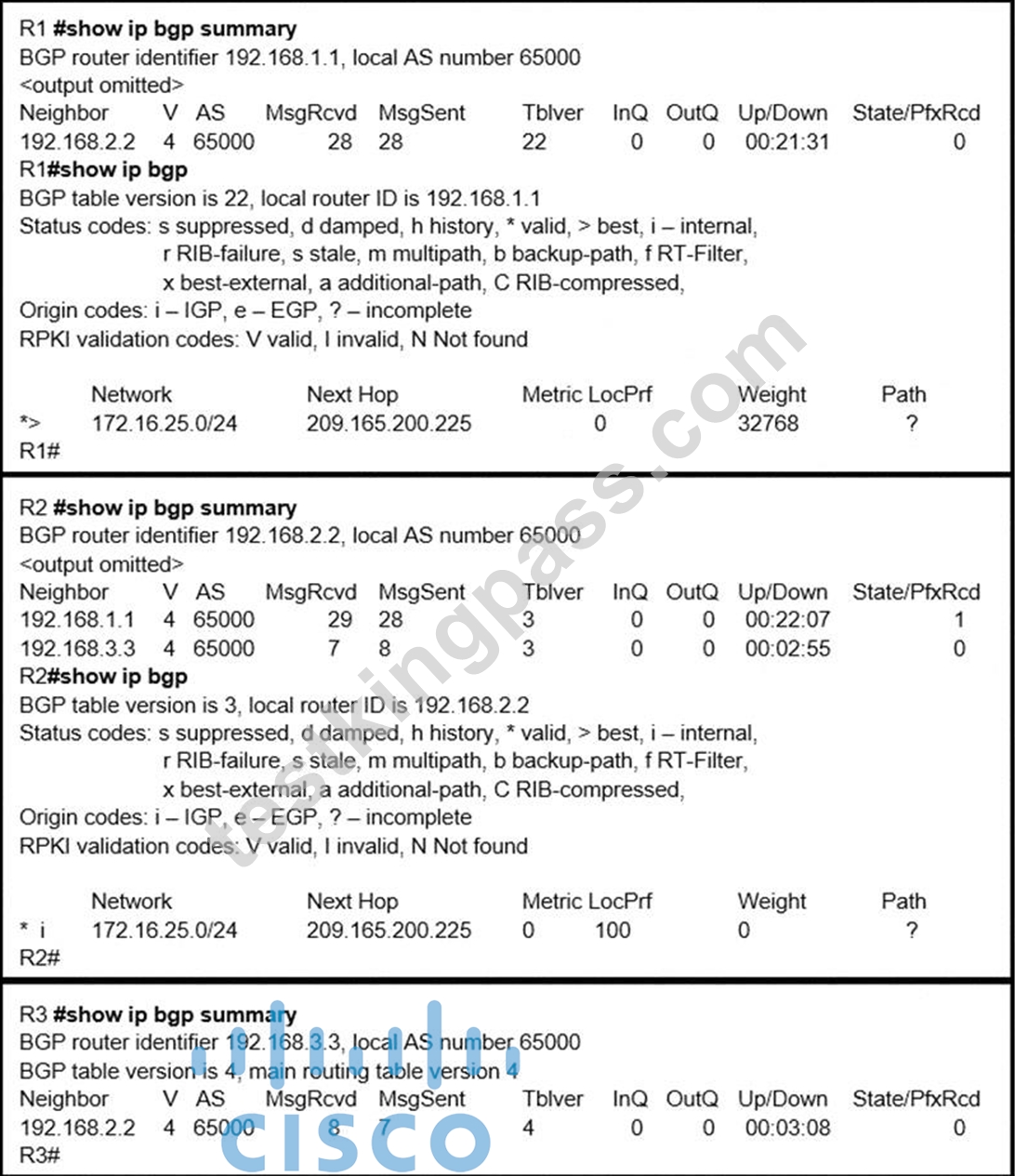
R2 is a route reflector, and R1 and R3 are route reflector clients. The route reflector learns the route to
172.16.25.0/24 from R1, but it does not advertise to R3. What is the reason the route is not advertised?
- A. In route reflector setups, prefixes are not advertised from one client to another.
- B. Route reflector setup requires full IBGP mesh between the routers.
- C. In route reflector setup, only classful prefixes are advertised to other clients.
- D. R2 does not have a route to the next hop, so R2 does not advertise the prefix to other clients.
Answer: D
NEW QUESTION # 48
What is LDP label binding?
- A. source prefix with label
- B. destination prefix with label
- C. two routers with label distribution session
- D. neighboring router with label
Answer: B
Explanation:
Text Description automatically generated with medium confidence
NEW QUESTION # 49
Refer to the exhibit. A network engineer troubleshooting a packet drop problem for the host
172.16.100.5 notices that only one link is used and installed on the routing table, which saturates the bandwidth. Which action must the engineer take to resolve the high bandwidth utilization problem and share the traffic toward this host between the two available links?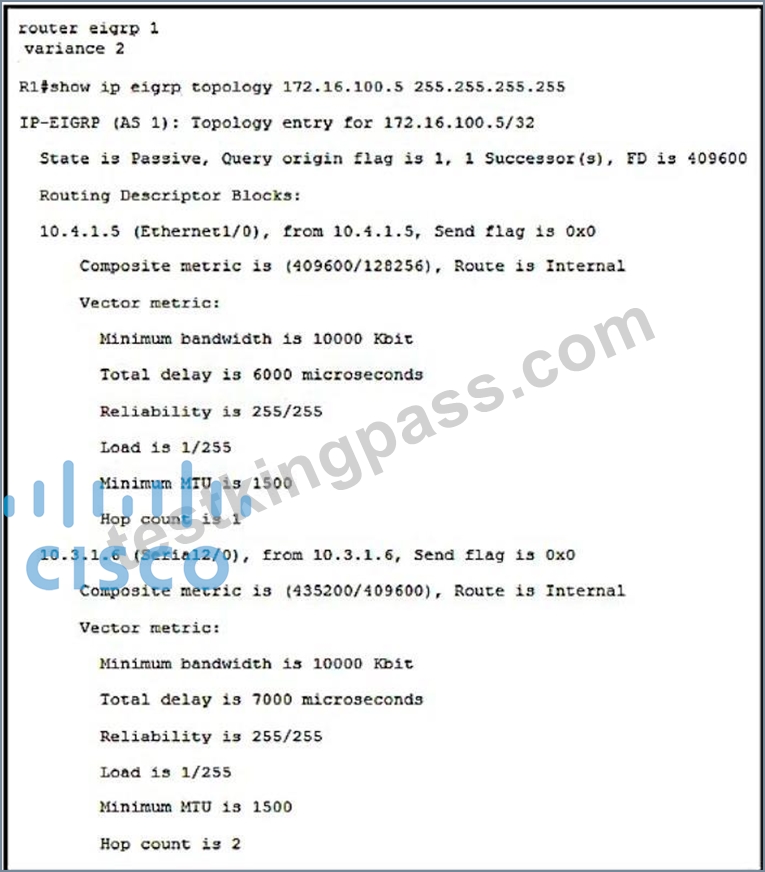
- A. Set the eigrp variance equal to 3 to install a second route with a metric not larger than 3 times of the best metric.
- B. Set the eigrp variance equal to 4 to install a second route with a metric not larger than 4 times of the best metric.
- C. Change the EIGRP delay metric to meet the feasibility condition.
- D. Disable the eigrp split horizon loop protection mechanism.
Answer: C
NEW QUESTION # 50
Exhibit: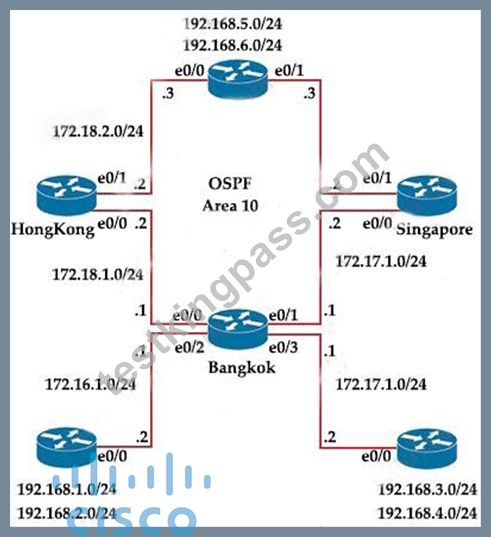
Bangkok is using ECMP to reach to the 192.168.5.0/24 network. The administrator must configure Bangkok in such a way that Telnet traffic from 192.168.3.0/24 and192.168.4.0/24 networks uses the HongKong router as the preferred router. Which set of configurations accomplishes this task?
- A. access-list 101 permit tcp 192.168.3.0 0.0.0.255 192.168.5.0 0.0.0.255 access-list 101 permit tcp 192.168.4.0 0.0.0.255 192.168.5.0 0.0.0.255
!
route-map PBR1 permit 10
match ip address 101
set ip next-hop 172.18.1.2
!
interface Ethernet0/1
ip policy route-map PBR1 - B. access-list 101 permit tcp 192.168.3.0 0.0.0.255 192.168.5.0 0.0.0.255 eq 23 access-list 101 permit tcp 192.168.4.0 0.0.0.255 192.168.5.0 0.0.0.255 eq 23
!
route-map PBR1 permit 10
match ip address 101
set ip next-hop 172.18.1.2
interface Ethernet0/1
ip policy route-map PBR1 - C. access-list 101 permit tcp 192.168.3.0 0.0.0.255 192.168.5.0 0.0.0.255 access-list 101 permit tcp 192.168.4.0 0.0.0.255 192.168.5.0 0.0.0.255
!
route-map PBR1 permit 10
match ip address 101
set ip next-hop 172.18.1.2
interface Ethernet0/3
ip policy route-map PBR1 - D. access-list 101 permit tcp 192.168.3.0 0.0.0.255 192.168.5.0 0.0.0.255 eq 23 access-list 101 permit tcp 192.168.4.0 0.0.0.255 192.168.5.0 0.0.0.255 eq 23
!
route-map PBR1 permit 10
match ip address 101
set ip next-hop 172.18.1.2
!
interface Ethernet0/3
ip policy route-map PBR1
Answer: D
Explanation:
We need to use Policy Based Routing (PBR) here on Bangkok router to match the traffic from 192.168.3.0/24 & 192.168.4.0/24 and "set ip next-hop" to HongKong router(172.18.1.2 in this case).
Note: Please notice that we have to apply the PBR on incoming interface e0/3 to receive traffic from 192.168.3.0/24 and 192.168.4.0/24.
NEW QUESTION # 51 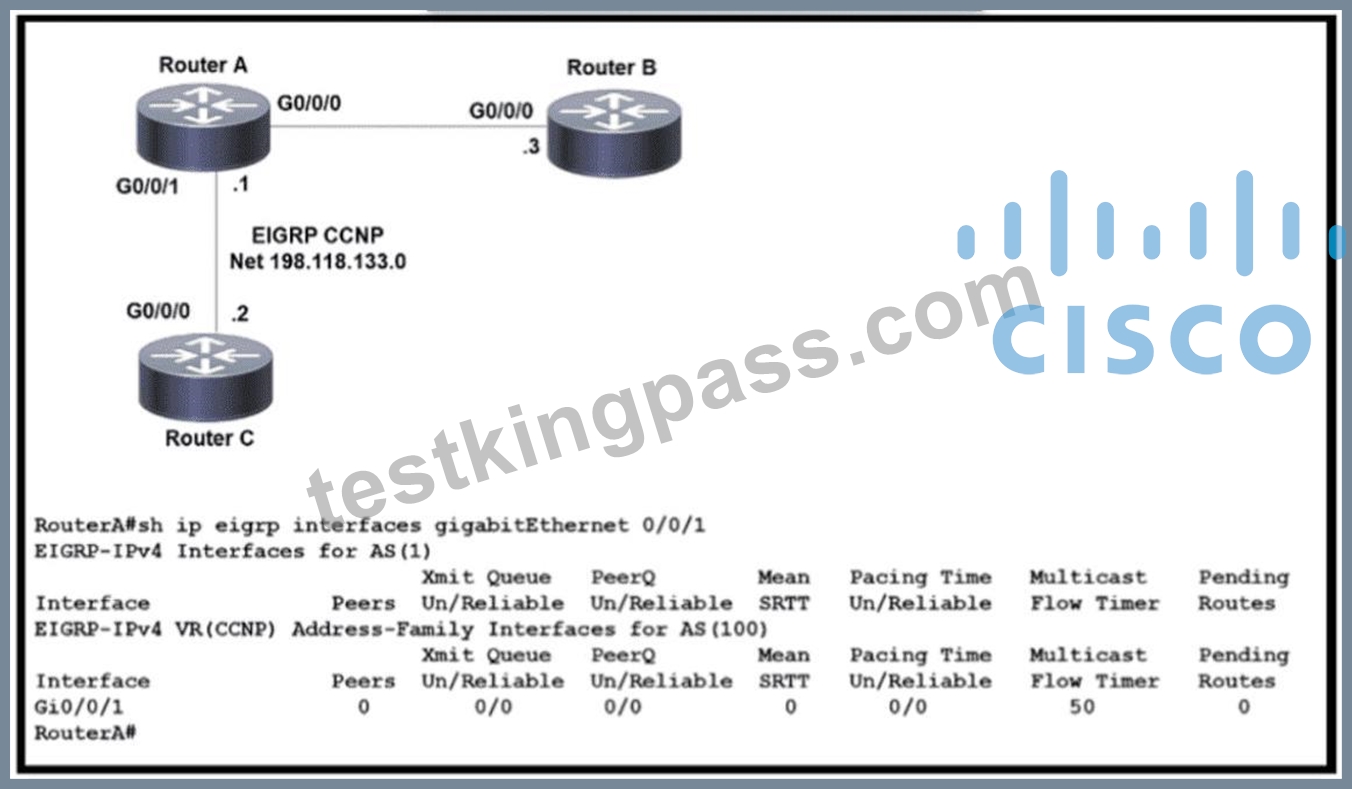
Refer to the exhibit EIGRP adjacency between router A and router C is not working as expected Which two configurations resolve the issue? (Choose two )
- A.
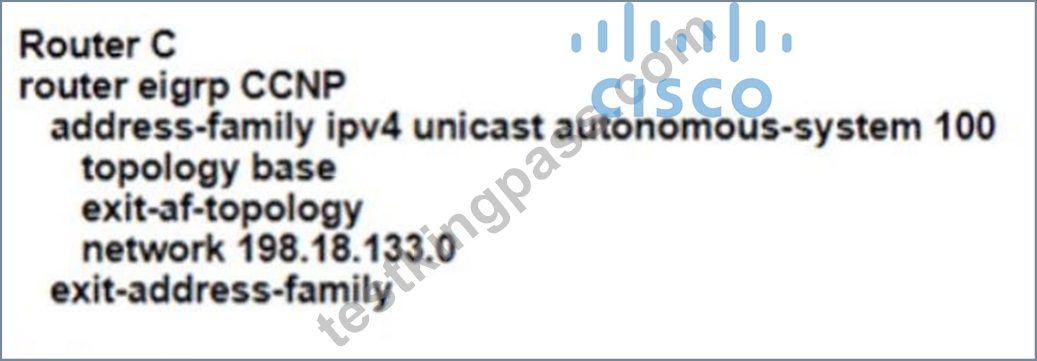
- B.
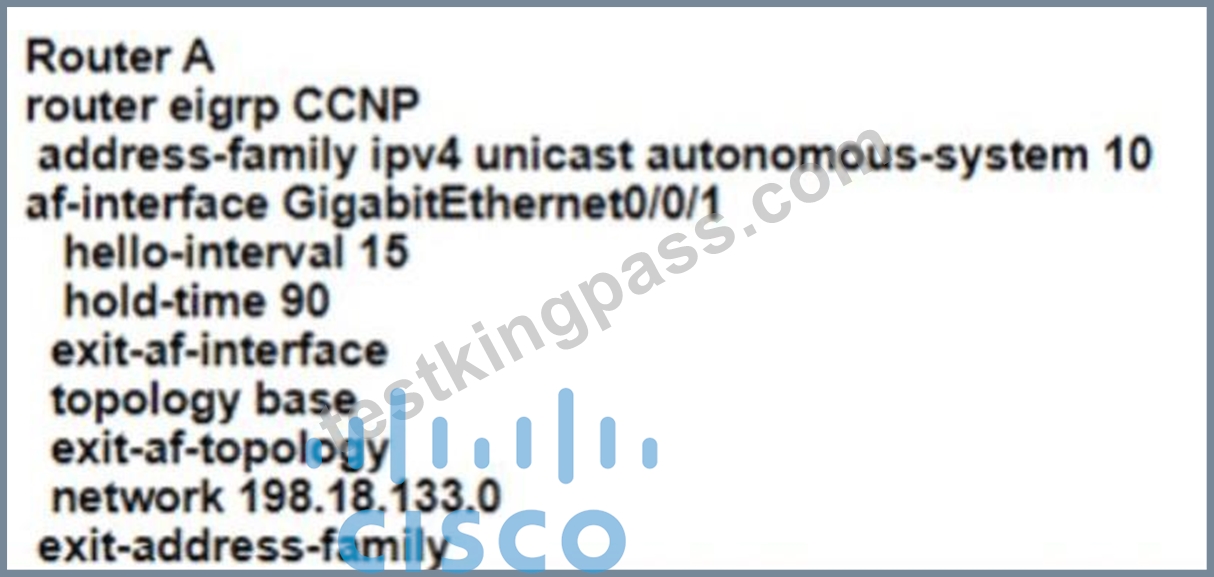
- C.
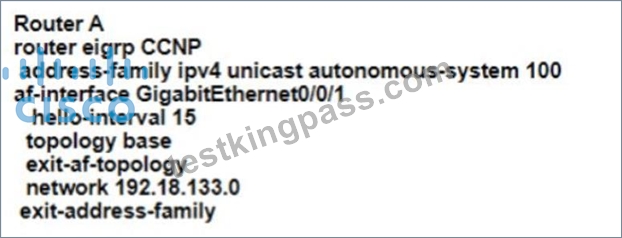
- D.
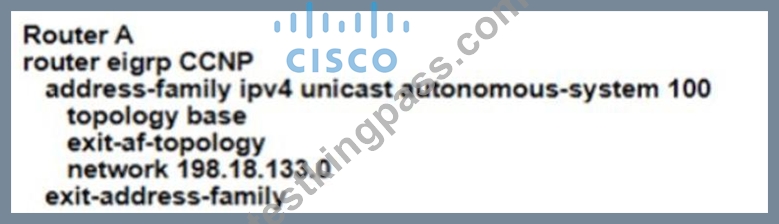
- E.
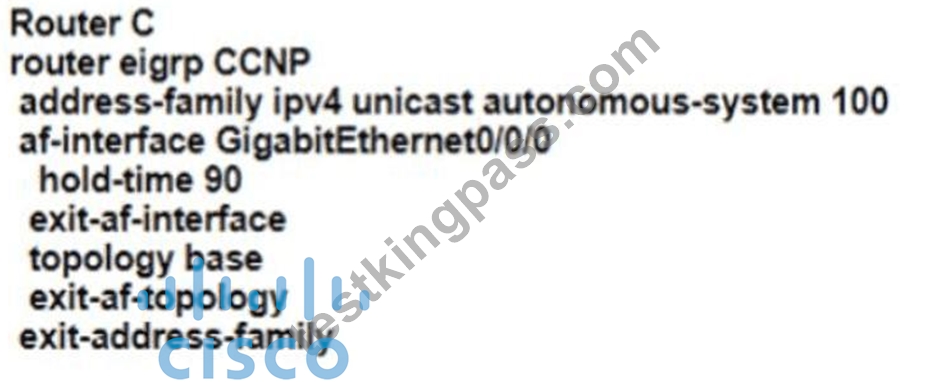
Answer: C,E
NEW QUESTION # 52
Refer to Exhibit.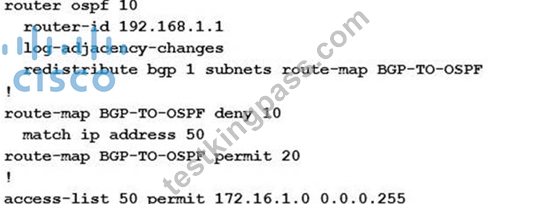
Which statement about redistribution from BGP into OSPF process 10 is true?
- A. Network 172.16.1.0/24 is redistributed with administrative distance of 1.
- B. Network 172.16.1.0/24 is not redistributed into OSPF.
- C. Network 10.10 10.0/24 is not redistributed into OSPF
- D. Network 10.10.10.0/24 is redistributed with administrative distance of 20.
Answer: B
NEW QUESTION # 53
Refer to the exhibit.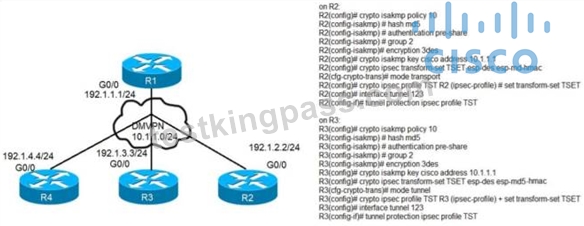
After applying IPsec, the engineer observed that the DMVPN tunnel went down, and both spoke-to-spoke and hub were not establishing.
Which two actions resolved the issue? (Choose two.)
- A. Remove the crypto isakmp key cisco address 10.1.1.1. on R2 and R3.
- B. Configure the mode from mode tunnel to mode transport on R3.
- C. Configure the crypto isakmp key cisco address 192.1.1.1 on R2 and R3.
- D. Configure the crypto isakmp key cisco address 0.0.0.0 on R2 and R3.
- E. Change the mode from mode transport to mode tunnel on R2.
Answer: B,D
NEW QUESTION # 54
A network administrator cannot connect to a device via SSH. The line vty configuration is as follows: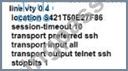
Which action resolves this issue?
- A. Configure the transport input SSH
- B. initialize the SSH key
- C. Change the stopbits to 10.
- D. Increase the session timeout
Answer: B
NEW QUESTION # 55
Refer to the exhibit. The IT router is connected with the Sales and Marketing departments. The interfaces have been assigned to their respective VRFs to keep the two department routes isolated. Which configuration set must the IT router use for BGP to distribute routes for each department that maintains their own routing table for network isolation?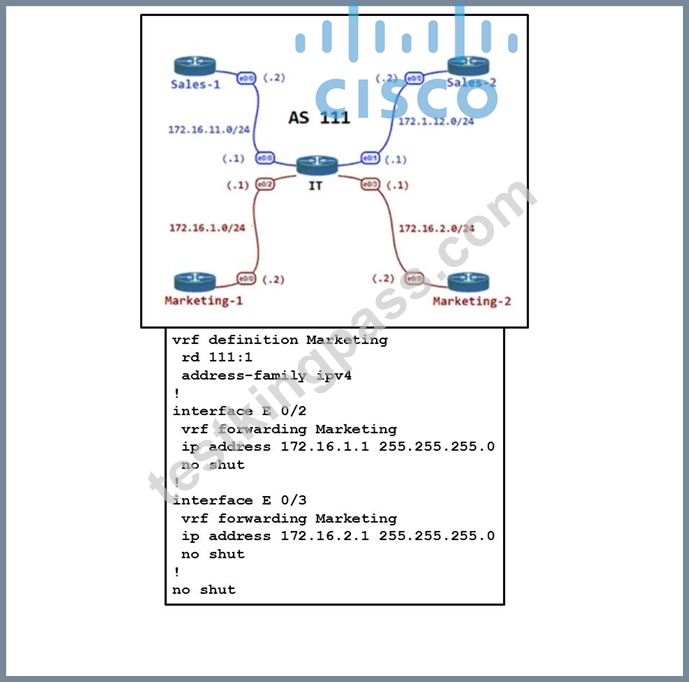
- A. router bgp 111
address-family ipv4 vrf Marketing
neighbor 172.16.1.2 remote-as 111
neighbor 172.16.1.2 Route-reflector-client
neighbor 172.16.2.2 remote-as 111
neighbor 172.16.2.2 Route-reflector-client
!
address-family ipv4 vrf Sales
neighbor 172.16.11.2 remote-as 111
neighbor 172.16.11.2 Route-reflector-client
neighbor 172.16.12.2 remote-as 111
neighbor 172.16.12.2 Route-reflector-client - B. router bgp 111
neighbor 172.16.1.2 remote-as 111
neighbor 172.16.2.2 remote-as 111
neighbor 172.16.11.2 remote-as 111
neighbor 172.16.12.2 remote-as 111 - C. router bgp 111
address-family ipv4 unicast
neighbor 172.16.1.2 remote-as 111
neighbor 172.16.2.2 remote-as 111
neighbor 172.16.11.2 remote-as 111
neighbor 172.16.12.2 remote-as 111 - D. router bgp 111
address-family ipv4 vrf Marketing
neighbor 172.16.1.2 remote-as 111
neighbor 172.16.2.2 remote-as 111
!
address-family ipv4 vrf Sales
neighbor 172.16.11.2 remote-as 111
neighbor 172.16.12.2 remote-as 111
Answer: D
NEW QUESTION # 56
Which mechanism provides traffic segmentation within a DMVPN network?
- A. iPsec
- B. RSVP
- C. MPLS
- D. BGP
Answer: C
Explanation:
Explanation
To use the DMPVN - Traffic Segmentation Within DMVPN feature you must configure Multiprotocol Label Switching (MPLS) by using the mpls ip command.
NEW QUESTION # 57
Refer to the exhibit.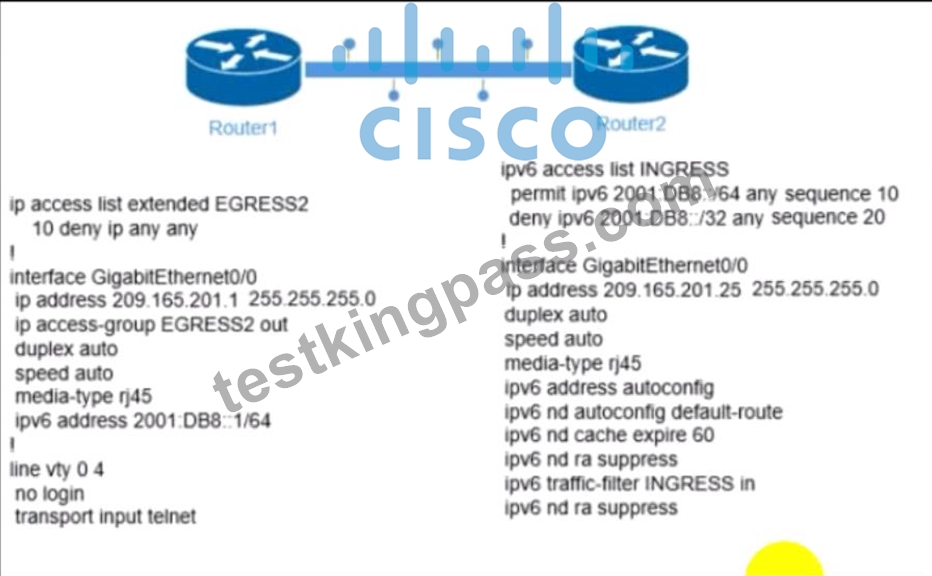
Refer to the exhibit. The engineer configured and connected Router2 to Router1. The link came up but could not establish a Telnet connection to Router1 IPv6 address of 2001:DB8::1. Which configuration allows Router2 to establish a Telnet connection to Router1?
- A. IPv6 address on GigabitEthernet0/0
- B. permit ip any any on access list EGRESS2 on Router1
- C. permit ICMPv6 on access list INGRESS for Router2 to obtain IPv6 address
- D. jpv6 unicast-routing
Answer: A
Explanation:
--------------------------R1--------------------------------------------- interface Ethernet0/0 ip address 209.165.201.1 255.255.255.0 ip access-group EGRESS2 out ipv6 address 2001:DB8::1/64 end
----------------------R2-------------------------------------------------- interface Ethernet0/0 ip address 209.165.201.25 255.255.255.0 ipv6 address 2001:DB8::2/64 ipv6 address autoconfig ipv6 nd autoconfig default-route ipv6 nd cache expire 60 ipv6 nd ra suppress ipv6 traffic-filter INGRESS in end IOU_Router2#telnet 2001:DB8::1 Trying 2001:DB8::1 ... Open IOU_Router1>
------------------------------------------------------------------------------
NEW QUESTION # 58
Refer to the exhibit.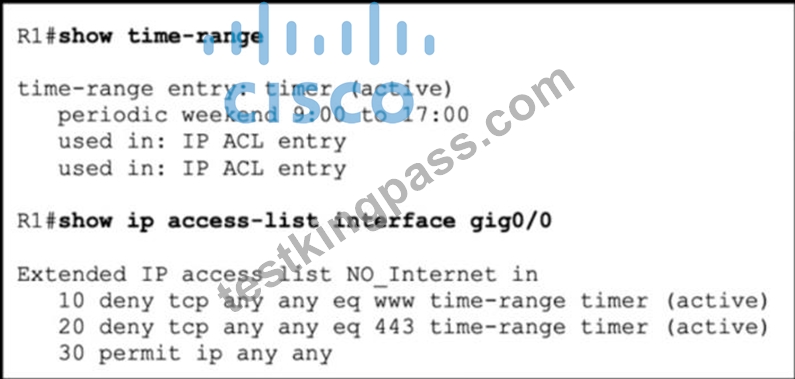
Refer to the exhibit. Users on a call center report that they cannot browse the internet on Saturdays during the afternoon. Which configuration resolves the issue?
A)
B)
C)
D)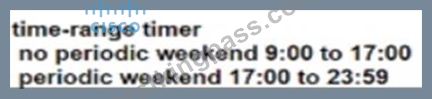
- A. Option B
- B. Option C
- C. Option A
- D. Option D
Answer: D
NEW QUESTION # 59
Refer to the exhibit.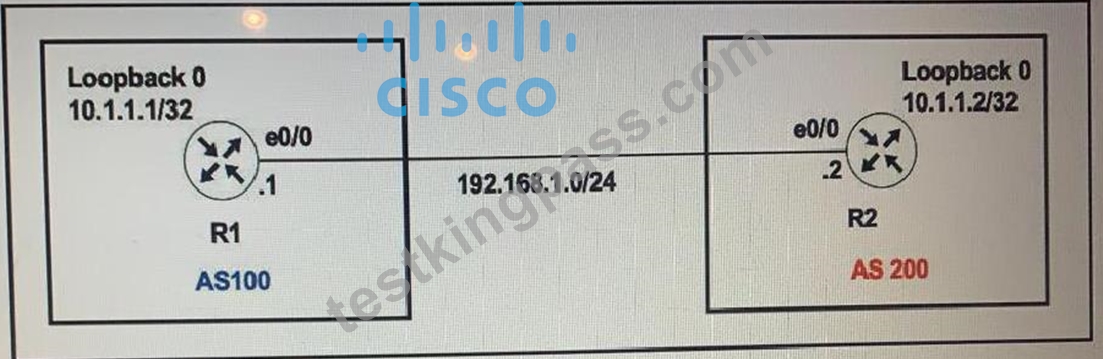
The R1 and R2 configurations are: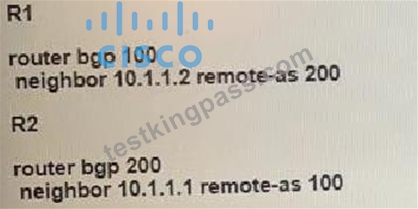
The neighbor is not coming up. Which two sets of configurations bring the neighbors up? (Choose two.)
- A. R1
ip route 10.1.1.2 255.255.255.255 192.168.1.2
router bgp 100
neighbor 10.1.1.2 disable-connected-check
neighbor 10.1.1.2 update-source Loopback0 - B. R2
ip route 10.1.1.2 255.255.255.255 192.168.1.2
router bgp 100neighbor 10.1.1.2 ttl-security hops 1
neighbor 10.1.1.2 update-source loopback 0 - C. R2
ip route 10.1.1.1 255.255.255.255 192.168.1.1
router bgp 200
neighbor 10.1.1.1 tti-security hops 1
neighbor 10.1.1.1 update-source loopback 0 - D. R2
ip route 10.1.1.1 255.255.255.255 192.168.1.1
router bgp 200
neighbor 10.1.1.1 disable-connected-check
neighbor 10.1.1.1 update-source loopback 0 - E. R1
ip route 10.1.1.2 255.255.255.255 192.168.1.2
router bgp 100
neighbor 10.1.1.1 ttl-security hops 1
neighbor 10.1.1.2 update-source loopback 0
Answer: A,D
Explanation:
NEW QUESTION # 60
Refer to the exhibit.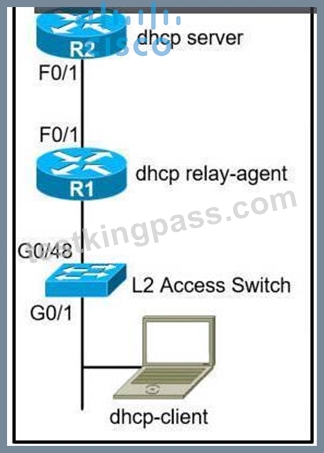
The network administrator can see the DHCP discovery packet in R1. but R2 is not replying to the DHCP request. The R1 related interface is configured with the DHCP helper address. If the PC is directly connected to the FaO/1 interface on R2, the DHCP server assigns as IP address from the DHCP pool to the PC. Which two commands resolve this issue? (Choose two.)
- A. ip dhcp relay information enable command on R1
- B. ip dhcp relay information trust-all command on R2
- C. ip dhcp option 82 command on R2
- D. service dhcp-relay command on R1
- E. service dhcp command on R1
Answer: C,E
NEW QUESTION # 61
Refer to the exhibit.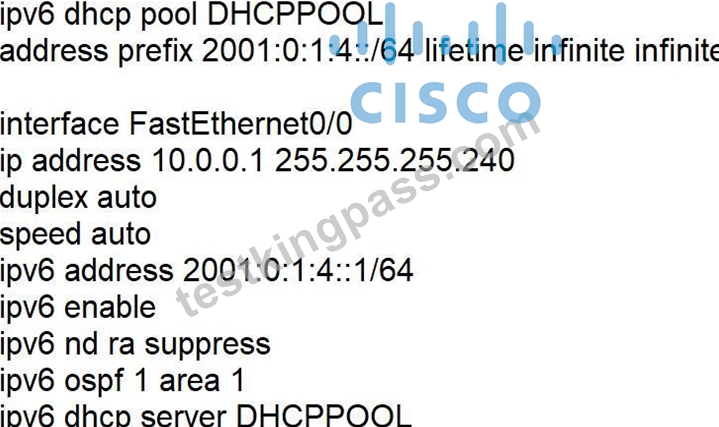
Reachability between servers in a network deployed with DHCPv6 is unstable. Which command must be removed from the configuration to make DHCPv6 function?
- A. address prefix 2001:0:1:4::/64 lifetime infinite infinite
- B. ipv6 dhcp server DHCPPOOL
- C. ipv6 address 2001:0:1:4::/64
- D. ipv6 nd ra suppress
Answer: D
NEW QUESTION # 62
Refer to the exhibit. An engineer must establish optimal routing between the app servers connected at the SPOKE routers. Which configurations are required on each router to create a distributed mapping database between SPOKE1 and SPOKE2 to achieve optimal routing so the traffic is forwarded directly from the App1 server to the App2 server?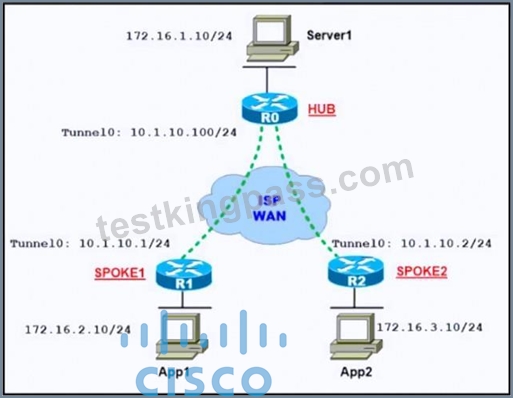
- A. R0#
interface Tunnel0
tunnel mode dvmrp
ip nhrp shortcut
R1#
interface Tunnel0
tunnel mode dvmrp
ip nhrp redirect
R2#
interface Tunnel0
tunnel mode dvmrp
ip nhrp redirect - B. R0#
interface Tunnel0
tunnel mode gre multipoint
ip nhrp redirect
R1#
interface Tunnel0
tunnel mode gre multipoint
ip nhrp shortcut
R2#
interface Tunnel0
tunnel mode gre multipoint
ip nhrp shortcut - C. R0#
interface Tunnel0
tunnel mode dvmrp
ip nhrp redirect
R1#
interface Tunnel0
tunnel mode dymrp
ip nhrp shortcut
R2#
interface Tunnel0
tunnel mode dvmrp
ip nhrp shortcut - D. R0#
interface Tunnel0
tunnel mode gre multipoint
ip nhrp shortcut
R1#
interface Tunnel0
tunnel mode gre multipoint
ip nhrp redirect
R2#
interface Tunnel0
tunnel mode gre multipoint
ip nhrp redirect
Answer: B
Explanation:
The hub must be configured with ip nhrp redirect to notify the spokes of optimal routing paths.
tunnel mode gre multipoint is required for DMVPN. The spokes must be configured with ip nhrp shortcut to support direct spoke-to-spoke communication. tunnel mode gre multipoint is also necessary. This setup ensures optimal routing with direct spoke-to-spoke communication.
NEW QUESTION # 63
Refer to the exhibit.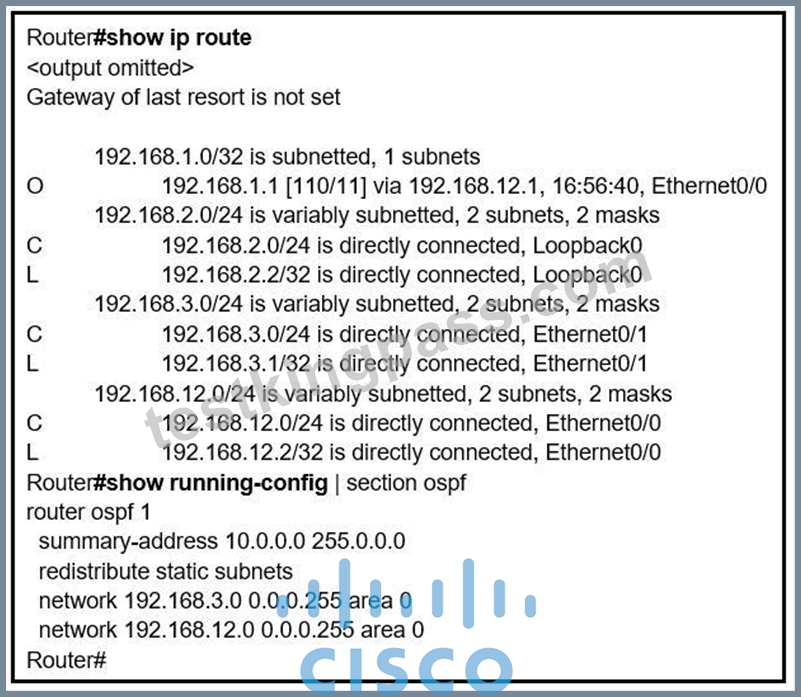
An engineer is trying to generate a summary route in OSPF for network 10.0.0.0/8, but the summary route does not show up in the routing table. Why is the summary route missing?
- A. The summary route is visible only in the OSPF database, not in the routing table.
- B. There is no route for a subnet inside 10.0.0.0/8, so the summary route is not generated.
- C. The summary-address command is used only for summarizing prefixes between areas.
- D. The summary route is not visible on this router, but it is visible on other OSPF routers in the same area.
Answer: B
Explanation:
Explanation
The summary-address is only used to create aggregate addresses for OSPF at an autonomous system boundary.
It means this command should only be used on the ASBR when you are trying to summarize externally redistributed routes from another protocol domain or you have a NSSA area. But a requirement to create a summarized route is:
The ASBR compares the summary route's range of addresses with all routes redistributed into OSPF on that ASBR to find any subordinate subnets (subnets that sit inside the summary route range). If at least one subordinate subnet exists, the ASBR advertises the summary route.
NEW QUESTION # 64
Refer to the exhibit.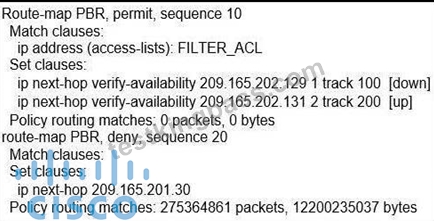
An engineer has configured policy-based routing and applied the configured to the correct interface. How is the configuration applied to the traffic that matches the access list?
- A. It is forwarded using the routing table lookup.
- B. It is sent to 209.165.202.129.
- C. It is sent to 209.165.202.131.
- D. It is dropped.
Answer: C
Explanation:
The set ip next-hop verify-availability command in route-map configuration mode to configure policy routing to verify the reachability of the next hop of a route map before the router performspolicy routing to that next hop. In this question we see track 100 is down so the PBR will not use this next-hop, it will use the second next-hop with track 200 (up).
NEW QUESTION # 65
Refer to the exhibit. Which action resolves the authentication problem?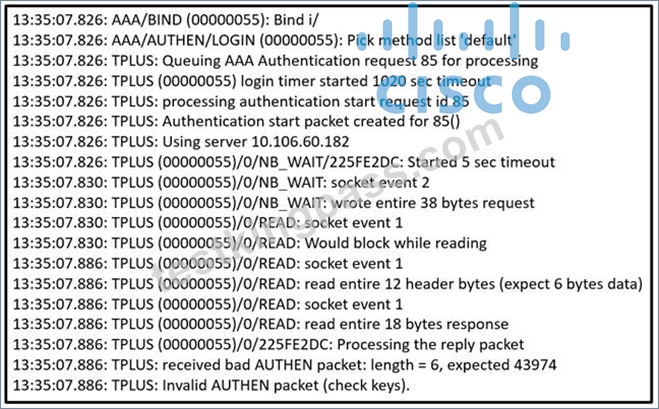
- A. Configure the user name on the TACACS+ server
- B. Configure the same password between the TACACS+ server and router.
- C. Configure the TCP port 49 to be reachable by the router
- D. Configure the UDP port 1812 to be allowed on the TACACS+ server
Answer: B
Explanation:
From the last line of the output, we notice that the result was "Invalid AUTHEN packet". Therefore something went wrong with the username or password.
Reference: https://www.cisco.com/c/en/us/support/docs/security-vpn/terminal-access-controller- access-control-system-tacacs-/200467-Troubleshoot-TACACS-Authentication-Issue.html
NEW QUESTION # 66 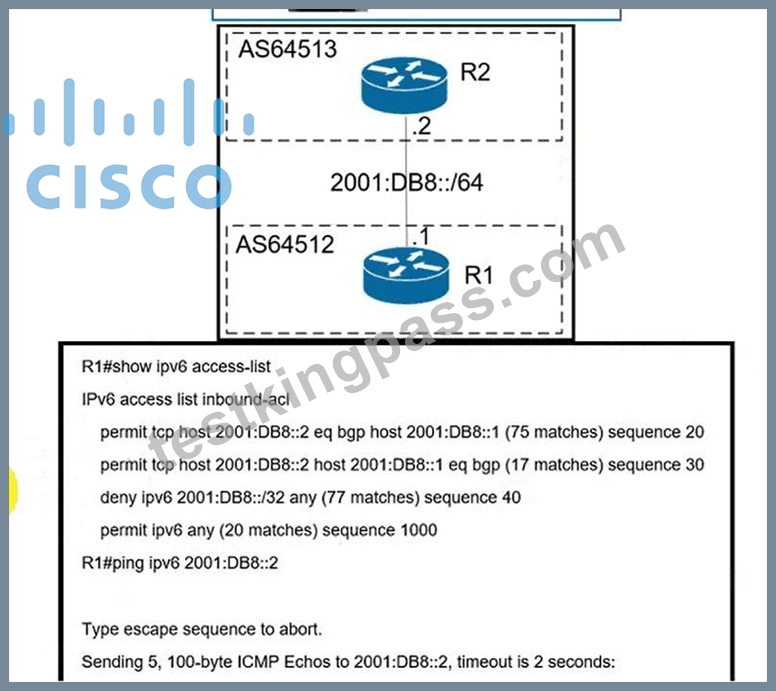
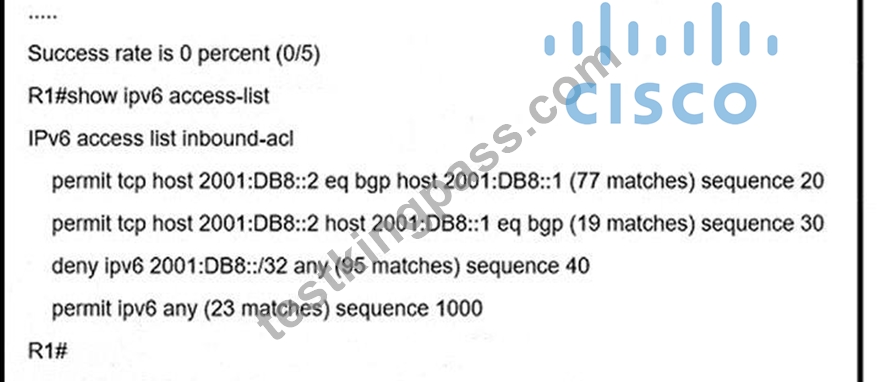
Refer to the exhibit. An engineer applied filter on R1 The interface flapped between R1 and R2 and cleaning the BGP session did not restore the BGP session and failed Which action must the engineer take to restore the BGP session from R2 to R1?
- A. Apply the IPv6 traffic filter in the outbound direction on the interface
- B. Enable the BGP session, which went down when the session was cleared.
- C. Swap the source and destination IP addresses in the IPv6 traffic filter
- D. ICMPv6 must be permitted by the IPv6 traffic filter
Answer: D
NEW QUESTION # 67
Refer to the exhibit.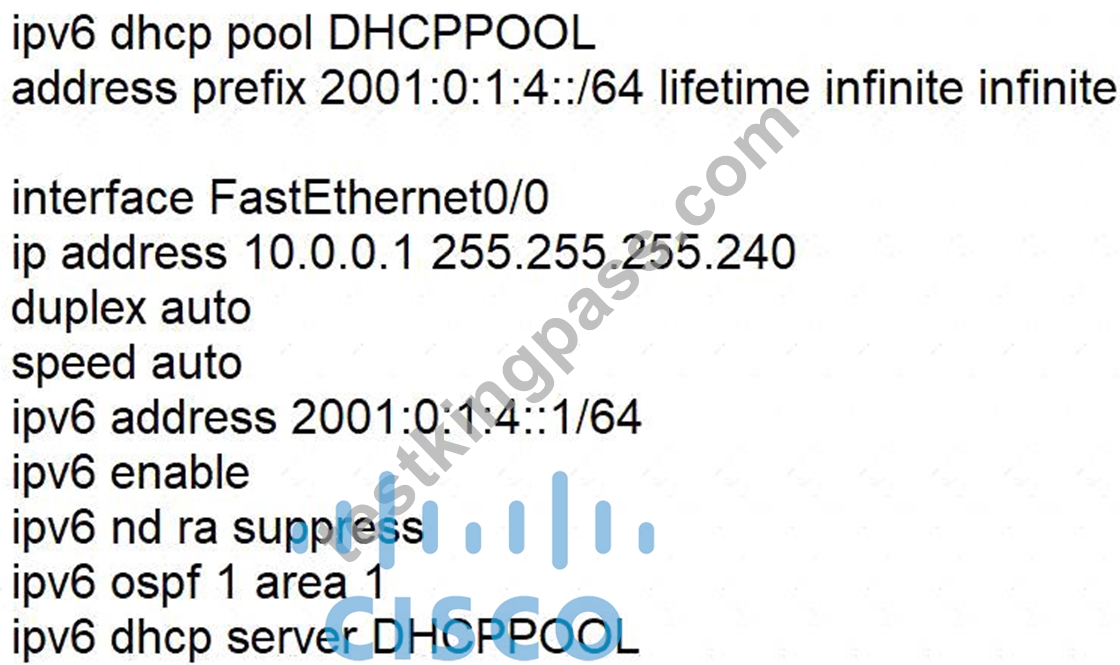
Reachability between servers in a network deployed with DHCPv6 is unstable. Which command must be removed from the configuration to make DHCPv6 function?
- A. address prefix 2001:0:1:4::/64 lifetime infinite infinite
- B. ipv6 dhcp server DHCPPOOL
- C. ipv6 address 2001:0:1:4::/64
- D. ipv6 nd ra suppress
Answer: D
NEW QUESTION # 68
Which two solutions are used to overcome a flapping link that causes a frequent label binding exchange between MPLS routers? (Choose two)
- A. Increase a hold-timer to protect the session.
- B. Increase a session delay to protect the session.
- C. Increase input queue on links to protect the session.
- D. Create targeted hellos to protect the session.
- E. Create link dampening on links to protect the session.
- F. When a link flaps (for a short time),
Answer: D,E
Explanation:
...
Solution:
+ When LDP session supported by link hello is setup, create a targeted hello to protect the session.
Explanation:
To avoid having to rebuild the LDP session altogether, you can protect it. When the LDP session between two directly connected LSRs is protected, a targeted LDP session is built between the two LSRs. When the directly connected link does go down between the two LSRs, the targeted LDP session is kept up as long as an alternative path exists between the two LSRs.
For the protection to work, you need to enable it on both the LSRs. If this is not possible, you can enable it on one LSR, and the other LSR can accept the targeted LDP Hellos by configuring the command mpls ldp discovery targeted-hello accept.
Reference:
Or from the reference
at https://www.ciscolive.com/c/dam/r/ciscolive/us/docs/2019/pdf/5eU6DfQV/TECMPL-3201.pdf Troubleshooting LDP Issues Problem:
NEW QUESTION # 69
An engineer notices that R1 does not hold enough log messages to identify the root cause during troubleshooting. Which command resolves this issue?
- A. (config)#logging buffered 4096 informational
- B. (config)#logging buffered 16000 informational
- C. #logging buffered 4096 critical
- D. #logging buffered 16000 critical
Answer: B
Explanation:
The router will theoretically accept a wide range of buffer sizes ranging from 4,096 bytes (nothing smaller) to an astronomical 2,147,483,647 bytes (about 2 GB). Exercise caution when choosing the size of your logging buffer because it comes out of the router's system memory. A good rule is to set your logging buffer to 16 KB for smaller routers. Routers with more than 32 MB of memory can safely dedicate 32 KB, or even 64 KB, without problems. To be safe, always check the amount of free memory on your router with the show memory command before increasing your buffer size.
Set the buffer size to 16,000 bytes, and the severity level to informational, by using a single configuration command.
NEW QUESTION # 70
......
Cisco 300-410 certification exam, also known as Implementing Cisco Enterprise Advanced Routing and Services, is designed for network engineers who want to validate their skills in implementing and troubleshooting advanced routing technologies and services. 300-410 exam is one of the six exams required to achieve the Cisco Certified Specialist - Enterprise Advanced Infrastructure Implementation certification. It covers a wide range of topics, including Layer 3 technologies such as OSPF, BGP, and EIGRP, VPN technologies such as DMVPN and FlexVPN, and network services such as QoS, NAT, and DHCP.
Updated 300-410 Dumps Questions For Cisco Exam: https://evedumps.testkingpass.com/300-410-testking-dumps.html